Get your free personalized podcast brief
We scan new podcasts and send you the top 5 insights daily.
Unlike text agents that tolerate multi-second latency, embodied agents handling real-world objects cannot wait on cloud inference without risking physical failure or safety hazards. Deployments require training large models and distilling them down for local execution.

Related Insights
The goal for computer use agents has shifted beyond mimicking human actions to exceeding them in speed. The primary bottleneck is no longer the AI's reasoning but the real-world latency of the software it operates, like website loading times. This changes how developers must think about agent performance optimization.
Unlike cloud-reliant AI, Figure's humanoids perform all computations onboard. This is a critical architectural choice to enable high-frequency (200Hz+) control loops for balance and manipulation, ensuring the robot remains fully functional and responsive without depending on Wi-Fi or 5G connectivity.

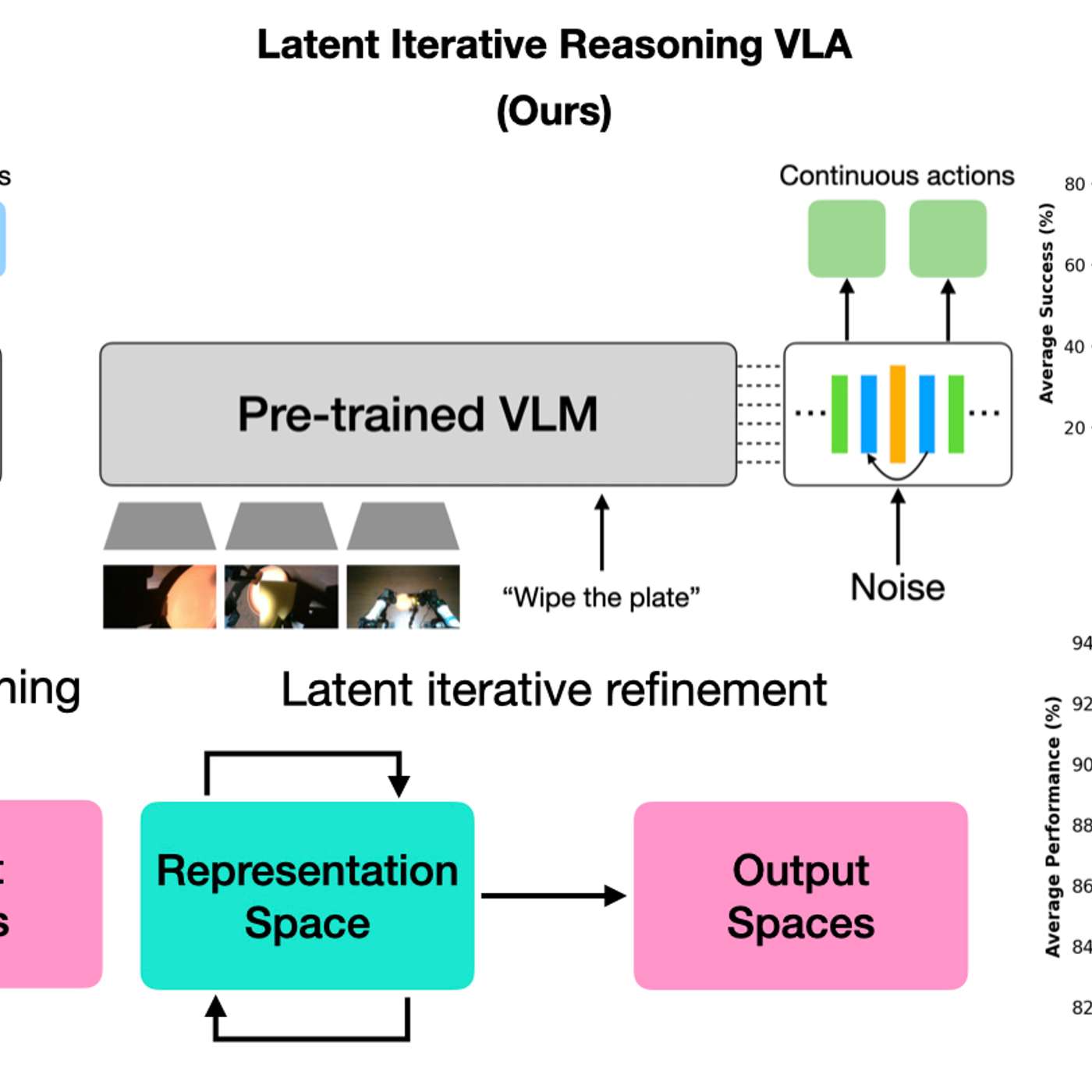
While letting a robot 'think' longer improves decision accuracy in lab tests, this added latency poses a significant risk in the real world. If the environment changes during the robot's reasoning period, its final decision may be outdated and dangerous, questioning its practical deployability.
A core challenge in physical AI is the tension between large, powerful models (offboard, in a data center) and the need for low-latency models (onboard, on the machine). The key is using techniques like distillation to create smaller derivatives that run in milliseconds for safety-critical decisions.
Language models execute identically regardless of device, but robotics software is constrained by the physical robot body. Keerthana Gopalakrishnan places current robotics in the 'GPT-2 era' because generic robotic brains cannot reliably control arbitrary, unseen robot embodiments out of the box, nor can they reliably generalize from few-shot demonstrations across hard, diverse tasks.

Separating robotic autonomy into a high-level reasoning model (like Gemini Robotics ER) and a low-level vision-language-action (VLA) policy causes practical bottlenecks. Beyond the communication and processing latency of reasoning models, sequential multi-step tasks suffer from compounded errors where the success rates of both models multiply across every handoff, creating compounding failure points during execution.
Waymo uses a foundation model to create specialized, high-capacity "teacher" models (Driver, Simulator, Critic) offline. These teachers then distill their knowledge into smaller, efficient "student" models that can run in real-time on the vehicle, balancing massive computational power with on-device constraints.

A 2-second delay is acceptable for a single user prompt. However, in an agentic system where 20 agents communicate sequentially, that delay compounds to 40 seconds, rendering the application unusable. This shift necessitates infrastructure with sub-second response times, driving hardware deployment to urban centers.

Cloud AI can batch user requests for efficiency. Physical AI devices like robots operate in real-time on a single stream of data ("batch size one"). This fundamental difference necessitates different, more efficient model architectures that don't rely on aggregation for performance.

A key technique for creating powerful edge models is knowledge distillation. This involves using a large, powerful cloud-based model to generate training data that 'distills' its knowledge into a much smaller, more efficient model, making it suitable for specialized tasks on resource-constrained devices.