Get your free personalized podcast brief
We scan new podcasts and send you the top 5 insights daily.
Despite appearing to lose ground to competitors, Microsoft's 2023 pause in leasing new datacenter sites was a strategic move. It aimed to prevent over-investing in hardware that would soon be outdated, ensuring it could pivot to newer, more power-dense and efficient architectures.
Related Insights
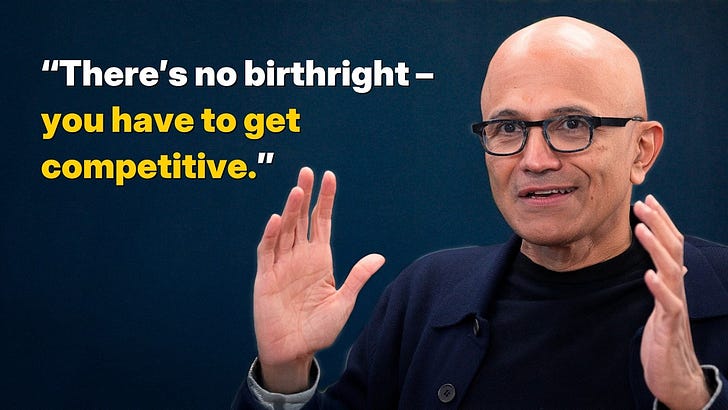
While some competitors prioritize winning over ROI, Nadella cautions that "at some point that party ends." In major platform shifts like AI, a long-term orientation is crucial. He cites Microsoft's massive OpenAI investment, committed *before* ChatGPT's success, as proof of a long-term strategy paying off.

Tech giants like Google and Microsoft are spending billions on AI not just for ROI, but because failing to do so means being locked out of future leadership. The motivation is to maintain their 'Mag 7' status, which is an existential necessity rather than a purely economic calculation.

OpenAI's strategy to lease rather than buy NVIDIA GPUs is presented as a shrewd financial move. Given the rapid pace of innovation, the future economic value of today's chips is uncertain. Leasing transfers the risk of holding depreciating or obsolete assets to the hardware provider, maintaining capital flexibility.

Instead of bearing the full cost and risk of building new AI data centers, large cloud providers like Microsoft use CoreWeave for 'overflow' compute. This allows them to meet surges in customer demand without committing capital to assets that depreciate quickly and may become competitors' infrastructure in the long run.

Unlike competitors focused on vertical integration, Microsoft's "hyperscaler" strategy prioritizes supporting a long tail of diverse customers and models. This makes a hyper-optimized in-house chip less urgent. Furthermore, their IP rights to OpenAI's hardware efforts provide them with access to cutting-edge designs without bearing all the development risk.
To navigate the massive capital requirements of AI, Nadella reframes the investment in cutting-edge training infrastructure. Instead of being purely reactive to customer demand, a significant portion is considered R&D, allowing for sustained, order-of-magnitude scaling necessary for breakthroughs.
The massive investment in data centers isn't just a bet on today's models. As AI becomes more efficient, smaller yet powerful models will be deployed on older hardware. This extends the serviceable life and economic return of current infrastructure, ensuring today's data centers will still generate value years from now.

Satya Nadella reveals that Microsoft prioritizes building a flexible, "fungible" cloud infrastructure over catering to every demand of its largest AI customer, OpenAI. This involves strategically denying requests for massive, dedicated data centers to ensure capacity remains balanced for other customers and Microsoft's own high-margin products.

Hyperscalers face a strategic challenge: building massive data centers with current chips (e.g., H100) risks rapid depreciation as far more efficient chips (e.g., GB200) are imminent. This creates a 'pause' as they balance fulfilling current demand against future-proofing their costly infrastructure.
Satya Nadella clarifies that the primary constraint on scaling AI compute is not the availability of GPUs, but the lack of power and physical data center infrastructure ("warm shelves") to install them. This highlights a critical, often overlooked dependency in the AI race: energy and real estate development speed.