Get your free personalized podcast brief
We scan new podcasts and send you the top 5 insights daily.
To navigate the massive capital requirements of AI, Nadella reframes the investment in cutting-edge training infrastructure. Instead of being purely reactive to customer demand, a significant portion is considered R&D, allowing for sustained, order-of-magnitude scaling necessary for breakthroughs.
Related Insights
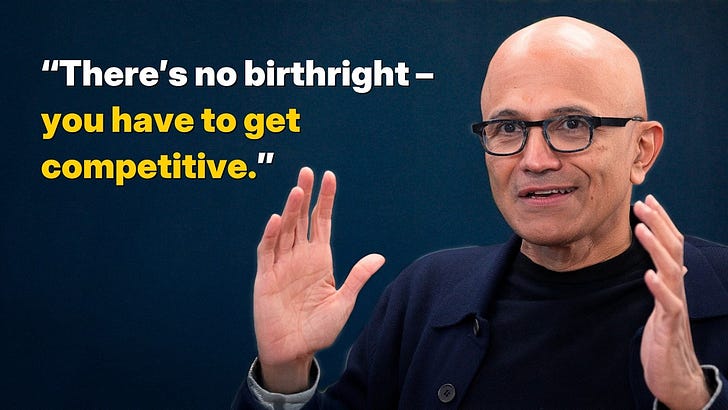
While some competitors prioritize winning over ROI, Nadella cautions that "at some point that party ends." In major platform shifts like AI, a long-term orientation is crucial. He cites Microsoft's massive OpenAI investment, committed *before* ChatGPT's success, as proof of a long-term strategy paying off.

While high capex is often seen as a negative, for giants like Alphabet and Microsoft, it functions as a powerful moat in the AI race. The sheer scale of spending—tens of billions annually—is something most companies cannot afford, effectively limiting the field of viable competitors.
Tech giants like Google and Microsoft are spending billions on AI not just for ROI, but because failing to do so means being locked out of future leadership. The motivation is to maintain their 'Mag 7' status, which is an existential necessity rather than a purely economic calculation.

AI's high computational cost (COGS) threatens SaaS margins. Nadella explains that just as the cloud expanded the market for computing far beyond the original server-license model, AI will create entirely new categories and user bases, offsetting the higher costs.
The world's most profitable companies view AI as the most critical technology of the next decade. This strategic belief fuels their willingness to sustain massive investments and stick with them, even when the ultimate return on that spending is highly uncertain. This conviction provides a durable floor for the AI capital expenditure cycle.

Sam Altman dismisses concerns about OpenAI's massive compute commitments relative to current revenue. He frames it as a deliberate "forward bet" that revenue will continue its steep trajectory, fueled by new AI products. This is a high-risk, high-reward strategy banking on future monetization and market creation.

Microsoft's early OpenAI investment was a calculated, risk-adjusted decision. They saw that generalizable AI platforms were a 'must happen' future and asked, 'Can we remain a top cloud provider without it?' The clear 'no' made the investment a defensive necessity, not just an offensive gamble.
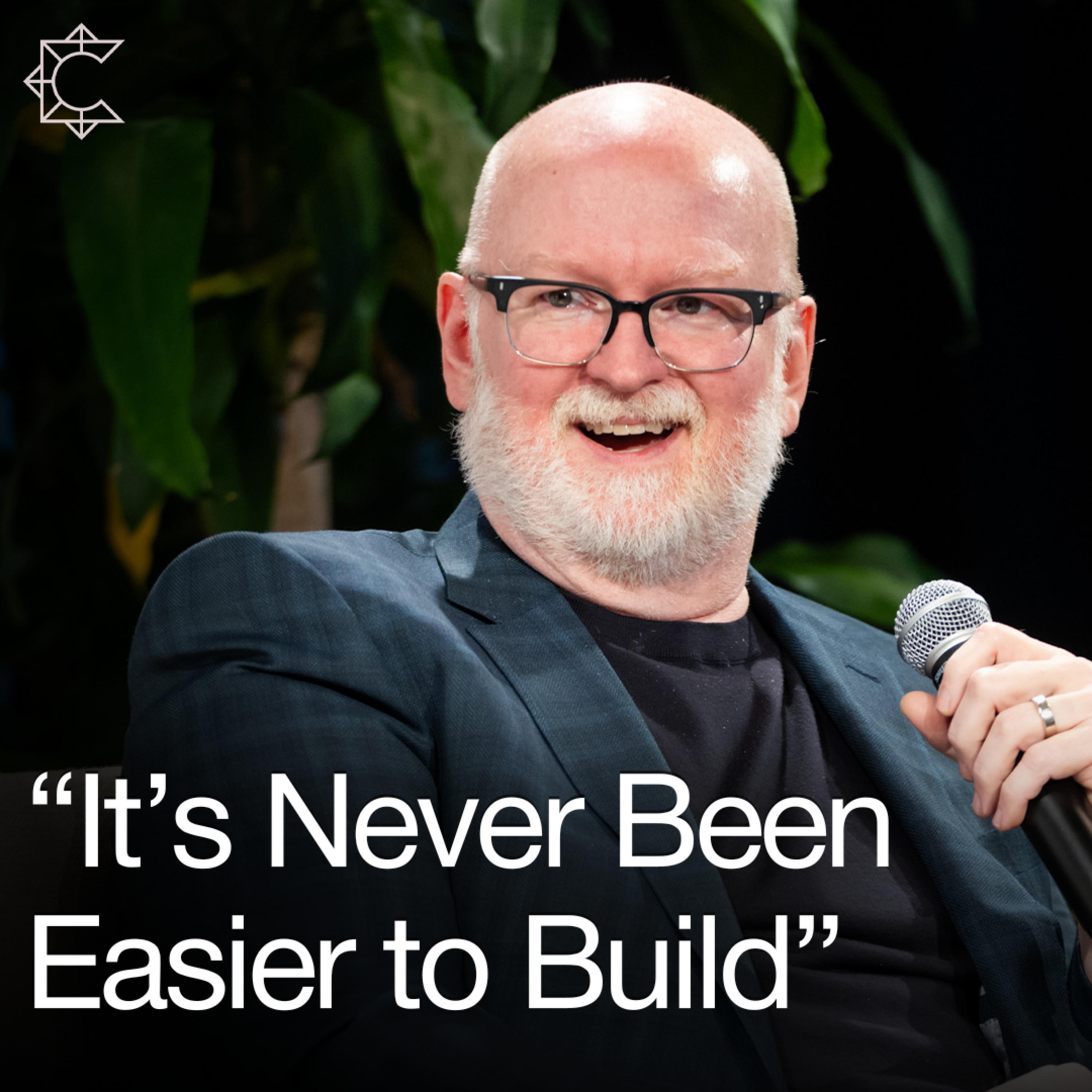
Satya Nadella clarifies that the primary constraint on scaling AI compute is not the availability of GPUs, but the lack of power and physical data center infrastructure ("warm shelves") to install them. This highlights a critical, often overlooked dependency in the AI race: energy and real estate development speed.
Sam Altman claims OpenAI is so "compute constrained that it hits the revenue lines so hard." This reframes compute from a simple R&D or operational cost into the primary factor limiting growth across consumer and enterprise. This theory posits a direct correlation between available compute and revenue, justifying enormous spending on infrastructure.

OpenAI’s pivotal partnership with Microsoft was driven more by the need for massive-scale cloud computing than just cash. To train its ambitious GPT models, OpenAI required infrastructure it could not build itself. Microsoft Azure provided this essential, non-commoditized resource, making them a perfect strategic partner beyond their balance sheet.