Get your free personalized podcast brief
We scan new podcasts and send you the top 5 insights daily.
Simply using the most powerful model to generate synthetic data for a smaller model often fails. Effective distillation requires matching the 'teacher' model's token probabilities to the 'student' model's base architecture and training data, making it a complex research problem.
![[LIVE] Anthropic Distillation & How Models Cheat (SWE-Bench Dead) | Nathan Lambert & Sebastian Raschka thumbnail](https://substackcdn.com/feed/podcast/1084089/post/189277598/ca7468da5614a246d2906ee8926f6de7.jpg)
Related Insights
While a multi-model approach—using the best AI for each specific task—is theoretically optimal, its practical implementation is difficult. A major roadblock is the need to create and maintain different optimized prompts for each model. This overhead leads users to default to a single, powerful model for simplicity.
Quantization and distillation don't simply create a smaller version of an LLM. These optimization processes alter the model's behavior to the point where it becomes a new entity—a "cousin." It may be legible and functional, but it will not produce the same outputs as the original.

China is gaining an efficiency edge in AI by using "distillation"—training smaller, cheaper models from larger ones. This "train the trainer" approach is much faster and challenges the capital-intensive US strategy, highlighting how inefficient and "bloated" current Western foundational models are.

Newer LLMs exhibit a more homogenized writing style than earlier versions like GPT-3. This is due to "style burn-in," where training on outputs from previous generations reinforces a specific, often less creative, tone. The model’s style becomes path-dependent, losing the raw variety of its original training data.

The public-facing models from major labs are likely efficient Mixture-of-Experts (MOE) versions distilled from much larger, private, and computationally expensive dense models. This means the model users interact with is a smaller, optimized copy, not the original frontier model.
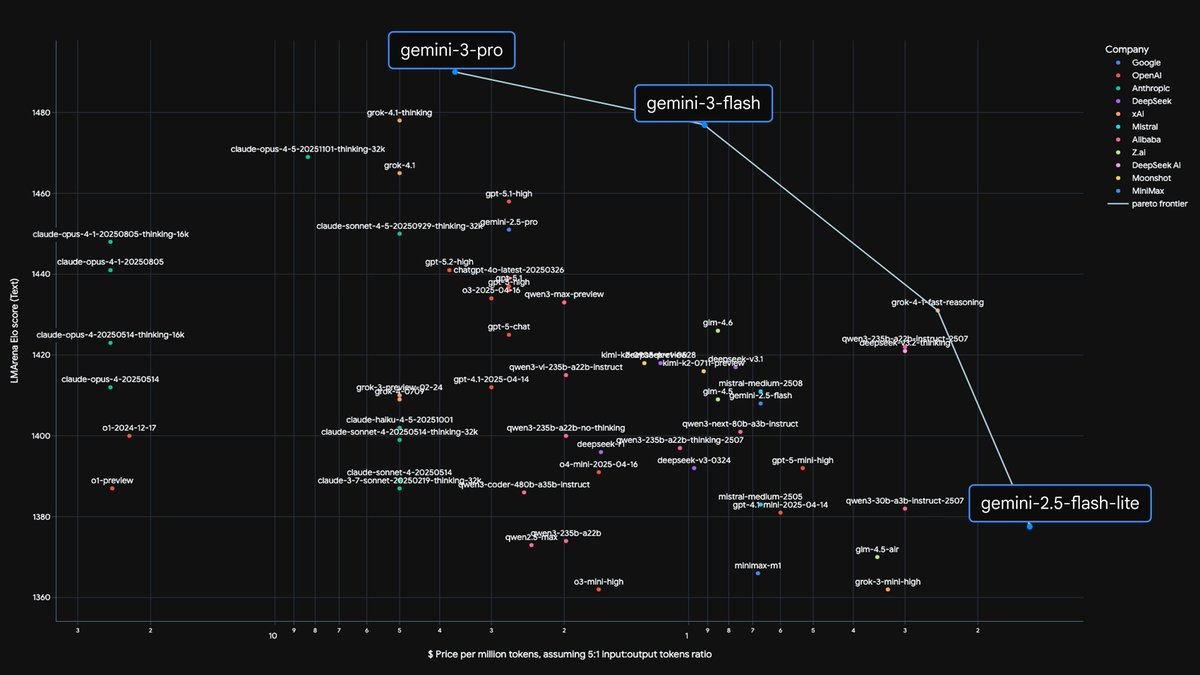
Google's strategy involves creating both cutting-edge models (Pro/Ultra) and efficient ones (Flash). The key is using distillation to transfer capabilities from large models to smaller, faster versions, allowing them to serve a wide range of use cases from complex reasoning to everyday applications.
Microsoft's research found that training smaller models on high-quality, synthetic, and carefully filtered data produces better results than training larger models on unfiltered web data. Data quality and curation, not just model size, are the new drivers of performance.

Autoencoding models (e.g., BERT) are "readers" that fill in blanks, while autoregressive models (e.g., GPT) are "writers." For non-generative tasks like classification, a tiny autoencoding model can match the performance of a massive autoregressive one, offering huge efficiency gains.
The binary distinction between "reasoning" and "non-reasoning" models is becoming obsolete. The more critical metric is now "token efficiency"—a model's ability to use more tokens only when a task's difficulty requires it. This dynamic token usage is a key differentiator for cost and performance.

While frontier models like Claude excel at analyzing a few complex documents, they are impractical for processing millions. Smaller, specialized, fine-tuned models offer orders of magnitude better cost and throughput, making them the superior choice for large-scale, repetitive extraction tasks.