Get your free personalized podcast brief
We scan new podcasts and send you the top 5 insights daily.
Hiding the use of AI to create product artifacts is a mistake born from insecurity. Google AI PM Marily Nika advises PMs to be transparent, even sharing their custom PRD generators. This normalizes AI usage and reframes the PM as an efficiency leader, as those who don't adopt these tools will be left behind.

Related Insights
By creating a central repository infused with company strategy and market data, AI tools can help junior PMs produce assets with the same contextual depth as a 20-year veteran, democratizing product intuition and standardizing quality across the team.

AI automates tactical tasks, shifting the PM's role from process management to de-risking delivery by developing deep customer insights. This allows PMs to spend more time confirming their instincts about customer needs, which engineering teams now demand.

AI tools are blurring the lines between product, design, and engineering. The future PM will leverage AI to not only spec features but also create mockups and even write and check in code for smaller tasks, owning the entire lifecycle from idea to delivery.

Traditional "writing-first" cultures create communication gaps and translation errors. With modern AI tools, product managers can now build working prototypes in hours. This "show, don't tell" approach gets ideas validated faster, secures project leadership, and overcomes language and team barriers.
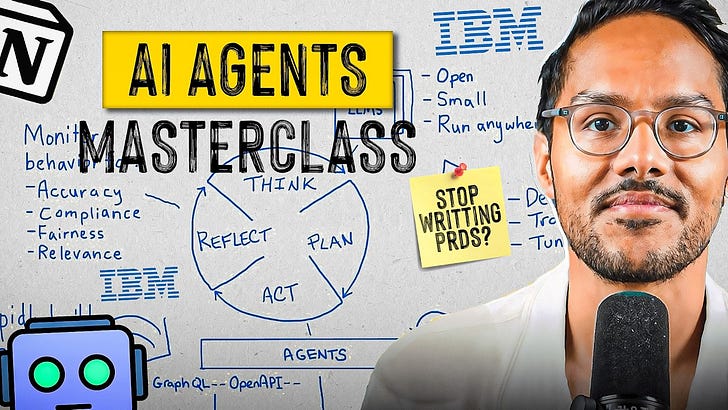
Instead of generic PRD generators, a high-leverage AI agent for PMs is a personalized reviewer. By training an agent on your manager's past document reviews, you can pre-empt their specific feedback, align your work with their priorities, and increase your credibility and efficiency.

AI won't replace product managers but will elevate their role. PMs will shift from executing tasks like financial forecasting to managing a team of specialized AI agents, forcing them to focus on high-level strategy and assumption-checking.

AI's value for PMs is augmentation, not replacement. By automating tactical tasks that consume most of a PM's day (e.g., "six out of eight hours"), AI frees up critical capacity for higher-level strategic, creative, and innovative work—the core functions of a product leader.

Beyond just using AI tools, the fundamental process of product management is evolving. For every new initiative, PMs must now consider the appropriate level of AI, automation, or customization. This question is now as critical as "what problem are we solving?" and addresses rising customer expectations for adaptive products.

The rise of AI tools isn't replacing the PM role, but transforming it. PMs who embrace an "AI-enhanced" workflow for research, docs, and prototyping will gain a massive productivity advantage, ultimately displacing those who stick to traditional methods.
As AI automates synthesis and creation, the product manager's core value shifts from managing the development process to deeply contextualizing all available information (market, customer, strategy) to define the *right* product direction.