Get your free personalized podcast brief
We scan new podcasts and send you the top 5 insights daily.
Conventional RAG systems face a trade-off: larger chunks provide context but reduce precision. Voyage AI's "contextualized chunking" resolves this by processing a specific sentence and its broader context separately. This technique flips the script, enabling better retrieval quality with smaller, more focused chunks.

Related Insights
Instead of one large context file, create a library of small, specific files (e.g., for different products or writing styles). An index file then guides the LLM to load only the relevant documents for a given task, improving accuracy, reducing noise, and allowing for 'lazy' prompting.

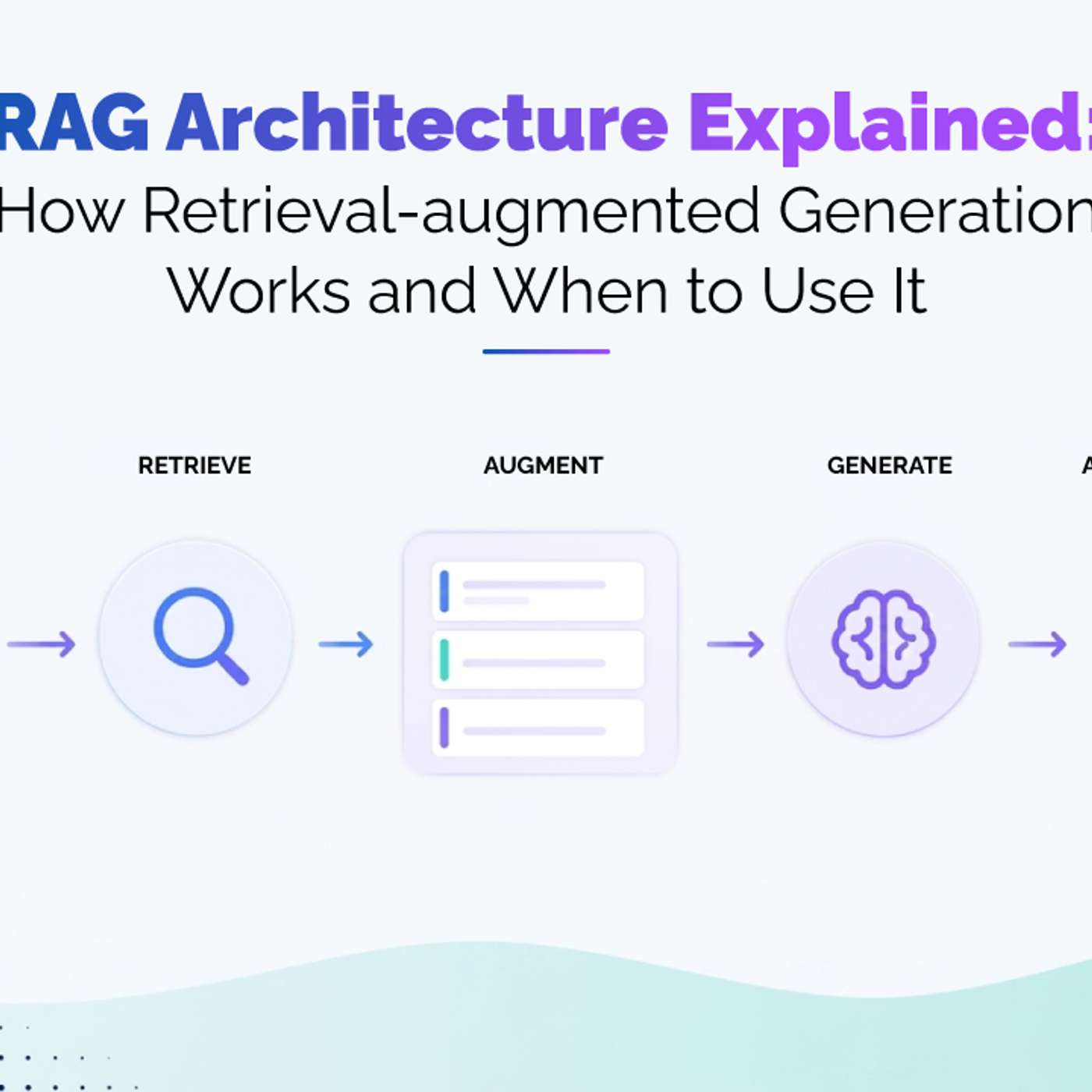
Before considering expensive model fine-tuning, implement Retrieval-Augmented Generation (RAG). RAG dynamically retrieves information from a knowledge base to augment the prompt, solving most domain-specific problems efficiently. The recommended hierarchy is: Prompt Optimization -> Context Engineering -> RAG -> Fine-tuning.

Splitting documents by a fixed token count is a common and costly error in RAG pipelines. According to a cited study, switching to an adaptive, meaning-based chunking strategy (e.g., by paragraph) can increase fully accurate answers from 13% to 50%.
Even models with million-token context windows suffer from "context rot" when overloaded with information. Performance degrades as the model struggles to find the signal in the noise. Effective context engineering requires precision, packing the window with only the exact data needed.

Teams often agonize over which vector database to use for their Retrieval-Augmented Generation (RAG) system. However, the most significant performance gains come from superior data preparation, such as optimizing chunking strategies, adding contextual metadata, and rewriting documents into a Q&A format.
Before implementing complex solutions like agentic loops, a highly effective first step for improving RAG performance is simply increasing the number of retrieved chunks (k). This simple change fixed nearly half of the initial flagged query failures by preventing relevant notes with similar chunks from consuming the entire context budget.

Relying solely on semantic clustering (RAG) is inaccurate for complex domains like code. Blitzy combines a deep, relational knowledge graph with semantic understanding to accurately retrieve context, using the semantic match as a map to the source of truth rather than the truth itself.

Most production RAG systems fail not because of the LLM or prompt, but due to poor document parsing, chunking, and indexing. Teams mistakenly debug the generation layer when the foundational data processing is the true root cause of poor performance.
Early agent memory simply crammed all session data into the context window. The state-of-the-art approach is more sophisticated, using memory types like taxonomic memory to select only the most relevant information for each task. This "perfect context window" approach reduces cost and improves LLM focus.
The nature of Retrieval-Augmented Generation (RAG) is evolving. Instead of a single search to populate an initial context window, AI agents are now performing numerous concurrent queries in a single turn. This allows them to explore diverse information paths simultaneously, driving new database requirements.