Get your free personalized podcast brief
We scan new podcasts and send you the top 5 insights daily.
As AI agents become autonomous workers, Microsoft's business model will shift from selling tools to humans to provisioning infrastructure for AI agents. This includes compute (Windows 365), security, and identity for these new digital employees, billed on a per-agent basis.
Related Insights
AI enables a fundamental shift in business models away from selling access (per seat) or usage (per token) towards selling results. For example, customer support AI will be priced per resolved ticket. This outcome-based model will become the standard as AI's capabilities for completing specific, measurable tasks improve.

The new generation of AI automates workflows, acting as "teammates" for employees. This creates entirely new, greenfield markets focused on productivity gains for every individual, representing a TAM potentially 10x larger than the previous SaaS era, which focused on replacing existing systems of record.

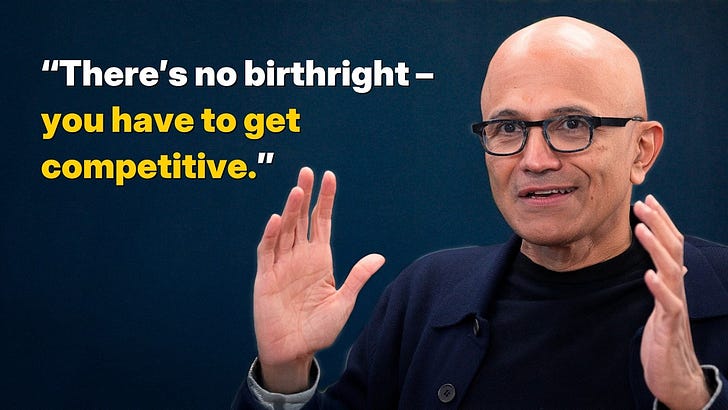
Satya Nadella suggests a fundamental shift in enterprise software monetization. As autonomous AI agents become prevalent, the value unit will move from the human user ("per seat") to the AI itself. "Agents are the new seats," signaling a future where companies pay for automated tasks and outcomes, not just software access for employees.

Satya Nadella predicts that SaaS disruption from AI will hit "high ARPU, low usage" companies hardest. He argues that products like Microsoft 365, with their high usage and low average revenue per user (ARPU), create a constant stream of data. This data graph is crucial for grounding AI agents, creating a defensive moat.
The dominant per-user-per-month SaaS business model is becoming obsolete for AI-native companies. The new standard is consumption or outcome-based pricing. Customers will pay for the specific task an AI completes or the value it generates, not for a seat license, fundamentally changing how software is sold.

Unlike high-margin SaaS, AI agents operate on thin 30-40% gross margins. This financial reality makes traditional seat-based pricing obsolete. To build a viable business, companies must create new systems to capture more revenue and manage agent costs effectively, ensuring profitability and growth from day one.

In the age of AI, software is shifting from a tool that assists humans to an agent that completes tasks. The pricing model should reflect this. Instead of a subscription for access (a license), charge for the value created when the AI successfully achieves a business outcome.

Sierra CEO Bret Taylor argues that transitioning from per-seat software licensing to value-based AI agents is a business model disruption, not just a technological one. Public companies struggle to navigate this shift as it creates a 'trough of despair' in quarterly earnings, threatening their core revenue before the new model matures.

The paradigm shift with AI agents is from "tools to click buttons in" (like CRMs) to autonomous systems that work for you in the background. This is a new form of productivity, akin to delegating tasks to a team member rather than just using a better tool yourself.

The push for AI-driven efficiency means many companies are past 'peak employee.' This creates a scenario analogous to a country with a declining population, where the total number of available seats is in permanent decline, making per-seat pricing a fundamentally flawed long-term business model.