Get your free personalized podcast brief
We scan new podcasts and send you the top 5 insights daily.
Peregrine's AI platform reveals its power when it uncovers insights previously impossible for humans to find. For example, it correlated a surge in water rescues not just to weather, but to an unprecedented three-day sequence of weather patterns creating dangerous rip currents—a non-obvious, actionable insight from integrated data.

Related Insights
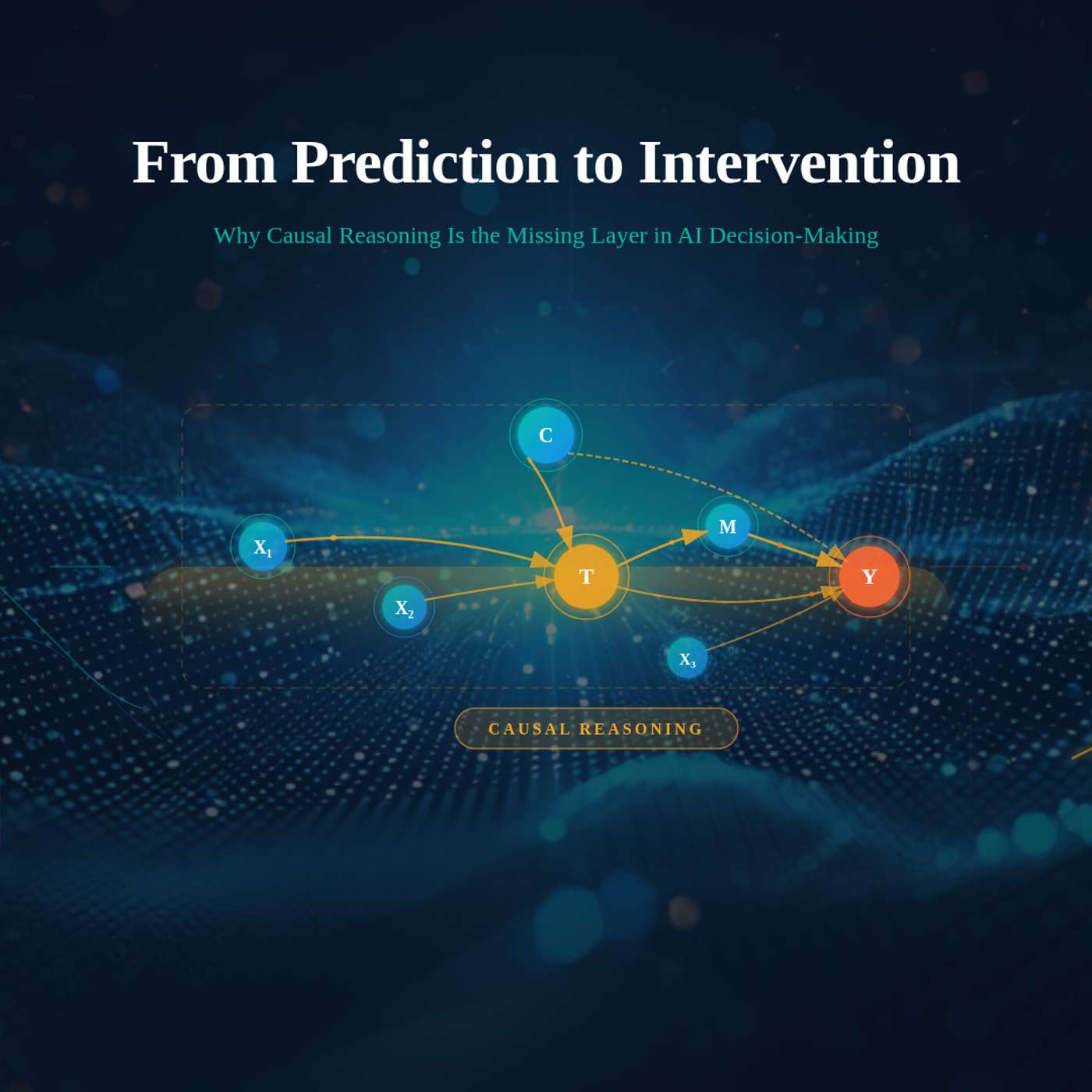
An estimated 80% of companies fail to scale their AI initiatives because they are caught in a 'prediction trap.' Their models produce accurate forecasts but do not support or inform actual business decisions, rendering them commercially ineffective. Causal reasoning is positioned as the solution to bridge this gap from prediction to actionable intelligence.
To elevate AI-driven analysis, connect it to unstructured data sources like Slack and project management tools. This allows the AI to correlate data trends with real-world events, such as a metric dip with a reported incident, mimicking how a senior human analyst thinks and providing deeper insights.

Predictive models often mistake correlation for causation, leading to poor decisions. For example, a model might link marketing spend to revenue, but causal analysis can reveal that customer seasonality is the true cause of both. This deeper understanding prevents wasteful investments based on misleading correlations.
The most exciting application of AI in partnerships isn't automation but its ability to analyze data and reveal non-obvious trends and correlations. This allows leaders to see patterns in partner performance and customer behavior that are invisible to the naked eye.

The core differentiator in AI application is shifting from the model itself to the quality of contextual data fed into it. An AI model is compared to a 'brain' that is useless without the 'eyes, ears, and legs' of integrated, proprietary data. This implies a company's data strategy is more critical to its competitive advantage than access to the latest frontier model.

Dashboards show data but not the 'so what.' While conversational AI helps answer user questions, the next evolution is proactive insight generation. Future AI tools will solve the 'we don't know what we don't know' problem by suggesting actions and surfacing opportunities marketers haven't thought to ask about.

When building revenue models, AI can quickly analyze infinite data slices to spot outliers that skew metrics, such as zero-day service renewals or old opportunities creating survivorship bias. This leads to a more accurate model, representing a performance gain, not just an efficiency one.

Frontier AI models excel in medicine less because of their encyclopedic knowledge and more because of their ability to integrate huge amounts of context. They can synthesize a patient's entire medical history with the latest research—a task difficult for any single human. This highlights that the key to unlocking AI's value is feeding it comprehensive data, as context is the primary driver of superhuman performance.

The most significant recent AI advance is models' ability to use chain-of-thought reasoning, not just retrieve data. However, most business users are unaware of this 'deep research' capability and continue using AI as a simple search tool, missing its transformative potential for complex problem-solving.

The biggest AI opportunity for large companies is breaking down data silos. By building a 'context graph,' you give AI agents access to information from different departments and systems. This enables agents to perform cross-functional tasks and surface insights that were previously impossible.
