Get your free personalized podcast brief
We scan new podcasts and send you the top 5 insights daily.
Glean discovered an unexpected growth loop: as usage of its intelligence layer *inside* other platforms like Claude grows, it creates a "spillover effect" that brings users back into the native Glean UI to build more powerful, team-wide agents and assets.

Related Insights
Users rarely seek out separate AI functionality. Adoption becomes natural when AI assistance appears contextually within existing workflows, addressing friction points directly where the user is already working. This embedded approach is far more effective than adding AI as a separate, layered-on tool.
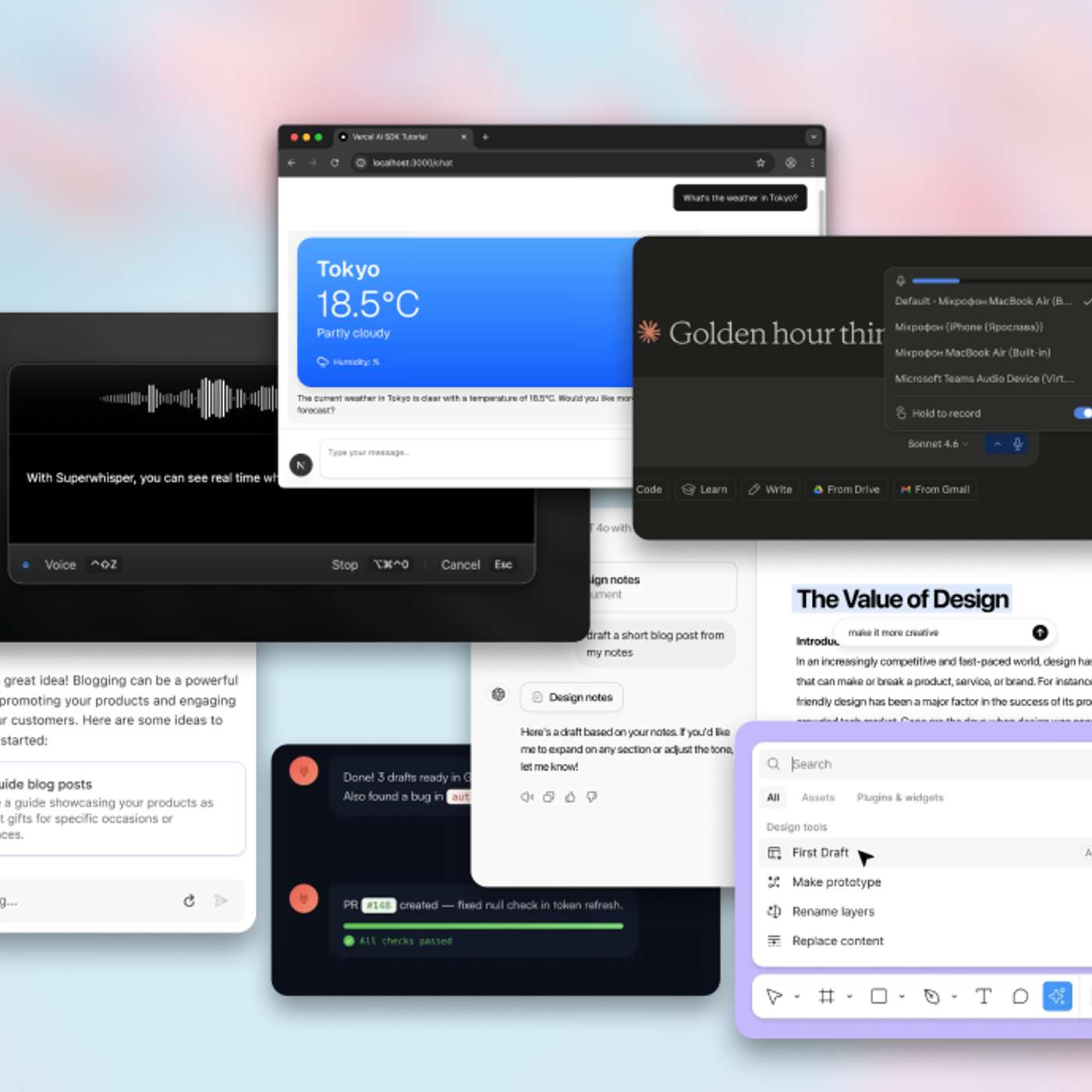
Snowflake boosted revenue with AI not through internal productivity gains, but by embedding AI capabilities directly into its core analytics product. This made the platform more valuable and easier for customers to use, which in a consumption-based model, directly drove more usage and revenue.

The narrative that new features from major AI labs kill startups is often wrong. Instead, these releases serve as massive free education, validate new user behaviors, and unlock enterprise budgets. This creates demand for more specialized, vertical-focused tools, ultimately growing the entire ecosystem for startups.

The key differentiator in AI is moving beyond model power to how seamlessly it's integrated into daily workflows. Tools like Claude Tag, which embeds AI into Slack, lower the barrier for non-technical users and prove that user experience and contextual integration are becoming primary drivers of value.
Instead of replacing core sales tools like Salesforce or Gong, Anthropic used its own AI, Claude, as the "connective tissue" between them. Claude unifies the customer journey by making these disparate systems communicate and share context, creating a coherent experience for reps and customers rather than being just another bolted-on application.

The value of an integrated AI platform compounds over time. Integrations and knowledge built for one channel (like chat) can be instantly redeployed to others (like voice) or used to assist human agents without rebuilding. This lets organizations focus on value, not redundant architecture.

Companies are licensing multiple AI tools like Copilot, ChatGPT, and Claude for different use cases. This fragmentation creates a significant business pain: a collection of disconnected AI products that don't share context. This "platform gap" is a major sales opportunity for vendors offering a unified, context-aware solution.

Despite perceptions of LLMs as interchangeable commodities, user behavior shows significant stickiness. This loyalty isn't just about model performance; it's driven by the overall product experience, workflow integrations (like Claude Code), and agentic capabilities, which make users reluctant to switch even with service interruptions.

Glean's strategy extends beyond being a user-facing app. It positions itself as a centralized system of intelligence that provides superior, offline-processed context to other AI front-ends like Claude or Cursor, a rapidly growing use case.
Instead of being a standalone feature, LLMs provide the most value when subtly integrated into existing workflows. YouTube's AI summaries or its ability to extract a parts list from a DIY video are examples of enhancing the user experience without being disruptive.
