Get your free personalized podcast brief
We scan new podcasts and send you the top 5 insights daily.
Encourage experimentation with AI, but mitigate risk by giving every pilot a clear budget limit ('a leash') and a deadline ('a clock'). This framework allows for innovation while ensuring underperforming projects are killed quickly, successful ones are funded, and great ones are scaled.

Related Insights
Esper established a clear policy for employees to pilot new AI tools. They can experiment without ingesting proprietary data, then submit promising tools to an IT and security-led committee that promises a quick decision. This approach balances fostering innovation with maintaining security.

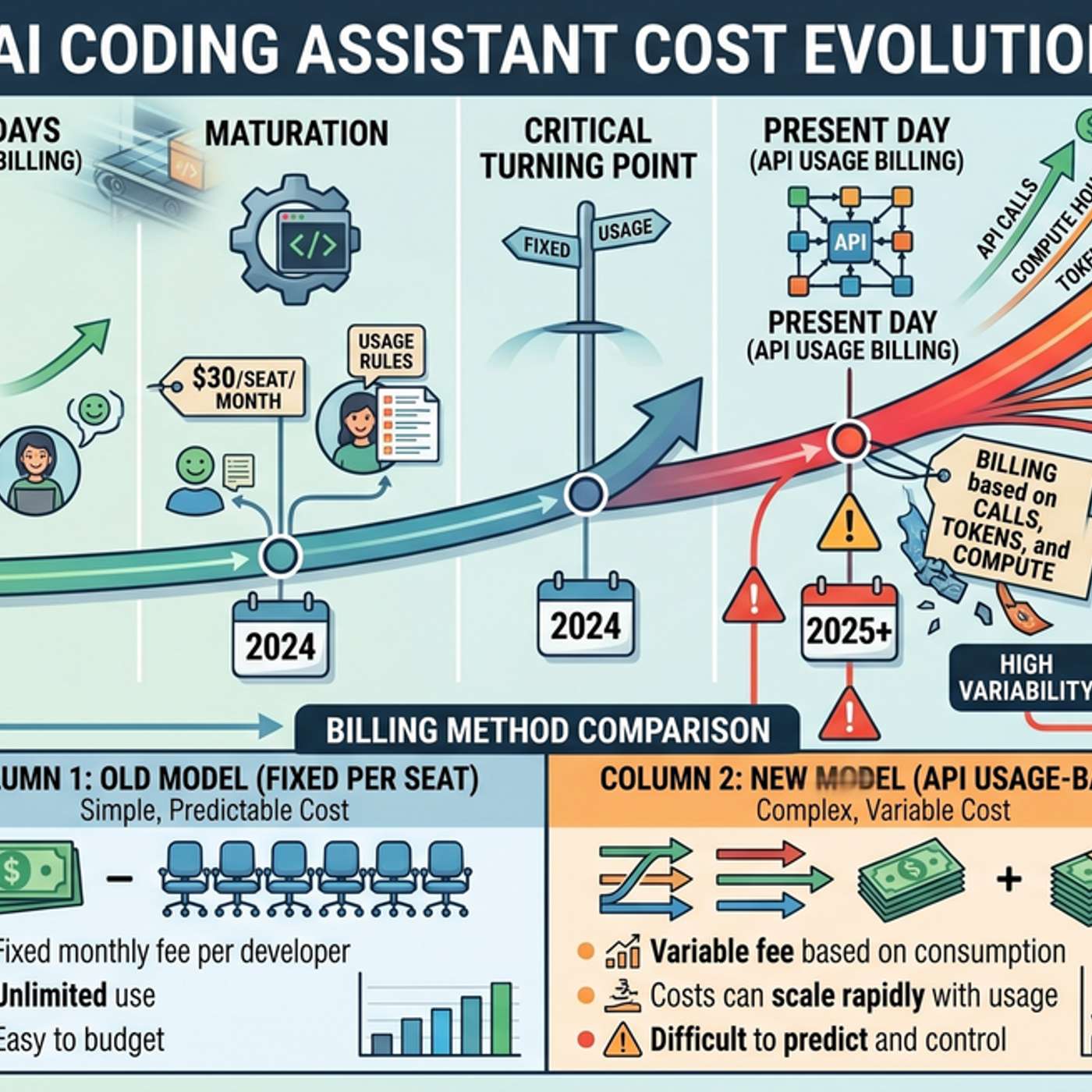
The optimal strategy for managing AI costs is neither total restriction nor a free-for-all. It's providing engineers with dedicated "learning budgets" and experimentation pools, coupled with clear visibility into costs. This fosters innovation responsibly without incurring surprise invoices and turns cost into a first-class constraint.
In ROI-focused cultures like financial services, protect innovation by dedicating a formal budget (e.g., 20% of team bandwidth) to experiments. These initiatives are explicitly exempt from the rigorous ROI calculations applied to the rest of the roadmap, which fosters necessary risk-taking.

Unlimited access to AI tools often results in wasted time on frivolous or bad ideas. Similar to how SNL's Lorne Michaels edits creatives to prevent them from 'getting in their own way,' managers must impose constraints and structure to guide AI usage toward valuable outcomes.

The massive cost of AI infrastructure makes the traditional startup ethos of "move fast and break things" reckless. Wastage costs are too high and margins for error too low. The new imperative is to "move fast with responsible infrastructure," valuing common sense and iterative development over rapid, wasteful scaling.

Unlike traditional software, AI prototypes can be built almost instantly. This requires a mindset shift: if a project doesn't demonstrate tangible value on its very first day, it should be abandoned immediately. Sticking with a weak AI concept leads to costly slow failure.

Instead of a binary human-in-the-loop decision, enterprises should use an "autonomy budget" for agents. Actions are classified by risk (e.g., irreversibility, financial impact) to determine the level of freedom, creating a spectrum from full autonomy to required human approval, avoiding agents becoming expensive suggestion boxes.

While most AI bets should be tied to ROI, CFOs should also establish an 'internal enablement fund' or 'slush fund.' This dedicated budget allows for low-ROI, high-learning experiments. It formally separates pure exploration from value-capture initiatives, fostering innovation without compromising financial discipline on major projects.
To balance AI capability with safety, implement "power caps" that prevent a system from operating beyond its core defined function. This approach intentionally limits performance to mitigate risks, prioritizing predictability and user comfort over achieving the absolute highest capability, which may have unintended consequences.

Successful AI pilots find a 'sweet spot.' They solve a problem large enough to be seen as representative of a broader organizational challenge, ensuring learnings are scalable. Yet, they are small enough to deliver value quickly, maintaining momentum and avoiding organizational fatigue.
