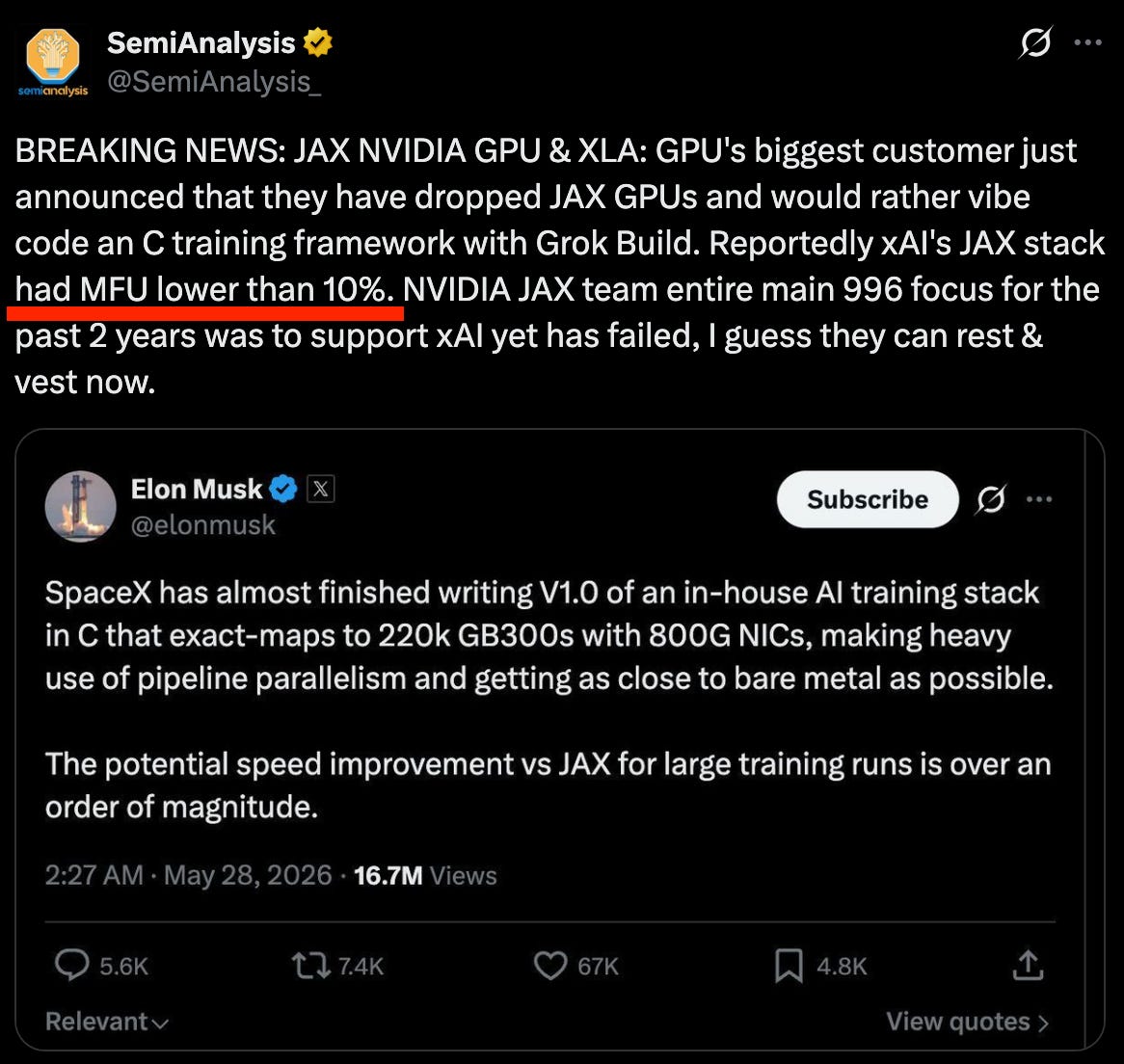
Top-tier data centers operate at extreme efficiency. Google's Borg team aimed for 96%+ node utilization, viewing anything less as a critical failure. This contrasts with MFU (Matrix Multiply Unit) utilization, where best-in-class is 60-70%. Most single-tenant clusters fall far short of Google's standards.
The massive cost of AI infrastructure makes the traditional startup ethos of "move fast and break things" reckless. Wastage costs are too high and margins for error too low. The new imperative is to "move fast with responsible infrastructure," valuing common sense and iterative development over rapid, wasteful scaling.
With 20% of new US data centers at risk of community backlash, a novel solution is to build profit-sharing into the pricing model. By adding a small premium (e.g., $0.50/hr) to compute costs and giving it directly to the local community, operators can turn residents into partners, ensuring project viability.
Instead of building a vertically integrated cloud, AMP acts as a neutral "Independent System Operator" (ISO) for compute. This model, borrowed from the power grid, focuses on pooling supply and demand across multiple clouds and silicon providers without owning the assets, aiming to make "flops flow like megawatts."
Google's internal "Brain Marketplace" used a credit-based bidding system for prioritizing compute jobs, optimizing for decentralized efficiency. A key criticism is that this "capitalism via credits" model prevents top-down, central commands needed for "all-in" strategic pushes, a factor that may have contributed to missing the GPT moment.
Large labs create a market failure by hoarding research. An internal embargo on potentially commercial work means only research deemed not valuable enough for business gets published. This adverse selection process results in a "tragedy" where the broader scientific community gets the "trash," slowing down global innovation.
AI models can provide highly precise end-of-life predictions, empowering patients and reducing healthcare costs. The primary barrier to implementation isn't the technology but the legal framework; it's currently impossible to shift the liability of a wrong diagnosis from a human physician to an AI system, stalling progress.
New chip companies like MatEx accelerate their go-to-market by strategically adopting NVIDIA's open data center reference architecture, making their chips plug-and-play. This allows them to focus innovation on a specific bottleneck, like the logic die, while leveraging the incumbent's ecosystem instead of fighting on every front.
For chip founders leaving labs like Google, a primary risk is the "trust boundary." They lose visibility into next-gen model architectures, critical for systems co-design. This creates a danger of spending two years taping out a chip that is already obsolete for the models being developed when it finally hits the market.
VCs often put researchers in a box, viewing them as unfit for CEO roles. This is a flawed heuristic. Becoming a top-tier scientist—publishing at the highest levels and competing for resources—requires a level of performance akin to a star athlete, making them excellent CEO candidates.
Anthropic's efficiency culture was a direct result of early fundraising struggles, which forced them to define priorities and operate with discipline. In contrast, AI labs that raise massive rounds too easily miss this crucial, character-building phase. They lack the hardship needed to form a resilient culture, making them brittle.