Get your free personalized podcast brief
We scan new podcasts and send you the top 5 insights daily.
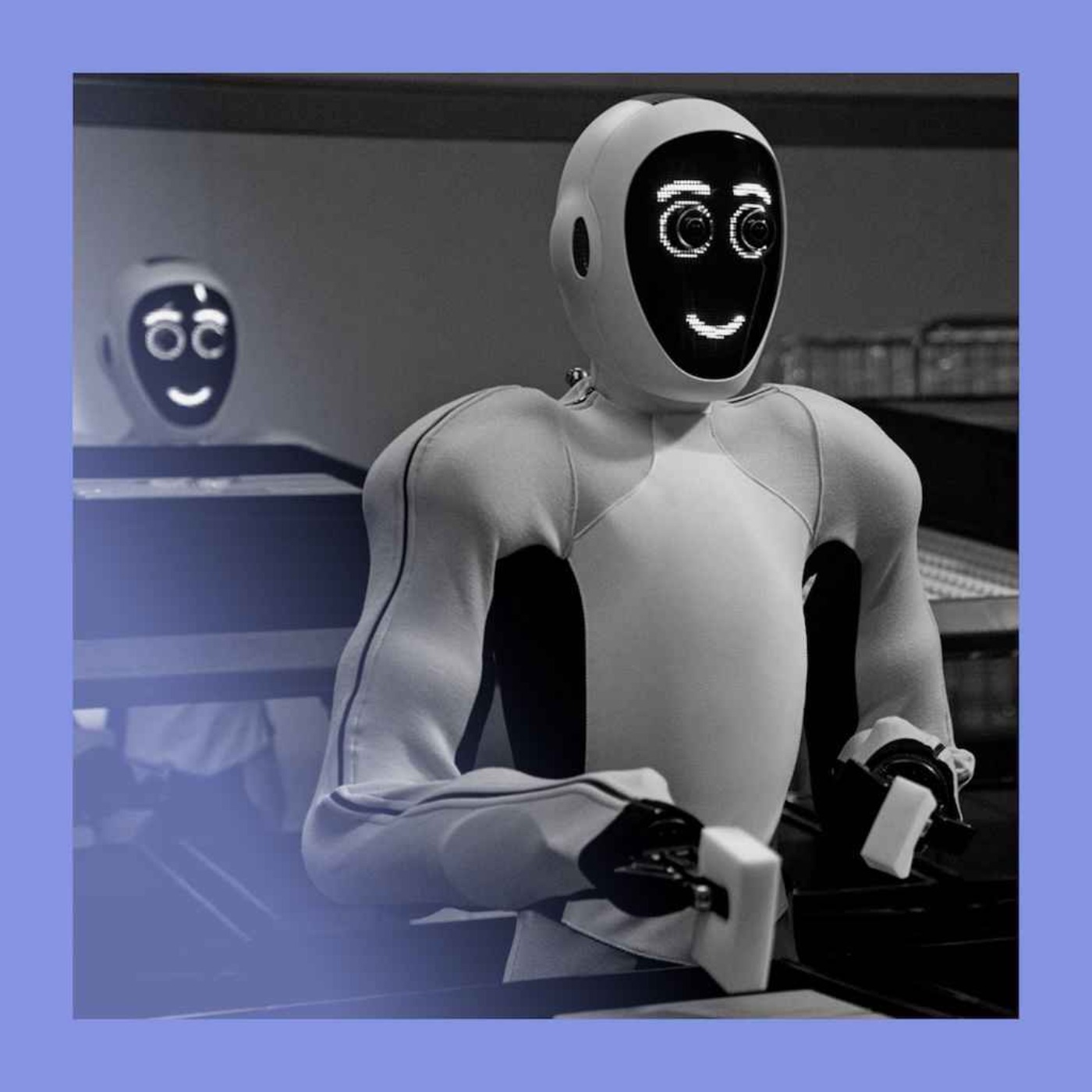
Companies like One X deploy robots that are remotely operated by humans to complete tasks. This strategy provides immediate value to customers while simultaneously collecting vast amounts of real-world training data, which is the primary bottleneck for developing full autonomy.

Related Insights
Unlike LLMs that train on the existing internet, robotics lacks a pre-training dataset for the physical world. This forces companies like Encore to build a full-stack solution combining a software platform for data management with human-led operations for data collection, annotation, and even real-time remote robot piloting for exception handling.

To overcome the data bottleneck in robotics, Sunday developed gloves that capture human hand movements. This allows them to train their robot's manipulation skills without needing a physical robot for teleoperation. By separating data gathering (gloves) from execution (robot), they can scale their training dataset far more efficiently than competitors who rely on robot-in-the-loop data collection methods.

The 1X robot's teleoperation, often seen as a sign of immaturity, is actually a key feature. It allows for both a "human-in-the-loop" expert service for complex tasks and personal remote control, like checking on a pet, creating immediate utility beyond full autonomy.

While many in the robotics industry chase the "fully autonomous" narrative, teleoperation—having remote workers control machines with Xbox controllers—is an extremely valuable and practical step. Customers care about task completion, not the level of autonomy, making teleop a key tool for gathering training data and ensuring reliability.

Companies developing humanoid robots, like One X, market a vision of autonomy but will initially ship a teleoperated product. This "human-in-the-loop" model allows them to enter the market and gather data while full autonomy is still in development.

Progress in robotics for household tasks is limited by a scarcity of real-world training data, not mechanical engineering. Companies are now deploying capital-intensive "in-field" teams to collect multi-modal data from inside homes, capturing the complexity of mundane human activities to train more capable robots.
While Figure's CEO criticizes competitors for using human operators in robot videos, this 'wizard of oz' technique is a critical data-gathering and development stage. Just as early Waymo cars had human operators, teleoperation is how companies collect the training data needed for true autonomy.
To achieve scalable autonomy, Flywheel AI avoids expensive, site-specific setups. Instead, they offer a valuable teleoperation service today. This service allows them to profitably collect the vast, diverse datasets required to train a generalizable autonomous system, mirroring Tesla's data collection strategy.

To create a powerful data flywheel for AI training, ONE X estimates that deploying 10,000 robots into the world would generate a data influx comparable to the daily upload rate of YouTube. This provides a concrete benchmark for the scale required to achieve self-improving general intelligence in robotics.

Firms are deploying consumer robots not for immediate profit but as a data acquisition strategy. By selling hardware below cost, they collect vast amounts of real-world video and interaction data, which is the true asset used to train more advanced and capable AI models for future applications.