Get your free personalized podcast brief
We scan new podcasts and send you the top 5 insights daily.
To create a powerful data flywheel for AI training, ONE X estimates that deploying 10,000 robots into the world would generate a data influx comparable to the daily upload rate of YouTube. This provides a concrete benchmark for the scale required to achieve self-improving general intelligence in robotics.
Related Insights
The primary challenge in robotics AI is the lack of real-world training data. To solve this, models are bootstrapped using a combination of learning from human lifestyle videos and extensive simulation environments. This creates a foundational model capable of initial deployment, which then generates a real-world data flywheel.

To build generalist robots, the most effective approach is pre-training foundation models on internet-scale video datasets, not just simulation or tele-operated data. This vast, diverse data provides a deep, implicit understanding of physics and object interaction that is impossible to replicate in controlled environments, enabling true generalization.

A key surprise in AI development was the non-linear impact of scale. Sebastian Thrun noted that while AI trained on millions of documents is 'fine,' training it on hundreds of billions creates an 'unbelievably smart' system, shocking even its creators and demonstrating data volume as a primary driver of breakthroughs.

Unlike cars, which gather data passively, humanoid robots need active training. To solve this, Musk's strategy is to build a physical 'academy' of 10,000-30,000 Optimus robots performing self-play on various tasks, using this real-world data to close the 'sim-to-real' gap from millions of simulated robots.
Progress in robotics for household tasks is limited by a scarcity of real-world training data, not mechanical engineering. Companies are now deploying capital-intensive "in-field" teams to collect multi-modal data from inside homes, capturing the complexity of mundane human activities to train more capable robots.

The future of valuable AI lies not in models trained on the abundant public internet, but in those built on scarce, proprietary data. For fields like robotics and biology, this data doesn't exist to be scraped; it must be actively created, making the data generation process itself the key competitive moat.

Contrary to starting in controlled industrial settings, ONE X believes the complex, diverse, and social nature of the home is the best environment to develop true general intelligence. The robot must learn to navigate social context, like holding a door for someone, which is data unavailable in a factory.
Brett Adcock states that Figure AI's "Helix 2" neural net provides the right technical stack for general robotics. The biggest remaining obstacle is not hardware but the immense data required to train the robot for a wide distribution of tasks. The company plans to spend nine figures on data acquisition in 2026 to solve this.
Firms are deploying consumer robots not for immediate profit but as a data acquisition strategy. By selling hardware below cost, they collect vast amounts of real-world video and interaction data, which is the true asset used to train more advanced and capable AI models for future applications.
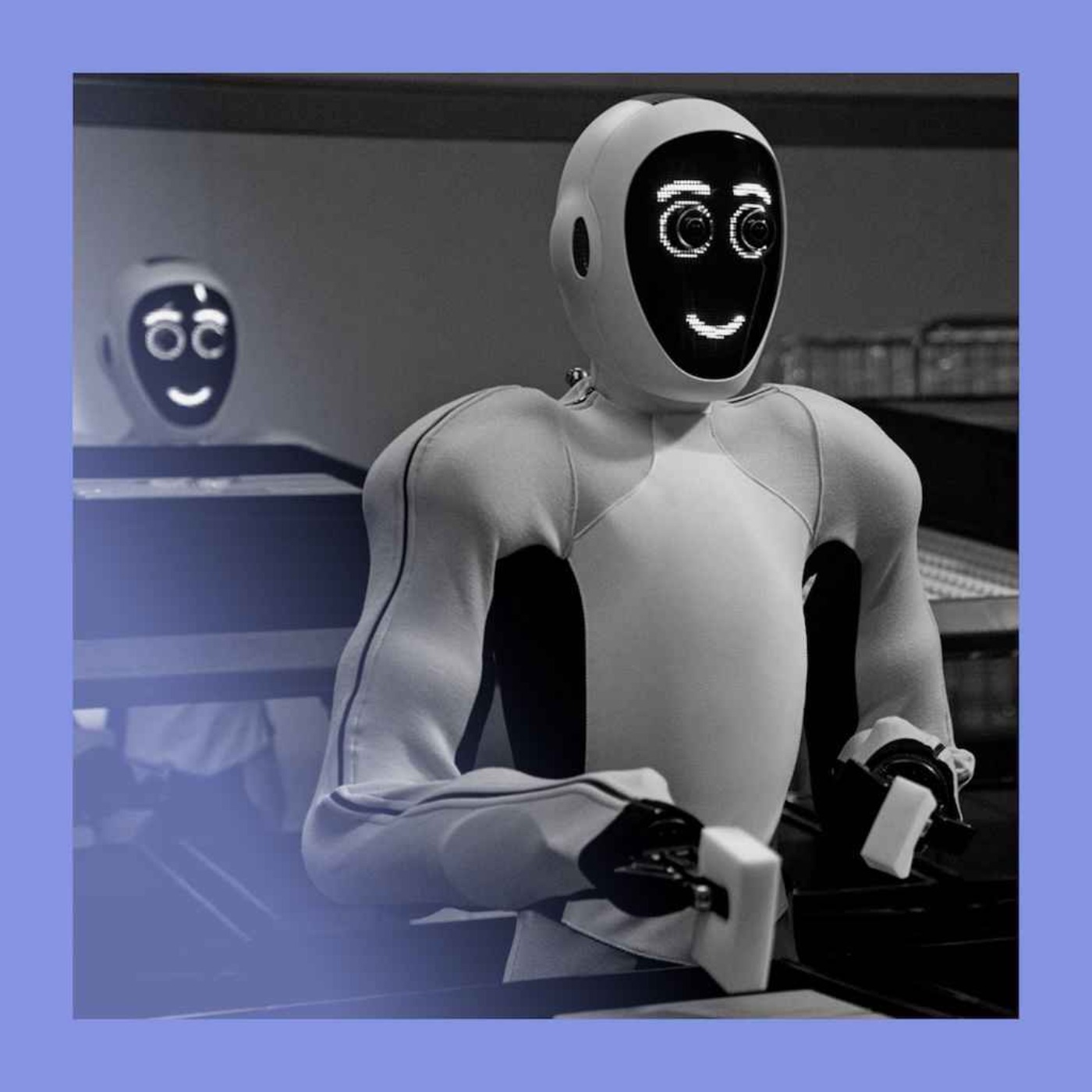
ONE X designs its robots with human-like physical properties, down to skin tissue stiffness. This allows them to effectively leverage the internet's vast repository of human video data (e.g., YouTube) as a training set, bootstrapping intelligence without needing to create an entirely new internet-sized dataset.