Get your free personalized podcast brief
We scan new podcasts and send you the top 5 insights daily.
A 2-second delay is acceptable for a single user prompt. However, in an agentic system where 20 agents communicate sequentially, that delay compounds to 40 seconds, rendering the application unusable. This shift necessitates infrastructure with sub-second response times, driving hardware deployment to urban centers.

Related Insights
The critical trade-off in AI is between throughput (cost efficiency via batching) and interactivity (low latency for users). This curve dictates infrastructure, model, and application decisions, determining whether a workload is optimized for cheap batch processing or high-value instant responses.

As frontier AI models reach a plateau of perceived intelligence, the key differentiator is shifting to user experience. Low-latency, reliable performance is becoming more critical than marginal gains on benchmarks, making speed the next major competitive vector for AI products like ChatGPT.

The need for low-latency services for agents and real-time applications in finance and healthcare is driving a shift towards distributed data centers. Instead of remote gigawatt facilities, companies are deploying smaller, power-efficient, air-cooled racks like SambaNova's in existing metropolitan data centers, closer to users.
The focus in AI engineering is shifting from making a single agent faster (latency) to running many agents in parallel (throughput). This "wider pipe" approach gets more total work done but will stress-test existing infrastructure like CI/CD, which wasn't built for this volume.
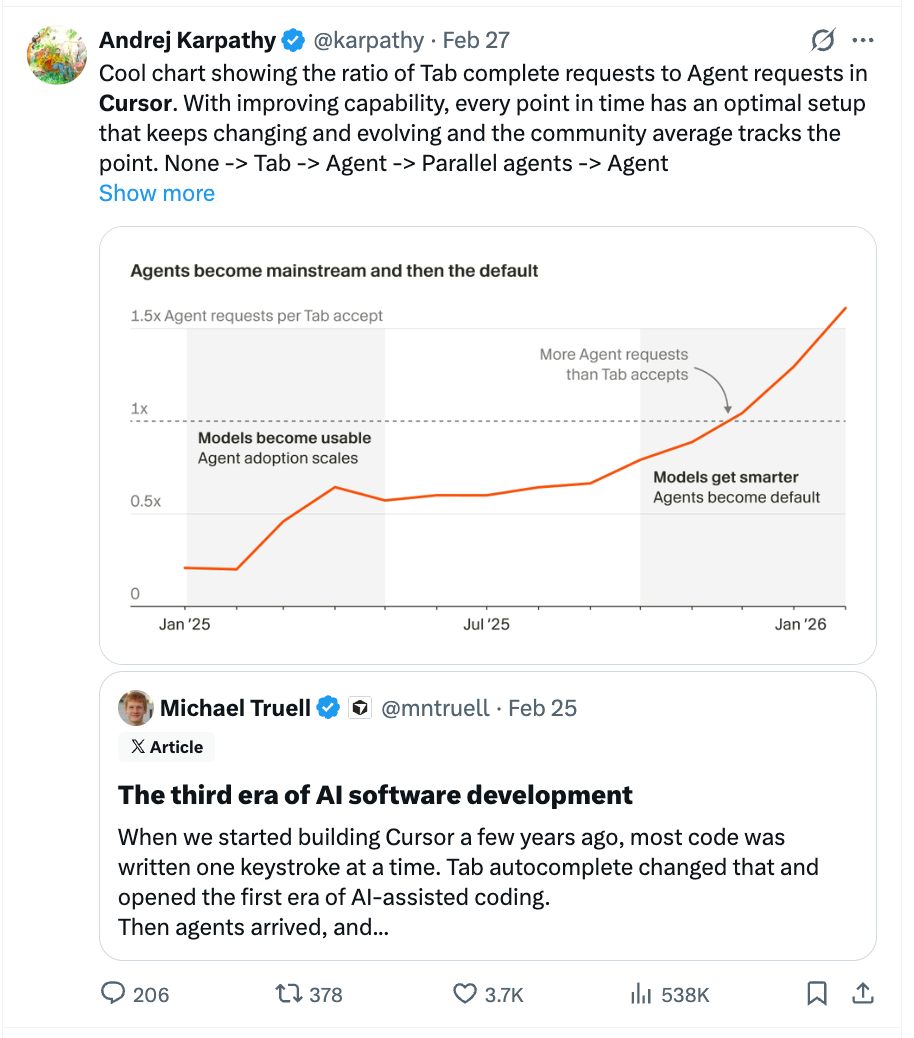
Speed is crucial for all AI applications, not just interactive ones. For background "agentic" tasks, a faster system provides a compounding business advantage. If a competitor's AI can complete ten tasks while yours does one, that lead grows exponentially over time.

The shift from simple query-based AI to agentic AI, where AI calls itself recursively to solve complex tasks, increases compute demand by orders of magnitude. Most people, especially non-coders, fail to grasp this exponential shift, leading them to consistently underestimate the scale and duration of the AI infrastructure build-out.

When splitting jobs across thousands of GPUs, inconsistent communication times (jitter) create bottlenecks, forcing the use of fewer GPUs. A network with predictable, uniform latency enables far greater parallelization and overall cluster efficiency, making it more important than raw 'hero number' bandwidth.

The transition from chatbots to autonomous 'agentic' AI represents a fundamental step-change. These agents, which execute complex tasks independently, have already increased the demand for computational power by 1000x, creating a massive, ongoing need for new infrastructure and hardware.

The evolution of AI towards complex, autonomous "agents" makes relying solely on the cloud slow and expensive, as users burn through token budgets. Nvidia's bet is that running these agents locally on powerful new PC chips will be faster and cheaper for consumers, driving a major hardware shift away from pure cloud computing.

After the current memory crunch, the next AI infrastructure bottleneck will be CPU and networking. The complex orchestration required for emerging agentic AI systems will strain these resources, a trend already visible in companies like Fastly seeing demand spikes just for workload orchestration.
