Get your free personalized podcast brief
We scan new podcasts and send you the top 5 insights daily.
The goal for computer use agents has shifted beyond mimicking human actions to exceeding them in speed. The primary bottleneck is no longer the AI's reasoning but the real-world latency of the software it operates, like website loading times. This changes how developers must think about agent performance optimization.

Related Insights
The proliferation of AI agents that constantly write and test code makes tooling performance critical. A two-minute compile time, an annoyance for a human, becomes a massive bottleneck for an automated agent that might trigger it hundreds of times, justifying major optimization efforts.

The dominant AI use case will shift from real-time, human-in-the-loop chatbots to long-running background agents. For these agents, which work for hours or days, an extra few seconds of latency is meaningless, unlocking massive cost-saving opportunities by prioritizing throughput over speed.
![Neil Movva - Making AI 10x Cheaper - [Invest Like the Best, EP.488] thumbnail](https://megaphone.imgix.net/podcasts/d56fad4c-876e-11f1-9151-5f1834daf707/image/de9954428adab72e672734106004bdcb.jpg?ixlib=rails-4.3.1&max-w=3000&max-h=3000&fit=crop&auto=format,compress)
As frontier AI models reach a plateau of perceived intelligence, the key differentiator is shifting to user experience. Low-latency, reliable performance is becoming more critical than marginal gains on benchmarks, making speed the next major competitive vector for AI products like ChatGPT.

The benchmark for AI agents should not be replicating 80% of a top performer. Instead, focus on narrow use cases where agents can achieve more than 100% of human capability, creating a new standard of "superhuman" performance.

Multi-agent systems allow AI to "think" faster by parallelizing reasoning tasks, much like a team of humans. This approach scales test-time compute beyond the latency bottlenecks of a single, serially-thinking agent, enabling faster and more complex problem-solving.

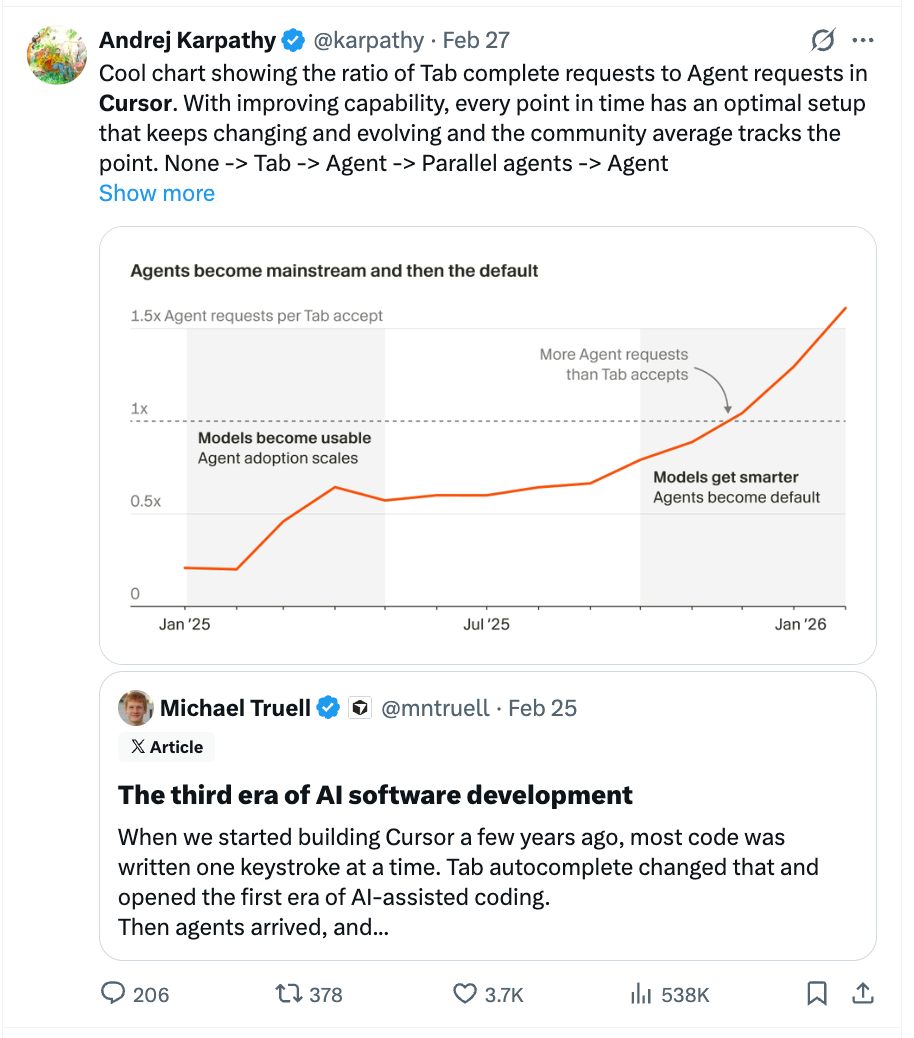
The focus in AI engineering is shifting from making a single agent faster (latency) to running many agents in parallel (throughput). This "wider pipe" approach gets more total work done but will stress-test existing infrastructure like CI/CD, which wasn't built for this volume.
Companies like OpenAI and Anthropic are intentionally shrinking their flagship models (e.g., GPT-4.0 is smaller than GPT-4). The biggest constraint isn't creating more powerful models, but serving them at a speed users will tolerate. Slow models kill adoption, regardless of their intelligence.
![Dylan Patel - Inside the Trillion-Dollar AI Buildout - [Invest Like the Best, EP.442] thumbnail](https://megaphone.imgix.net/podcasts/799253cc-9de9-11f0-8661-ab7b8e3cb4c1/image/d41d3a6f422989dc957ef10da7ad4551.jpg?ixlib=rails-4.3.1&max-w=3000&max-h=3000&fit=crop&auto=format,compress)
Speed is crucial for all AI applications, not just interactive ones. For background "agentic" tasks, a faster system provides a compounding business advantage. If a competitor's AI can complete ten tasks while yours does one, that lead grows exponentially over time.

A key evolution in computer use agents is their ability to move beyond single, sequential actions. Agents now write and execute chunks of JavaScript code to perform multiple operations at once. This significantly improves speed and capability, allowing them to handle more sophisticated, long-horizon tasks on websites and applications.
Obsessing over linear model benchmarks is becoming obsolete, akin to comparing dial-up speeds. The real value and locus of competition is moving to the "agentic layer." Future performance will be measured by the ability to orchestrate tools, memory, and sub-agents to create complex outcomes, not just generate high-quality token responses.
