Get your free personalized podcast brief
We scan new podcasts and send you the top 5 insights daily.
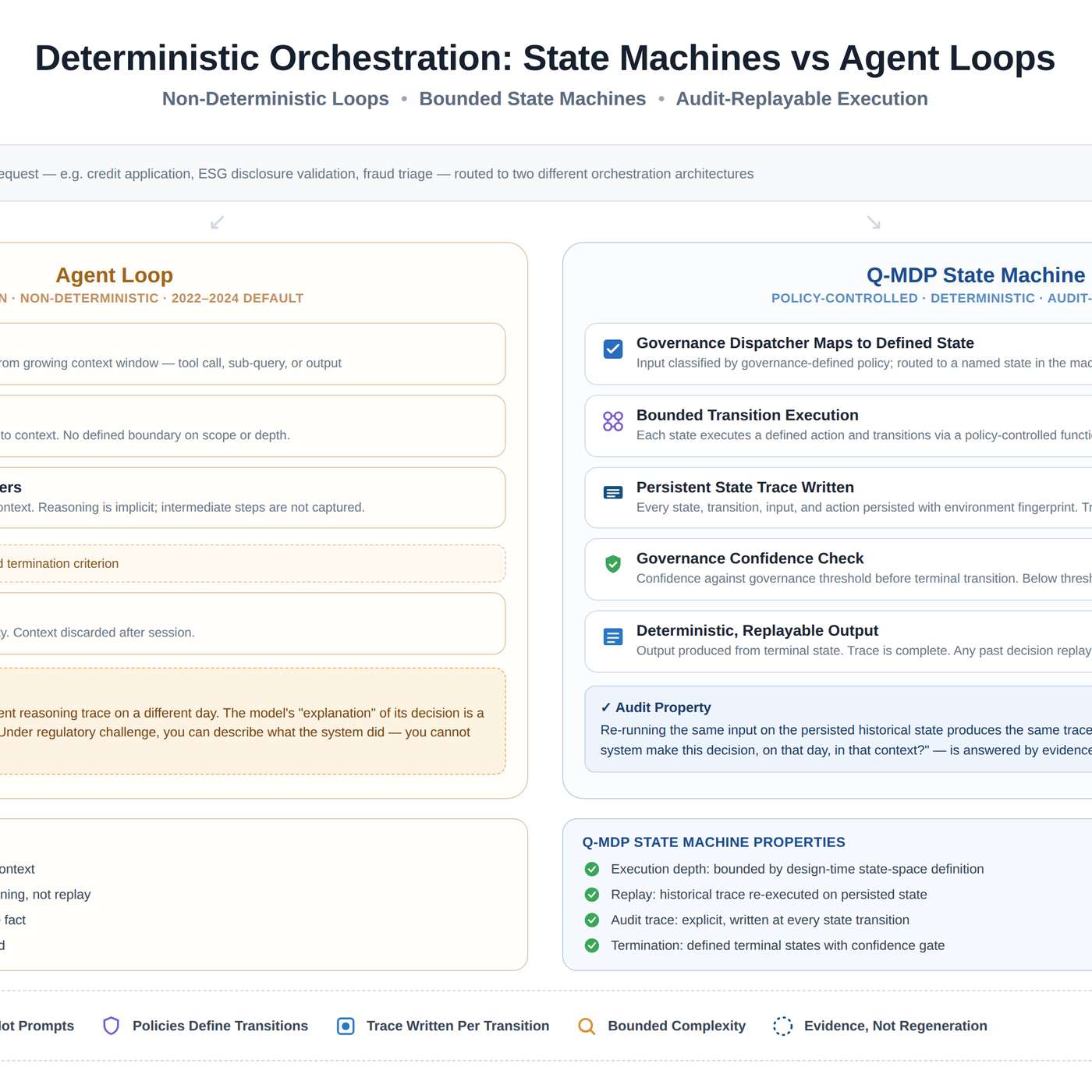
Building with deterministic state machines makes every decision inspectable and every trajectory reproducible. This provides a structural advantage, creating an audit defense capability from day one, which prevents costly retrofitting when regulatory pressure inevitably arrives.
Related Insights
Instead of trying to anticipate every potential harm, AI regulation should mandate open, internationally consistent audit trails, similar to financial transaction logs. This shifts the focus from pre-approval to post-hoc accountability, allowing regulators and the public to address harms as they emerge.

To achieve true deterministic AI, transition conditions must be implemented as explicit code with deterministic semantics (e.g., a probability threshold). Relying on natural language instructions in prompts to guide an LLM is merely a simulation of control, not an enforceable structural guarantee.
Simply killing a misbehaving agent's process is a failing strategy because it destroys the audit trail needed for compliance (e.g., HIPAA). A "graceful" kill switch operates within a managed envelope, preserving the agent's state, cost data, and intermediate work products.

For industries like insurance, deploying AI agents isn't just about functionality; it's about compliance. These companies require agents that produce deterministic, auditable outcomes to comply with regulations. This necessitates robust human-in-the-loop systems to prevent bias and ensure policy adherence, a major hurdle for production deployment.

LangChain-style agent loops produce different outputs from identical inputs. This inherent non-determinism makes them architecturally unsuitable for regulated sectors like finance and healthcare, which mandate deterministic replay for auditing purposes.
To assess audit-readiness, pick an AI-driven decision from months ago and attempt to reconstruct every detail: data input, model version, validation status, and review trail. If you cannot gather all this information within 48 hours, your governance framework will fail a real-world audit.

Tools like LangGraph support state machine patterns, but don't guarantee them. The critical shift is an engineering discipline where orchestration logic is explicitly designed and bounded by developers, rather than being improvised by the LLM at runtime.
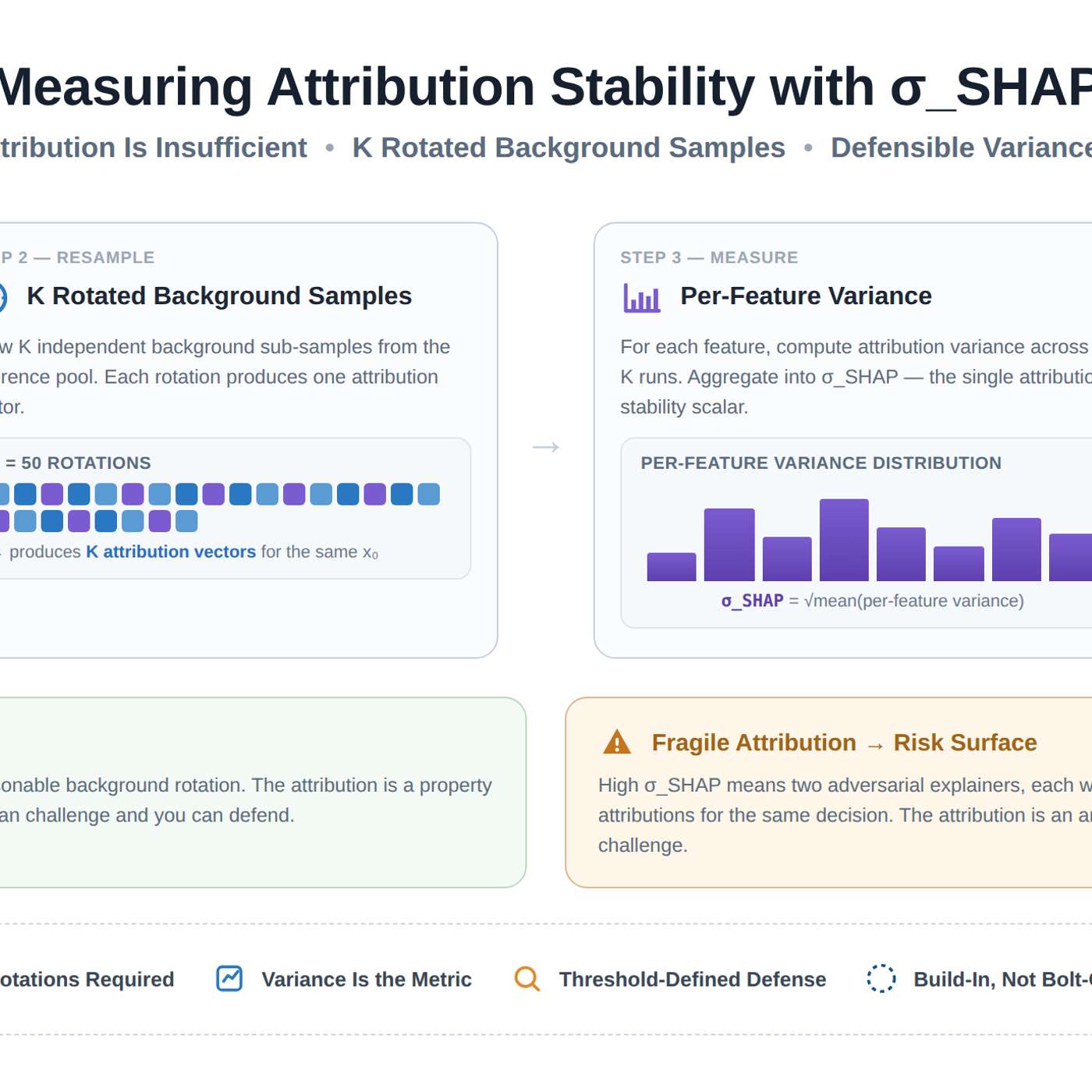
Instead of treating model explainability as a one-off documentation task, teams should engineer for stability. This involves measuring attribution variance, and for audit purposes, versioning and persisting the specific background data sample used to create a deterministic, reproducible explanation for regulators.
Traditional audit logs and screenshots are inadequate for AI agents. To ensure accountability, every agent needs a distinct, machine-readable identity, like a Decentralized Identifier (DID). All agent actions should be cryptographically signed and recorded in a tamper-evident ledger to create a trustworthy audit trail.

Treat accountability as an engineering problem. Implement a system that logs every significant AI action, decision path, and triggering input. This creates an auditable, attributable record, ensuring that in the event of an incident, the 'why' can be traced without ambiguity, much like a flight recorder after a crash.
