Get your free personalized podcast brief
We scan new podcasts and send you the top 5 insights daily.
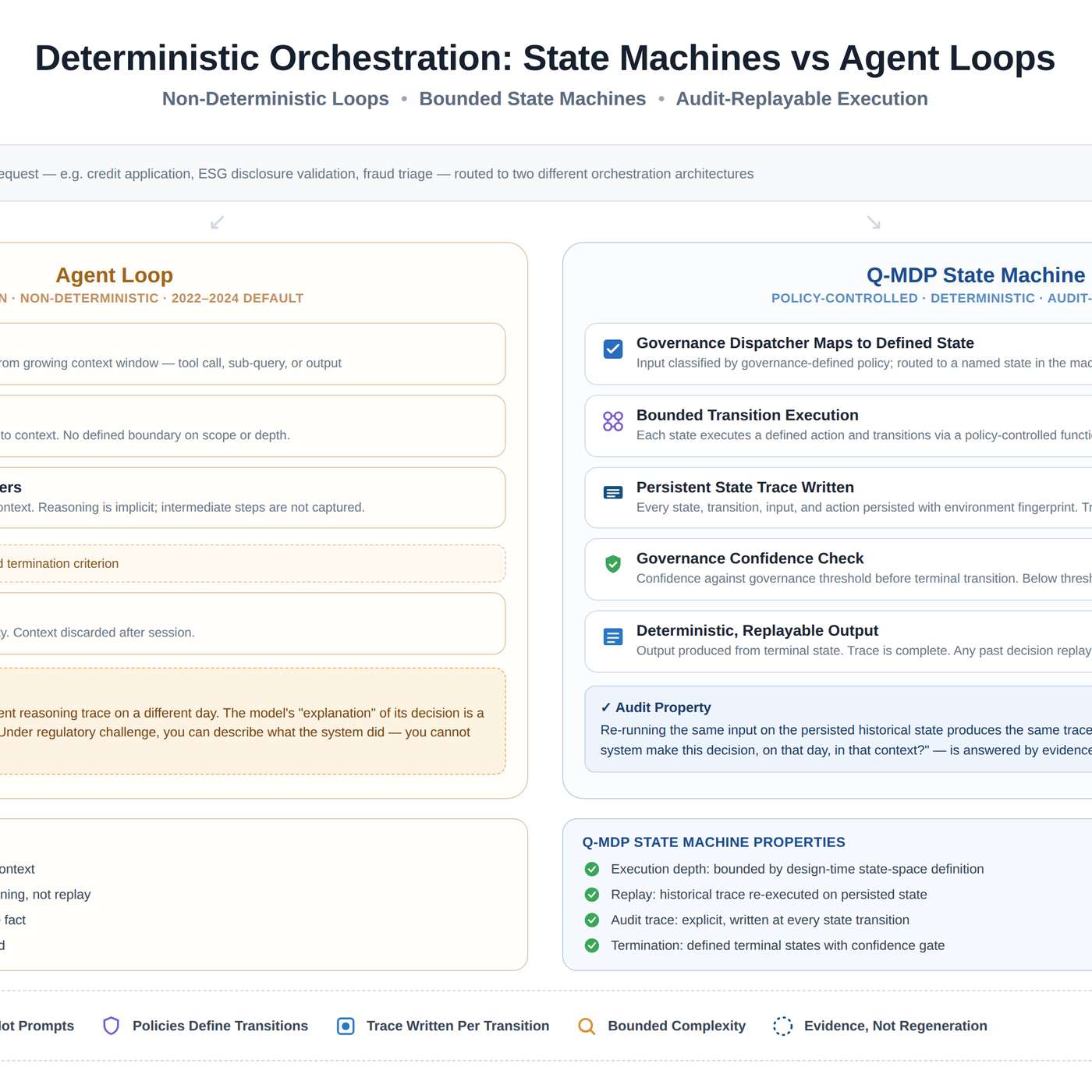
Tools like LangGraph support state machine patterns, but don't guarantee them. The critical shift is an engineering discipline where orchestration logic is explicitly designed and bounded by developers, rather than being improvised by the LLM at runtime.
Related Insights
To achieve true deterministic AI, transition conditions must be implemented as explicit code with deterministic semantics (e.g., a probability threshold). Relying on natural language instructions in prompts to guide an LLM is merely a simulation of control, not an enforceable structural guarantee.
Traditional software relies on predictable, deterministic functions. AI agents introduce a new paradigm of "stochastic subroutines," where correctness and logic are abdicated. This means developers must design systems that can achieve reliable outcomes despite the non-deterministic paths the AI might take to get there.

Don't give LLMs full control. Use deterministic code for core logic, validation, and enforcing rules. Delegate only tasks requiring flexibility or understanding of unstructured input to the LLM, treating it as a specialized component, not the entire system.
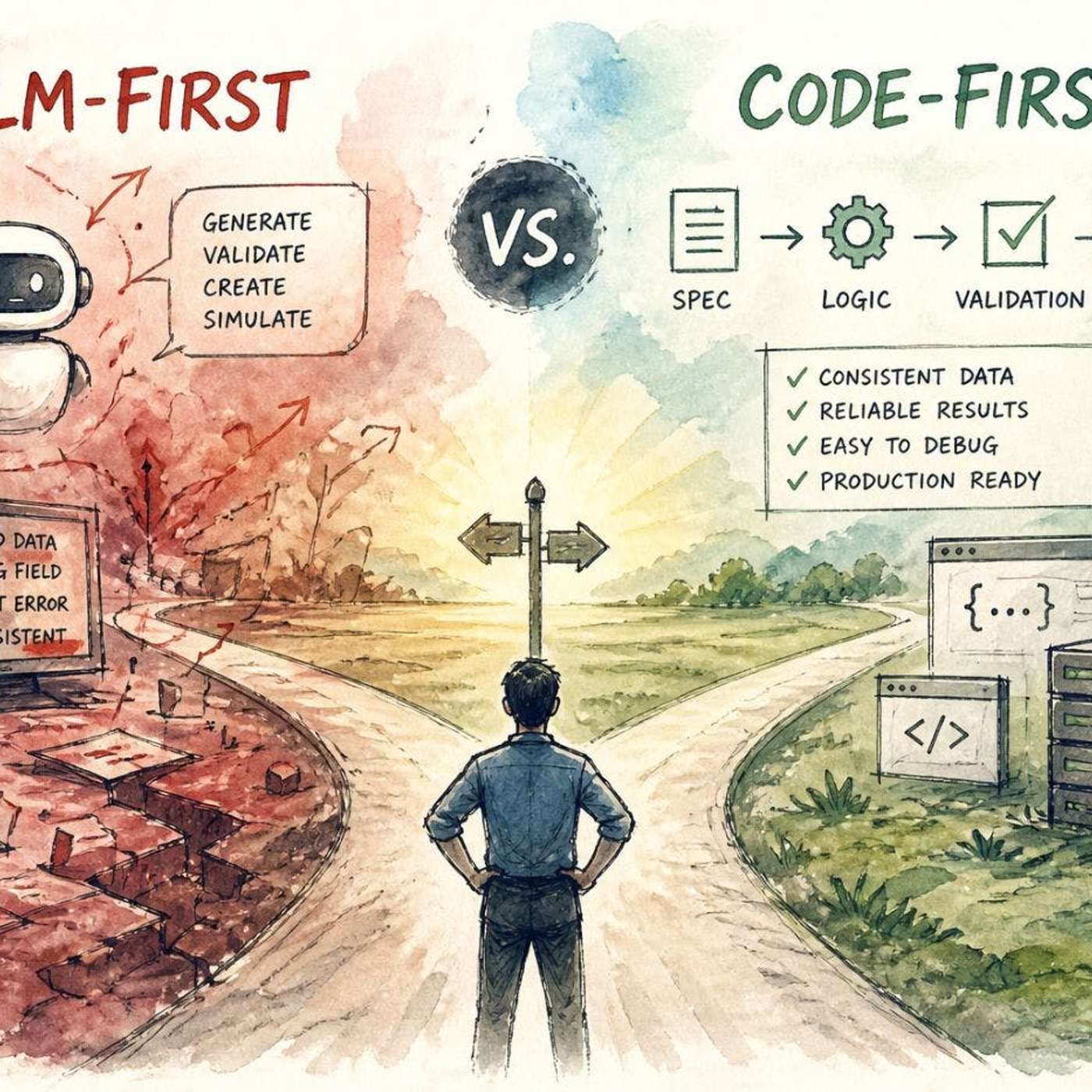
A new academic framework, ArbiterK, challenges the standard model of an LLM acting as the central controller. It inverts the paradigm by embedding the LLM within a deterministic execution system, demoting it to a suggestion engine. This ensures the system, not the probabilistic LLM, retains final control and enforces rules.

Elicit built a Domain-Specific Language (DSL) defining reasoning primitives as microservices. Frontier models orchestrate these primitives to create structured workflows, ensuring complex processes run exactly as defined and overcoming the inherent unreliability of standard LLMs for high-stakes tasks.

For critical enterprise functions like financial modeling, 99.9% accuracy from a probabilistic LLM is unacceptable. Platforms like Salesforce's Agent Force 360 solve this by layering deterministic logic and guardrails on top of the AI, ensuring compliance and preventing costly errors where even a 0.1% failure rate is too high.

Relying solely on natural language prompts like 'always do this' is unreliable for enterprise AI. LLMs struggle with deterministic logic. Salesforce developed 'AgentForce Script,' a dedicated language to enforce rules and ensure consistent, repeatable performance for critical business workflows, blending it with LLM reasoning.

Purely probabilistic LLMs are unreliable for critical business processes. GetVocal's architecture uses a deterministic "context graph" based on user intentions as the core decision-making engine. This provides traceability and reliability, while selectively calling generative models for conversational nuance.

For an LLM's output to be useful in a software system, it cannot be treated as ambiguous text. It must be forced through a "hard boundary"—a strict schema or contract—that constrains, validates, and types the data, making it observable and safe for downstream services to trust and consume.

As AI models execute tasks via function calling, their internal state is insufficient for reliable, repeatable business outcomes. They must integrate with external systems (like BPMS) to become predictable "runtimes," ensuring consistent results despite prompt failures or hallucinations.