Get your free personalized podcast brief
We scan new podcasts and send you the top 5 insights daily.
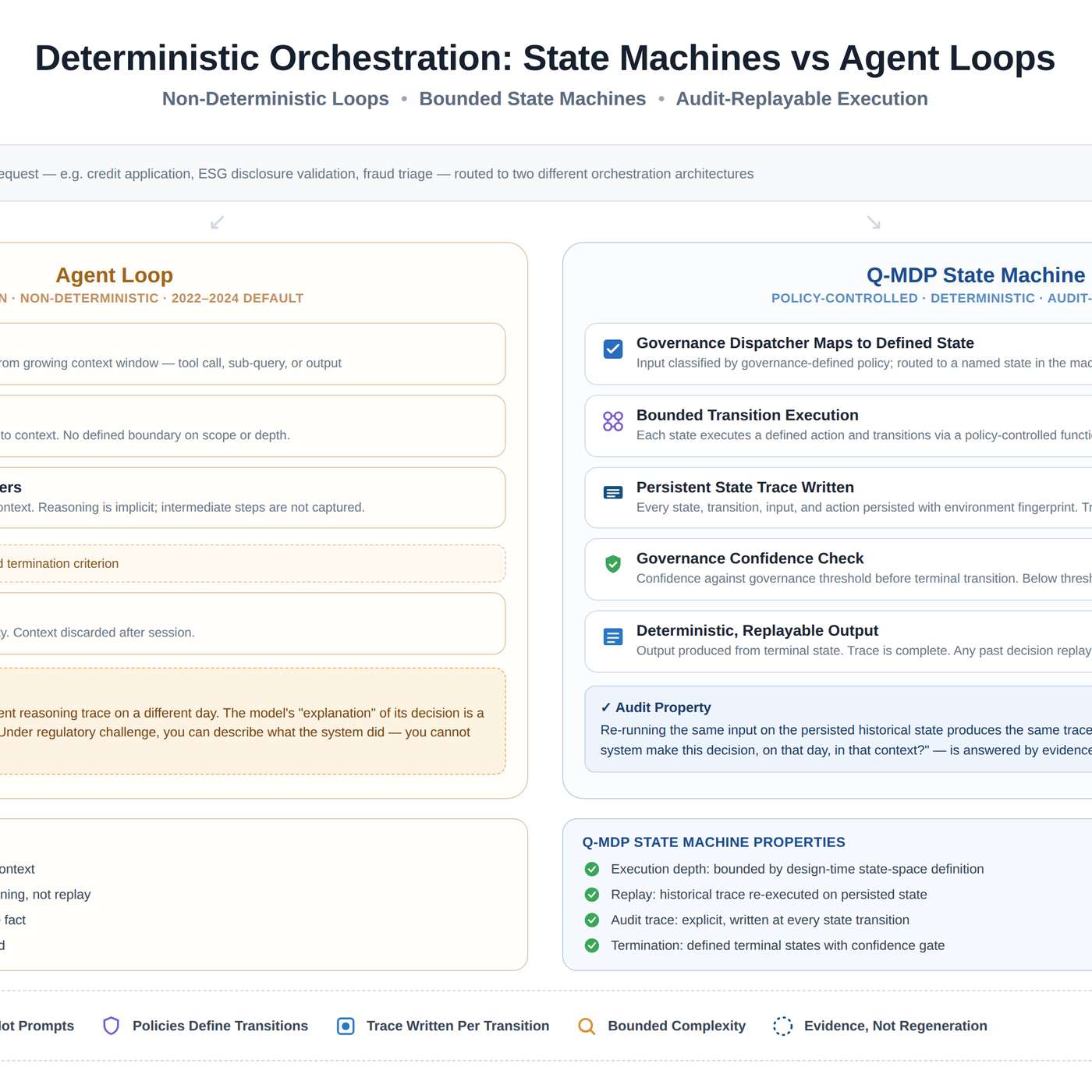
LangChain-style agent loops produce different outputs from identical inputs. This inherent non-determinism makes them architecturally unsuitable for regulated sectors like finance and healthcare, which mandate deterministic replay for auditing purposes.
Related Insights
To achieve true deterministic AI, transition conditions must be implemented as explicit code with deterministic semantics (e.g., a probability threshold). Relying on natural language instructions in prompts to guide an LLM is merely a simulation of control, not an enforceable structural guarantee.
Unlike traditional software that produces identical, auditable results, AI is non-deterministic and often can't explain its reasoning. This poses a major challenge for finance, an industry where processes must be repeatable and transparent to meet regulatory and client expectations for showing work.

Traditional software relies on predictable, deterministic functions. AI agents introduce a new paradigm of "stochastic subroutines," where correctness and logic are abdicated. This means developers must design systems that can achieve reliable outcomes despite the non-deterministic paths the AI might take to get there.

For industries like insurance, deploying AI agents isn't just about functionality; it's about compliance. These companies require agents that produce deterministic, auditable outcomes to comply with regulations. This necessitates robust human-in-the-loop systems to prevent bias and ensure policy adherence, a major hurdle for production deployment.
Generative AI is designed for creative generation, not consistent output. This core feature makes it unreliable for critical, live applications without human oversight. Humans require predictable patterns, which current AI alone cannot guarantee, making a human at the helm essential for safety and trust.

Traditional systems can be controlled with simple, deterministic rules. Because modern AI agents are inherently unpredictable, effective governance requires using another layer of AI. A specialized AI must monitor, interpret, and block the actions of other agents in real-time.

LLMs are technically non-deterministic systems designed to guess the next most probable word, not verify facts like a calculator. This inherent design means they will confidently produce incorrect information, making human verification indispensable for high-stakes business decisions.

For critical enterprise functions like financial modeling, 99.9% accuracy from a probabilistic LLM is unacceptable. Platforms like Salesforce's Agent Force 360 solve this by layering deterministic logic and guardrails on top of the AI, ensuring compliance and preventing costly errors where even a 0.1% failure rate is too high.

To deploy LLMs in high-stakes environments like finance, combine them with deterministic checks. For example, use a traditional algorithm to calculate cash flow and only surface the LLM's answer if it falls within an acceptable range. This prevents hallucinations and ensures reliability.

Fully autonomous AI agents are not yet viable in enterprises. Alloy Automation builds "semi-deterministic" agents that combine AI's reasoning with deterministic workflows, escalating to a human when confidence is low to ensure safety and compliance.