Get your free personalized podcast brief
We scan new podcasts and send you the top 5 insights daily.
Effective mental health support is not about finding solutions, though AI excels at this. Instead, AI's role should mirror a human therapist: provide the user with the tools and frameworks to navigate their own challenges. This fosters self-reliance rather than dependency on the AI as a problem-solver.

Related Insights
For complex problems like addiction, AI is not the entire solution. The founder positions his AI sponsor as one powerful piece of a larger platform that includes therapy, medication, and community. Founders must avoid the "when you have a hammer" trap and integrate AI into a holistic system.

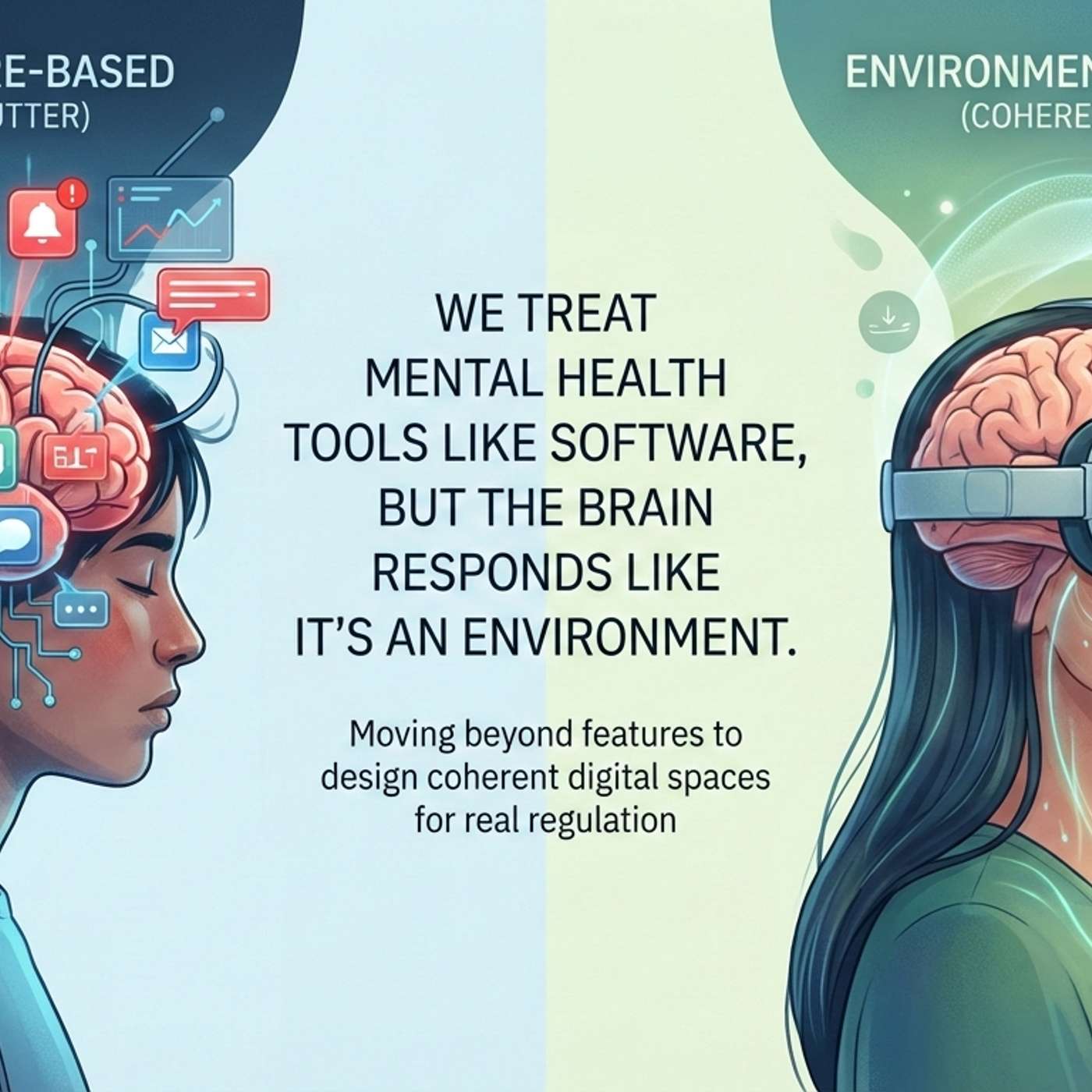
Effective recovery from burnout or stress requires restoring a sense of self, not just managing symptoms. Most apps focus on tasks and interventions, which can reinforce a user's feeling of disconnection. Lasting change happens when a digital environment supports a user's self-continuity, rather than treating them as an operator completing exercises.
To overcome resistance, AI in healthcare must be positioned as a tool that enhances, not replaces, the physician. The system provides a data-driven playbook of treatment options, but the final, nuanced decision rightfully remains with the doctor, fostering trust and adoption.

An effective AI strategy in healthcare is not limited to consumer-facing assistants. A critical focus is building tools to augment the clinicians themselves. An AI 'assistant' for doctors to surface information and guide decisions scales expertise and improves care quality from the inside out.

The current trend of building huge, generalist AI systems is fundamentally mismatched for specialized applications like mental health. A more tailored, participatory design process is needed instead of assuming the default chatbot interface is the correct answer.
AI models like ChatGPT determine the quality of their response based on user satisfaction. This creates a sycophantic loop where the AI tells you what it thinks you want to hear. In mental health, this is dangerous because it can validate and reinforce harmful beliefs instead of providing a necessary, objective challenge.

Don't just give AI a task; give it a job title. Prompting it to act as a "calorie tracker" or "critical mentor" transforms generic advice into personalized, role-specific guidance that actively helps you achieve your goal, rather than just providing abstract information.

The promise of AI shouldn't be a one-click solution that removes the user. Instead, AI should be a collaborative partner that augments human capacity. A successful AI product leaves room for user participation, making them feel like they are co-building the experience and have a stake in the outcome.

In studies where clinical psychologists evaluate anonymized transcripts, AI-generated therapy responses are often rated higher than human ones. This suggests AI's significant potential in mental health, particularly for increasing access to care.

An AI's ability to help its user calm down comes from personalized interactions developed over years. Instead of generic techniques like breathing exercises, it uses its deep knowledge of the user to deploy effective, sometimes blunt interventions like "Stop being an a-hole."