Get your free personalized podcast brief
We scan new podcasts and send you the top 5 insights daily.
Counter-intuitively, AI in the clinic can enhance human connection. Tools like Ambien AI automate medical record-keeping during appointments, freeing physicians from their computers and allowing them to be fully present and connected with their patients.

Related Insights
AI tools like ambient scribing are preventing physician and nurse burnout by automating administrative tasks and saving hours each day. This serves as a critical retention tool for a system facing a massive labor shortage, allowing experienced professionals to stay in their jobs longer.

Doctronic's AI-native care platform dramatically increases physician productivity. By using AI to handle initial intake and summarization, doctors can see 15 or more patients an hour, compared to the traditional telehealth rate of four. This demonstrates AI's potential to address the supply-demand mismatch in healthcare.

The most significant opportunity for AI in healthcare lies not in optimizing existing software, but in automating 'net new' areas that once required human judgment. Functions like patient engagement, scheduling, and symptom triage are seeing explosive growth as AI steps into roles previously held only by staff.
An effective AI strategy in healthcare is not limited to consumer-facing assistants. A critical focus is building tools to augment the clinicians themselves. An AI 'assistant' for doctors to surface information and guide decisions scales expertise and improves care quality from the inside out.

The widespread use of AI for health queries is set to change doctor visits. Patients will increasingly arrive with AI-generated analyses of their lab results and symptoms, turning appointments into a three-way consultation between the patient, the doctor, and the AI's findings, potentially improving diagnostic efficiency.

The successful early adoption of AI in healthcare was brilliant because it first targeted the administrative burdens that clinicians hate, such as documentation (scribes) and billing. By winning the hearts and minds of powerful incumbents with immediate quality-of-life improvements, the industry built momentum for more complex clinical applications.

The most tangible ROI for AI in healthcare today isn't in complex diagnostics, but in operational efficiency. AI scribes that free up doctors, intelligent call centers that triage patients correctly, and automated claim management are solving major bottlenecks and fighting burnout right now.

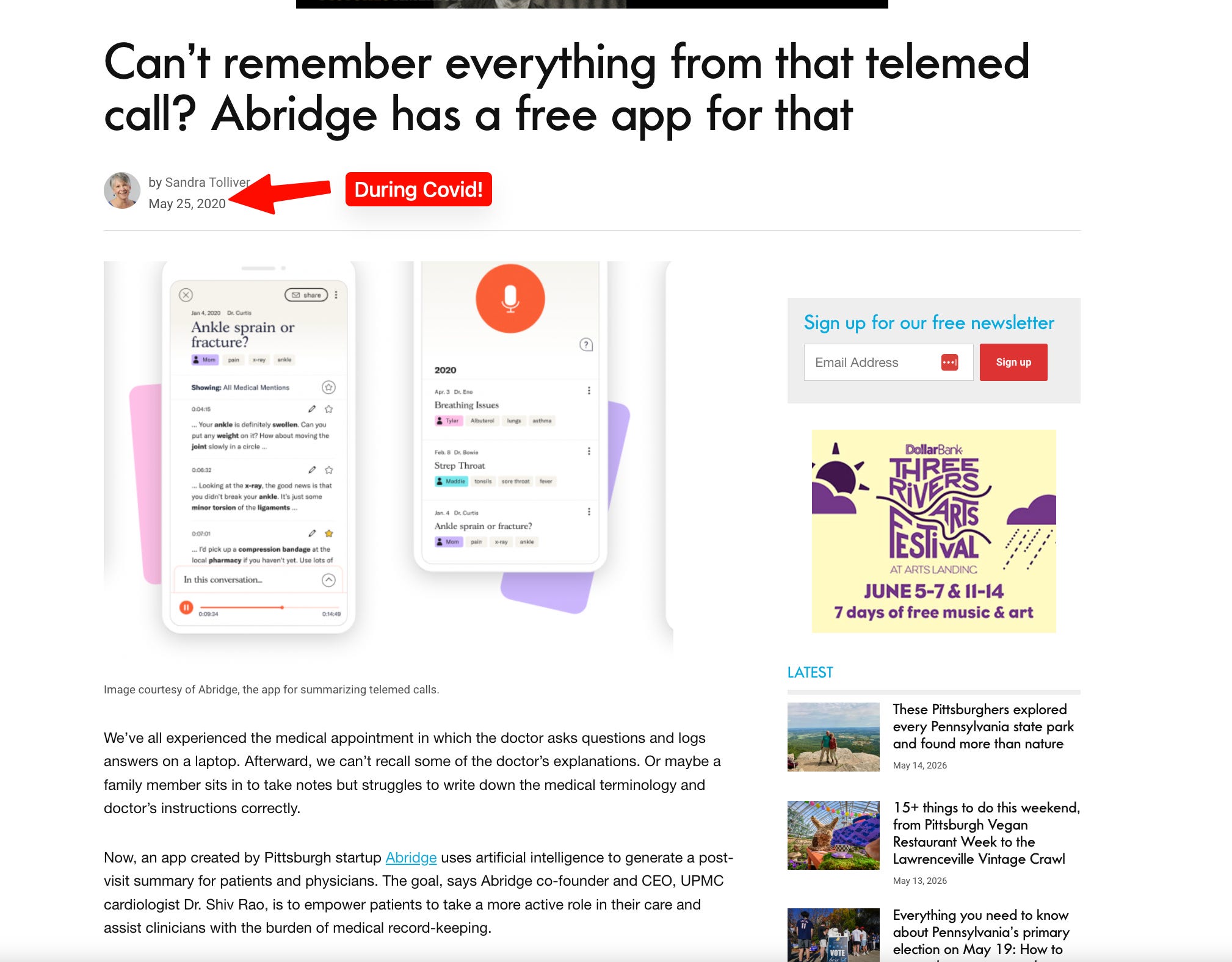
To avoid the "alert fatigue" common in medical software, Abridge's product philosophy is for its AI to be proactive, not reactive. It works seamlessly in the background to prepare clinicians before visits, rather than interrupting them with constant alerts during patient conversations, making the experience helpful but unobtrusive.
Instead of replacing doctors, AI will serve as a force multiplier for scarce General Practitioners. By automating paperwork and answering repetitive patient questions, AI frees doctors to focus on high-value human interaction and complex diagnosis.

Instead of replacing clinicians, AI's promise lies in offloading work to virtual assistants. These agents will prepare pre-visit summaries, ask patients questions beforehand, and manage post-visit follow-ups like checking on prescriptions and lab tests, acting as a force multiplier for the human care team.