Get your free personalized podcast brief
We scan new podcasts and send you the top 5 insights daily.
Contrary to starting in controlled industrial settings, ONE X believes the complex, diverse, and social nature of the home is the best environment to develop true general intelligence. The robot must learn to navigate social context, like holding a door for someone, which is data unavailable in a factory.
Related Insights
To build generalist robots, the most effective approach is pre-training foundation models on internet-scale video datasets, not just simulation or tele-operated data. This vast, diverse data provides a deep, implicit understanding of physics and object interaction that is impossible to replicate in controlled environments, enabling true generalization.

Instead of deploying thousands of expensive robots to gather manipulation data, Sunday Robotics is distributing cheaper, specialized gloves. This allows them to collect high-quality, diverse data from humans performing tasks in their own homes, accelerating model development.
Instead of reacting to its environment, ONE X's world model AI allows its robots to 'think' forward and simulate potential outcomes of an action. Like a human anticipating spilling hot coffee, the robot can identify risks and select the safest trajectory, which is critical for operating in a home.
Leading robotics companies are taking different paths to market. Boston Dynamics targets industrial use cases (e.g., DHL, BP). In contrast, both Figure AI and 1X are now focused on the home, but 1X is moving more aggressively by accepting consumer pre-orders first.

Progress in robotics for household tasks is limited by a scarcity of real-world training data, not mechanical engineering. Companies are now deploying capital-intensive "in-field" teams to collect multi-modal data from inside homes, capturing the complexity of mundane human activities to train more capable robots.

The AI robotics industry is entering a high-stakes period as companies move from research to reality by shipping general-purpose robots for testing in consumer homes. This marks a critical test of whether the technology is robust enough for real-world environments, with a high probability of more failures than successes.
Initially, factories seemed like the easier first market for humanoids due to structured environments. However, Figure's founder now believes the home is a more near-term opportunity. The challenge of environmental variability is now seen as a data-bound problem that can be solved with large-scale data collection programs.

To create a powerful data flywheel for AI training, ONE X estimates that deploying 10,000 robots into the world would generate a data influx comparable to the daily upload rate of YouTube. This provides a concrete benchmark for the scale required to achieve self-improving general intelligence in robotics.
Firms are deploying consumer robots not for immediate profit but as a data acquisition strategy. By selling hardware below cost, they collect vast amounts of real-world video and interaction data, which is the true asset used to train more advanced and capable AI models for future applications.
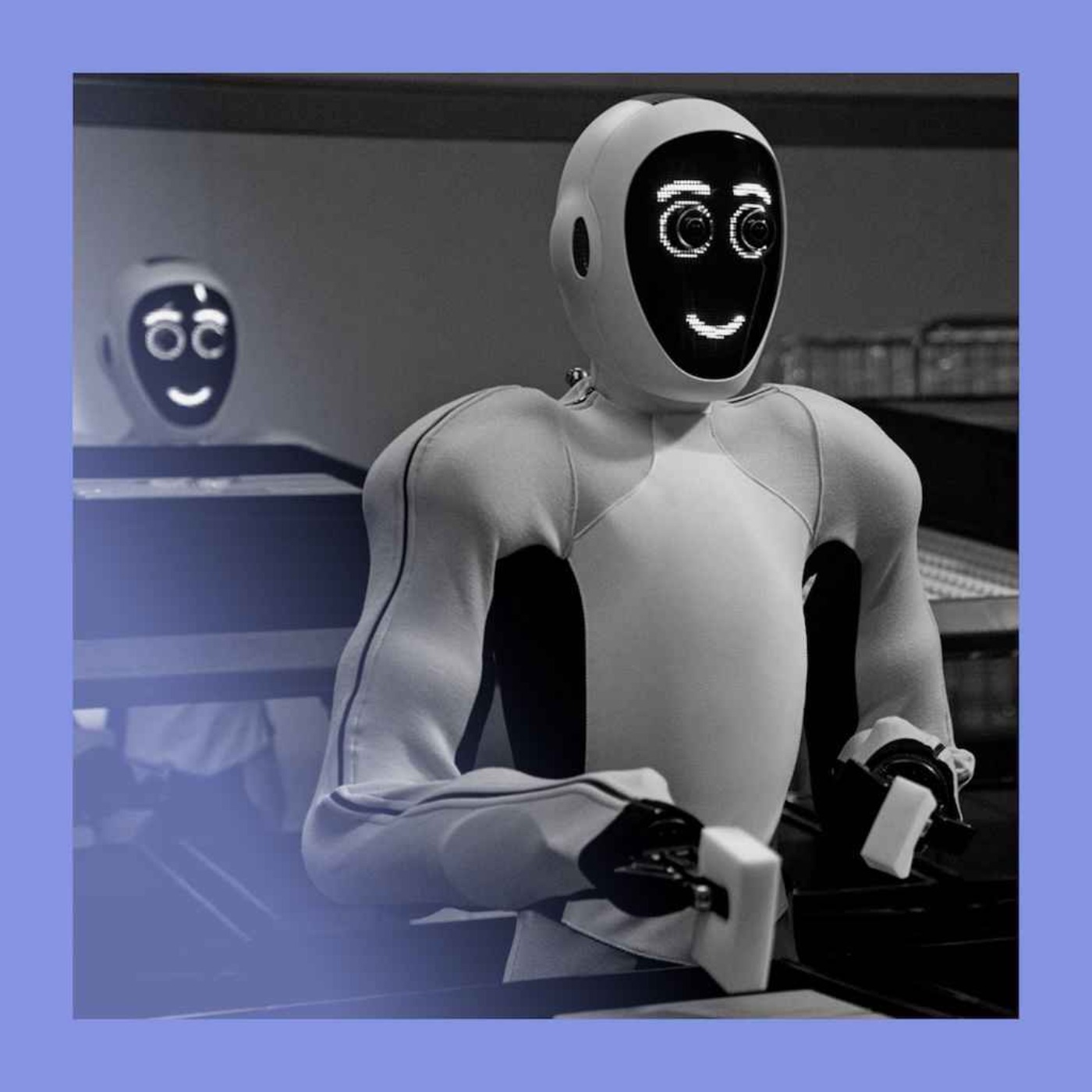
ONE X designs its robots with human-like physical properties, down to skin tissue stiffness. This allows them to effectively leverage the internet's vast repository of human video data (e.g., YouTube) as a training set, bootstrapping intelligence without needing to create an entirely new internet-sized dataset.