Get your free personalized podcast brief
We scan new podcasts and send you the top 5 insights daily.
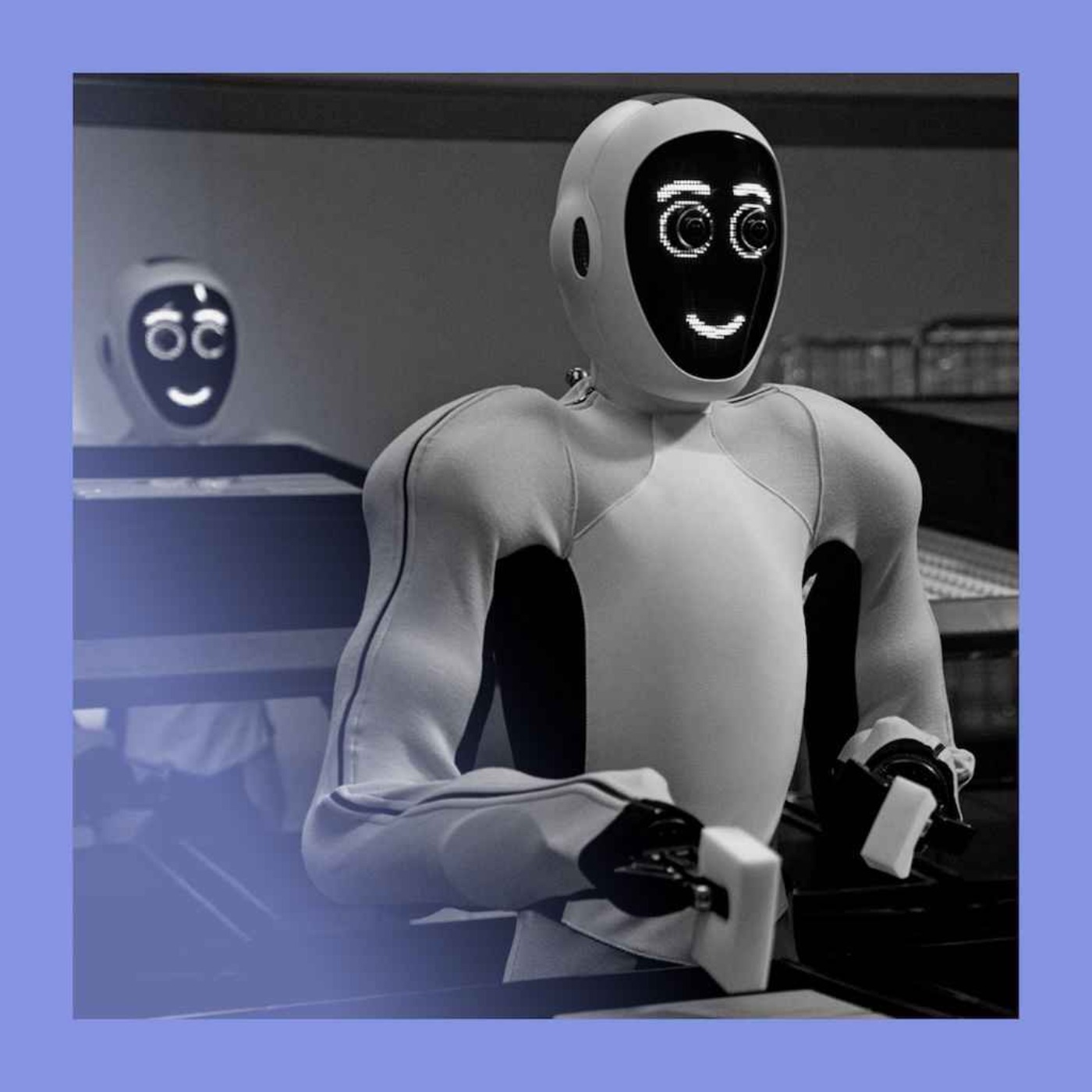
Unlike cars, which gather data passively, humanoid robots need active training. To solve this, Musk's strategy is to build a physical 'academy' of 10,000-30,000 Optimus robots performing self-play on various tasks, using this real-world data to close the 'sim-to-real' gap from millions of simulated robots.

Related Insights
The primary challenge in robotics AI is the lack of real-world training data. To solve this, models are bootstrapped using a combination of learning from human lifestyle videos and extensive simulation environments. This creates a foundational model capable of initial deployment, which then generates a real-world data flywheel.

The rapid progress of many LLMs was possible because they could leverage the same massive public dataset: the internet. In robotics, no such public corpus of robot interaction data exists. This “data void” means progress is tied to a company's ability to generate its own proprietary data.

The decision to end production of iconic Tesla models is a strategic move to retool manufacturing capacity for Optimus humanoid robots. This action supports Musk's larger vision of a "real-world AI flywheel" integrating data and hardware from Tesla, SpaceX, and xAI.

Progress in robotics for household tasks is limited by a scarcity of real-world training data, not mechanical engineering. Companies are now deploying capital-intensive "in-field" teams to collect multi-modal data from inside homes, capturing the complexity of mundane human activities to train more capable robots.

The future of valuable AI lies not in models trained on the abundant public internet, but in those built on scarce, proprietary data. For fields like robotics and biology, this data doesn't exist to be scraped; it must be actively created, making the data generation process itself the key competitive moat.

The push toward physical AI and spatial intelligence is primarily a strategy to overcome data scarcity for training general models. By creating simulated 3D environments, researchers can generate the novel, complex data that is currently unavailable but crucial for advancing AI into the real world.

Ken Goldberg quantifies the challenge: the text data used to train LLMs would take a human 100,000 years to read. Equivalent data for robot manipulation (vision-to-control signals) doesn't exist online and must be generated from scratch, explaining the slower progress in physical AI.

As reinforcement learning (RL) techniques mature, the core challenge shifts from the algorithm to the problem definition. The competitive moat for AI companies will be their ability to create high-fidelity environments and benchmarks that accurately represent complex, real-world tasks, effectively teaching the AI what matters.

Firms are deploying consumer robots not for immediate profit but as a data acquisition strategy. By selling hardware below cost, they collect vast amounts of real-world video and interaction data, which is the true asset used to train more advanced and capable AI models for future applications.
The "bitter lesson" (scale and simple models win) works for language because training data (text) aligns with the output (text). Robotics faces a critical misalignment: it's trained on passive web videos but needs to output physical actions in a 3D world. This data gap is a fundamental hurdle that pure scaling cannot solve.