Get your free personalized podcast brief
We scan new podcasts and send you the top 5 insights daily.
Urban infrastructure provides a fixed amount of physical space (streets). With demand for that space exceeding supply, the only variable engineers can truly control is time. Their entire job revolves around allocating slivers of time (green lights) to competing users, framing the problem as a temporal, not spatial, challenge.
Related Insights
The massive pressure of the 1984 Olympics forced Los Angeles to develop the ATSAC system, a centralized traffic control network. Initially an experiment for the games, its success in reducing delays by 35% led to its permanent adoption and expansion, fundamentally changing the city's infrastructure and becoming a global model.
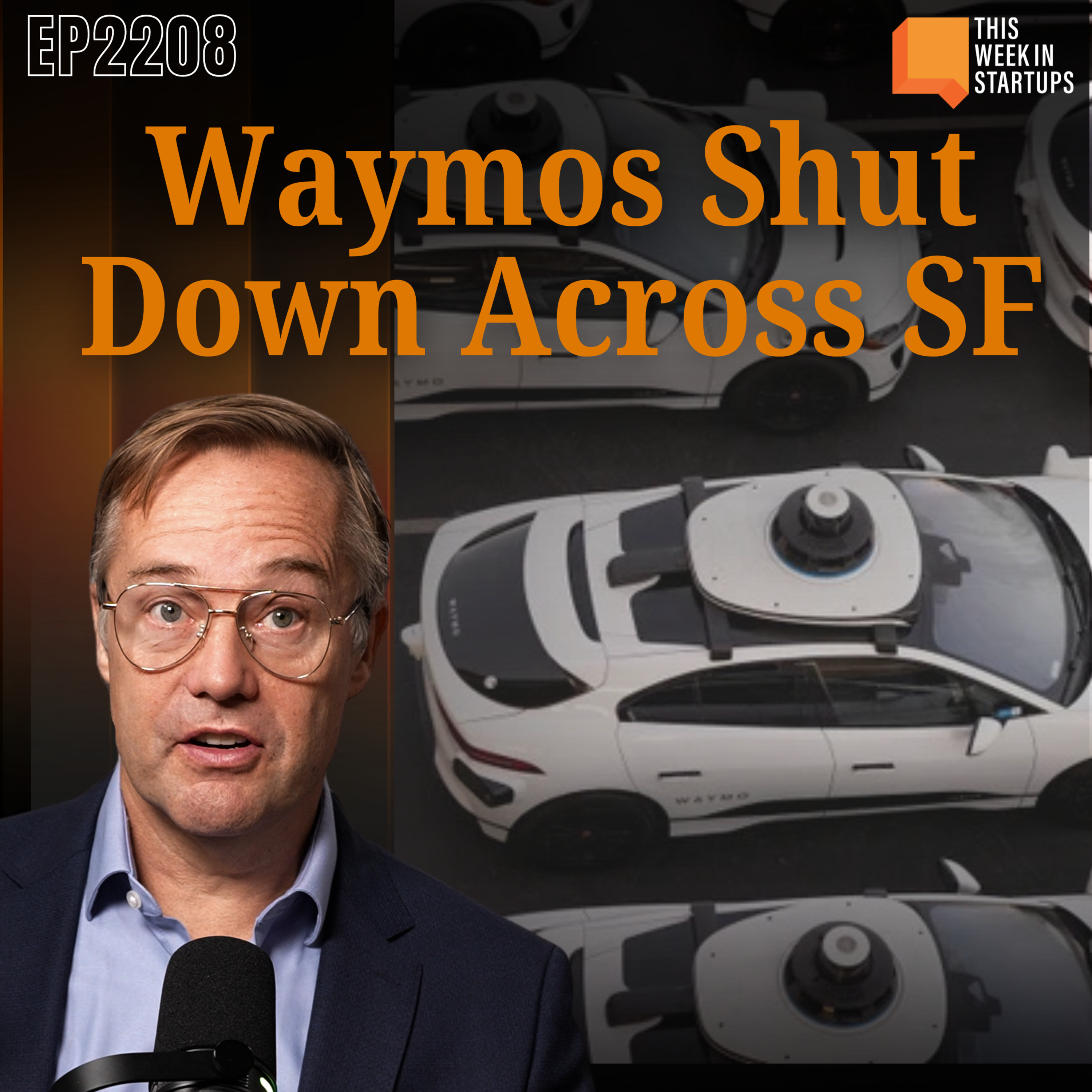
Waymo vehicles froze during a San Francisco power outage because traffic lights went dark, causing gridlock. This highlights the vulnerability of current AV systems to real-world infrastructure failures and the critical need for protocols to handle such "edge cases."
Unlike a solid speed bump, a 'speed cushion' is a traffic calming device with wheel-wide gaps. This simple design innovation effectively slows down standard cars while allowing wider-axle vehicles like ambulances and fire trucks to pass through without slowing down, prioritizing emergency response.

Today's routing algorithms use approximations for complex scenarios. Praveen Murugesan explains that quantum computing could provide precise, optimal solutions by processing immense variables like real-time traffic across thousands of stops and multiple vehicles, moving beyond predictive models.

LA's sophisticated ATSAC system, with its real-time data and algorithms, cannot solve the traffic problems at the geometrically bizarre "Fairfax asterisk" intersection. This demonstrates that advanced technology is limited by underlying physical infrastructure; it can optimize but cannot fix fundamentally poor design, becoming "lipstick on a pig."
The goal of a traffic system isn't to create a pain-free experience for everyone, which is impossible. Instead, it's a utilitarian calculation to manage and distribute delay and frustration across the network, prioritizing the "greatest good for the greatest number" and ensuring everyone shares the burden.
Achieving near-perfect AV reliability (99.999%) is exponentially harder than getting to 99%. This final push involves solving countless subtle, city-specific issues, from differing traffic light colors and curb heights to unique local sounds like emergency sirens, which vehicles must recognize.
Sebastian Thrun points out a startling fact: even a highway at a standstill is 92% empty space due to inefficient car spacing and lane design. This illustrates the immense, untapped capacity in our infrastructure that could be unlocked by the precision of coordinated, self-driving vehicles.
While driven by data and algorithms, effective traffic engineering is fundamentally about understanding and shaping human behavior. Small physical changes, like moving a painted line by six inches, can alter driving speeds and actions more than a complex equation, making it as much an art as a science.
LA's ATSAC system runs primarily on automated algorithms that adjust to traffic flow. However, its resilience comes from human engineers who can manually intervene during "extraordinary circumstances" like sinkholes or protests. This human-in-the-loop design is critical for handling unpredictable events that algorithms cannot foresee.