Get your free personalized podcast brief
We scan new podcasts and send you the top 5 insights daily.
To visualize the imperceptible vibrations on his ultrasonic knife, Scott Heimendinger substituted a $10,000/week Laser Doppler Vibrometer with $3 worth of fine-grained popcorn salt. The salt forms visible patterns (Chladni figures) at the vibration nodes, providing an effective low-cost measurement.

Related Insights
An ultrasonic knife feels "slippery" and releases food easily because its microscopic surface oscillations cause food to experience the lower coefficient of kinetic friction, not static friction. This non-stick effect is a key benefit beyond simply reducing cutting force.
For field trials, Rainbird creates 'production intent' parts using 'soft tooling'—cheaper, lower-volume molds made from softer steel. Unlike 3D prints, these parts have the same manufacturing limitations as the final product, providing far more realistic feedback on form, fit, and durability before investing in expensive production molds.

Frustrated by subjective chef's knife reviews, Scott Heimendinger built a robotic test rig with force sensors to gather objective performance data. He then open-sourced the data, creating a new benchmark and powerful marketing asset for his own product.
Scott Heimendinger discovered that while equations exist for ultrasonic resonance in simple shapes like cylinders, they are useless for a complex shape like a chef's knife. This forced him to abandon pure modeling and rely entirely on extensive physical prototyping and testing.
Instead of starting with a blank slate, Nike's team prototypes new ideas by physically cutting and modifying existing products. This "cobbling" method enables rapid, low-cost testing of core concepts before investing in new designs and expensive molds, allowing them to fail fast and forward.

Instead of buying expensive, custom-built lab equipment, Shelter Skin creatively repurposed machinery from the food and beverage industry, like bakery mixers and milk pasteurizers. This resourceful approach enabled them to scale production on a bootstrapped budget, proving ingenuity can replace capital.

Frustrated by the $1,200 cost of sous vide machines, Scott Heimendinger created a $75 DIY version. Sharing the instructions online went viral, proving a massive market demand and leading directly to him co-founding his first startup, Sansaire.
To safely stop a free-falling high-speed camera for a zero-G photography rig, Scott Heimendinger rejected a proposed $15,000 servo system. Instead, he used basic physics calculations and $20 worth of memory foam, which worked perfectly.
Anduril's R&D building houses machine shops, labs, and a 'dev test area' designed specifically to break products. By putting engineers across the parking lot from facilities that can rapidly prototype and test for failures (e.g., saltwater corrosion, vibration), they create an extremely tight feedback loop, speeding up iteration.
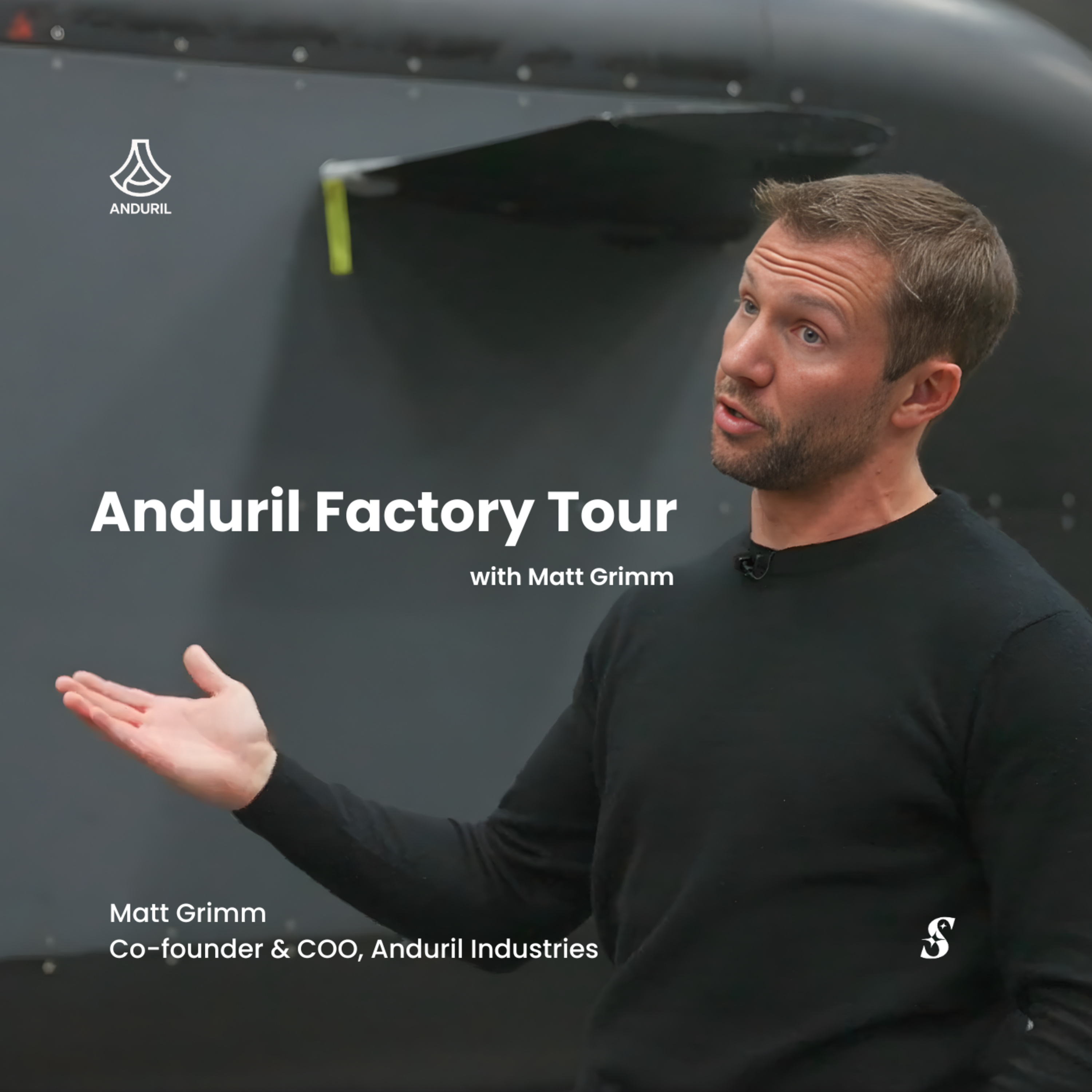
Anduril prototypes drone frames by milling them from solid metal blocks. While extremely wasteful and expensive for mass production, this method bypasses the slow and costly process of creating molds for casting, drastically reducing latency during the critical iterative design phase and getting products to market faster.