Get your free personalized podcast brief
We scan new podcasts and send you the top 5 insights daily.
Early voice models required hardcoding parameters like accent or emotion. Modern models, like those from ElevenLabs, learn these nuances contextually from data, allowing complex traits like a specific accent to emerge naturally without being explicitly programmed.
Related Insights
A one-size-fits-all AI voice fails. For a Japanese healthcare client, ElevenLabs' agent used quick, short responses for younger callers but a calmer, slower style for older callers. This personalization of delivery, not just content, based on demographic context was critical for success.
Current transcription models use a global approach, often struggling with individual accents. ElevenLabs states that models fine-tuned on a specific person's voice (e.g., from an hour of audio) are not a distant research challenge but a solvable problem and an imminent product release, promising superhuman accuracy.
To create a convincing voice agent, don't use a single LLM. Instead, deploy multiple LLMs that an agent can call upon. Each represents a different state or role of the persona, such as a 'sales hat' versus a 'customer service hat,' ensuring contextually appropriate responses and tone.

While direct speech-to-speech models are faster (lower latency), they are less reliable and "dumber." ElevenLabs bets on a "cascaded" approach that uses text as an intermediate layer, providing greater accuracy, visibility, and control—features that are critical for most enterprise applications.
Unlike LLMs, where performance often scales with size, specific voice AI applications appear to have an optimal parameter count. For tasks like audiobook narration, ElevenLabs believes it has found the size sweet spot, where making models larger yields diminishing returns on quality, suggesting different scaling laws for specialized AI.
Standard methods can produce 'blurry' audio by averaging possible speech inflections. Flow matching models the full distribution of how a word can be spoken, allowing it to pick a specific, sharp inflection from that distribution, leading to more natural-sounding speech.
An AI company is revolutionizing movie dubbing by analyzing the emotion in an actor's voice (e.g., angry, happy) and replicating that tone in the target language. This creates a more authentic viewing experience than traditional dubbing, which often sounds wooden and disconnected.

A common objection to voice AI is its robotic nature. However, current tools can clone voices, replicate human intonation, cadence, and even use slang. The speaker claims that 97% of people outside the AI industry cannot tell the difference, making it a viable front-line tool for customer interaction.

ElevenLabs found that traditional data labelers could transcribe *what* was said but failed to capture *how* it was said (emotion, accent, delivery). The company had to build its own internal team to create this qualitative data layer. This shows that for nuanced AI, especially with unstructured data, proprietary labeling capabilities are a critical, often overlooked, necessity.

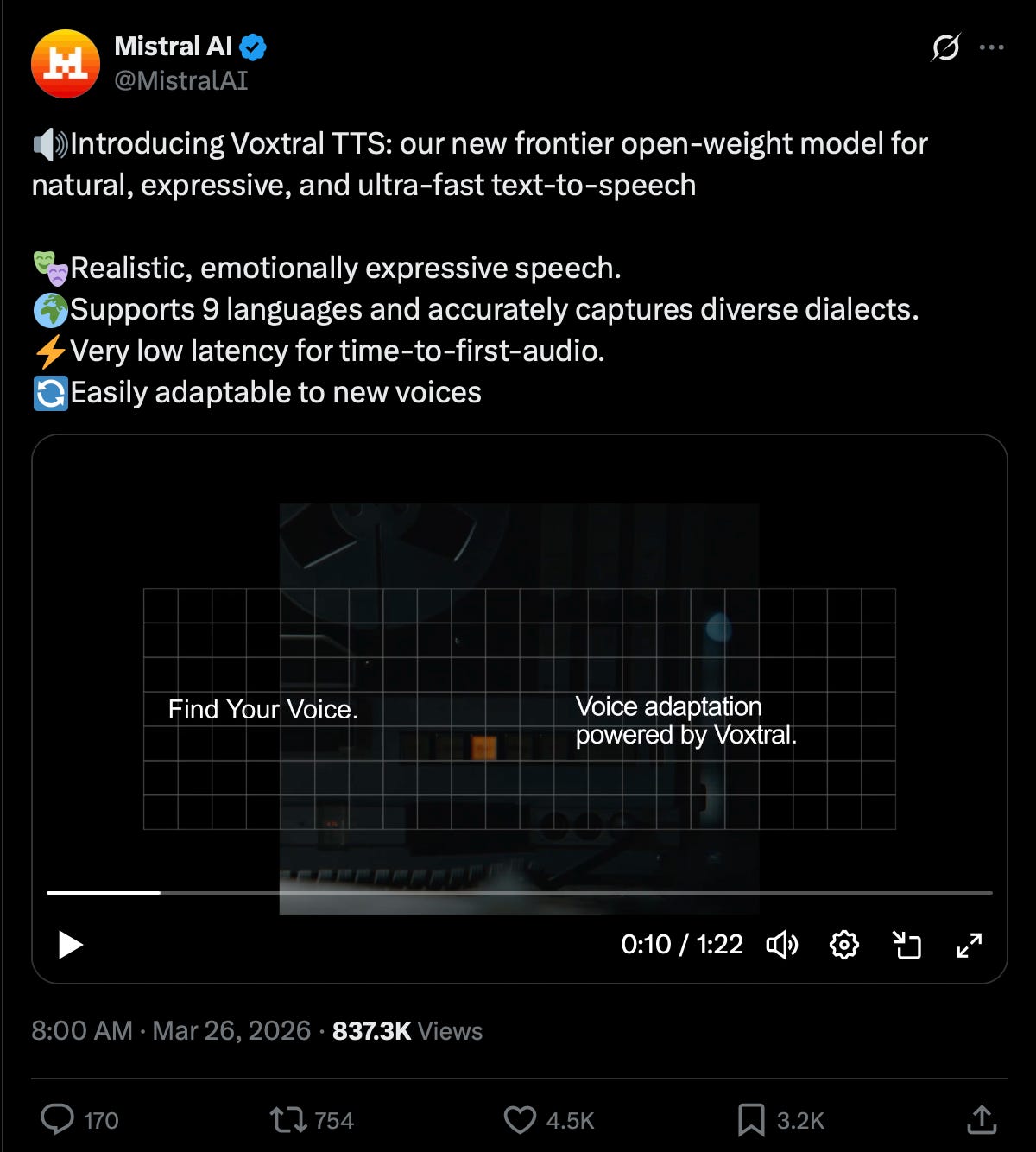
Mistral developed a new TTS architecture combining autoregressive flow matching with a custom neural audio codec. This approach aims to model speech inflections more efficiently than depth transformers or full diffusion models, targeting real-time voice agent use cases.