Get your free personalized podcast brief
We scan new podcasts and send you the top 5 insights daily.
While direct speech-to-speech models are faster (lower latency), they are less reliable and "dumber." ElevenLabs bets on a "cascaded" approach that uses text as an intermediate layer, providing greater accuracy, visibility, and control—features that are critical for most enterprise applications.
Related Insights
The product requirements for voice AI differ significantly by use case. Consumer-facing assistants (B2C) like Siri must prioritize low latency and human-like empathy. In contrast, enterprise applications (B2B) like automated patient intake prioritize reliability and task completion over emotional realism, a key distinction for developers.

Voice-to-voice AI models promise more natural, low-latency conversations by processing audio directly. However, they are currently impractical for many high-stakes enterprise applications due to a hallucination rate that can be eight times higher than text-based systems.
![Jesse Zhang - Building Decagon - [Invest Like the Best, EP.443] thumbnail](https://megaphone.imgix.net/podcasts/2cc4da2a-a266-11f0-ac41-9f5060c6f4ef/image/7df6dc347b875d4b90ae98f397bf1cb1.jpg?ixlib=rails-4.3.1&max-w=3000&max-h=3000&fit=crop&auto=format,compress)
To create a convincing voice agent, don't use a single LLM. Instead, deploy multiple LLMs that an agent can call upon. Each represents a different state or role of the persona, such as a 'sales hat' versus a 'customer service hat,' ensuring contextually appropriate responses and tone.

Success for dictation tools is measured not by raw accuracy, but by the percentage of messages that are perfect and require no manual correction. While incumbents like Apple have a ~10% 'zero edit rate,' Whisperflow's 85% rate is what drives adoption by eliminating the friction of post-dictation fixes.

Unlike LLMs, where performance often scales with size, specific voice AI applications appear to have an optimal parameter count. For tasks like audiobook narration, ElevenLabs believes it has found the size sweet spot, where making models larger yields diminishing returns on quality, suggesting different scaling laws for specialized AI.
By converting audio into discrete tokens, the system allows a large language model (LLM) to generate speech just as it generates text. This simplifies architecture by leveraging existing model capabilities, avoiding the need for entirely separate speech synthesis systems.

ElevenLabs' defense against giants isn't just a better text-to-speech model. Their strategy focuses on building deep, workflow-specific platforms for agents and creatives. This includes features like CRM integrations and collaboration tools, creating a sticky application layer that a foundational model alone cannot replicate.

Early voice models required hardcoding parameters like accent or emotion. Modern models, like those from ElevenLabs, learn these nuances contextually from data, allowing complex traits like a specific accent to emerge naturally without being explicitly programmed.
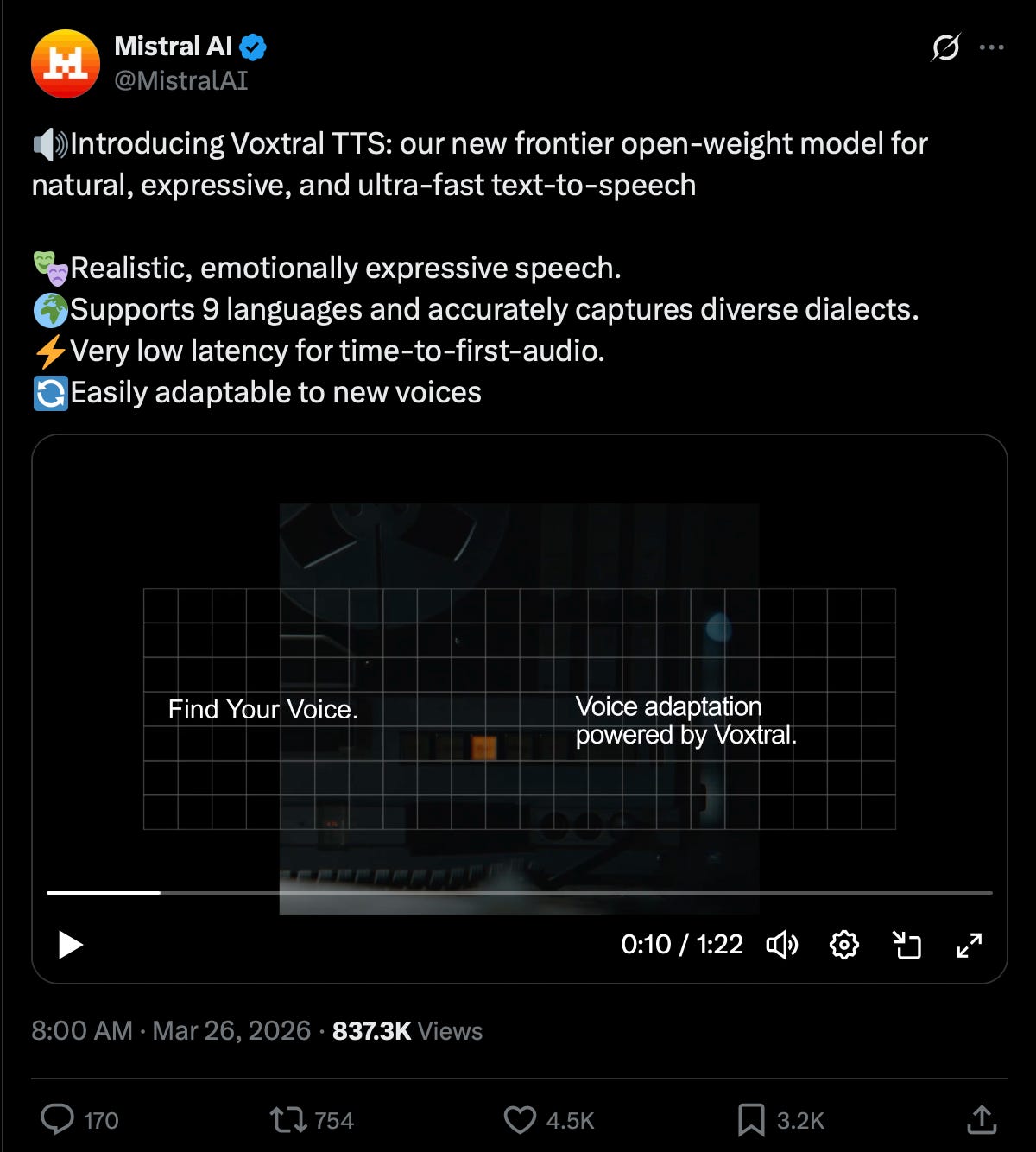
Mistral developed a new TTS architecture combining autoregressive flow matching with a custom neural audio codec. This approach aims to model speech inflections more efficiently than depth transformers or full diffusion models, targeting real-time voice agent use cases.
Despite the focus on text interfaces, voice is the most effective entry point for AI into the enterprise. Because every company already has voice-based workflows (phone calls), AI voice agents can be inserted seamlessly to automate tasks. This use case is scaling faster than passive "scribe" tools.
