Get your free personalized podcast brief
We scan new podcasts and send you the top 5 insights daily.
Early trial data for single-agent bispecific antibodies in elderly or frail patients with large cell lymphoma reveals surprisingly high efficacy. This success is prompting discussions about a chemotherapy-free future for this population, with combinations like glofitumab-polatuzumab potentially replacing traditional regimens.

Related Insights
The 5-year follow-up of the Polarix trial revealed an unexpected overall survival benefit for patients with the activated B-cell (ABC) subtype of diffuse large B-cell lymphoma. This post-hoc finding suggests the drug's efficacy is not uniform and is most pronounced in this historically harder-to-treat patient group, challenging initial interpretations of the data.
Combining polatuzumab vedotin with bispecific antibodies appears particularly effective for patients with double-hit lymphoma. This is significant because these high-risk patients, who have poor prognoses, were notably excluded from pivotal trials like STAR GLOW, suggesting a potential new standard for this specific subgroup.
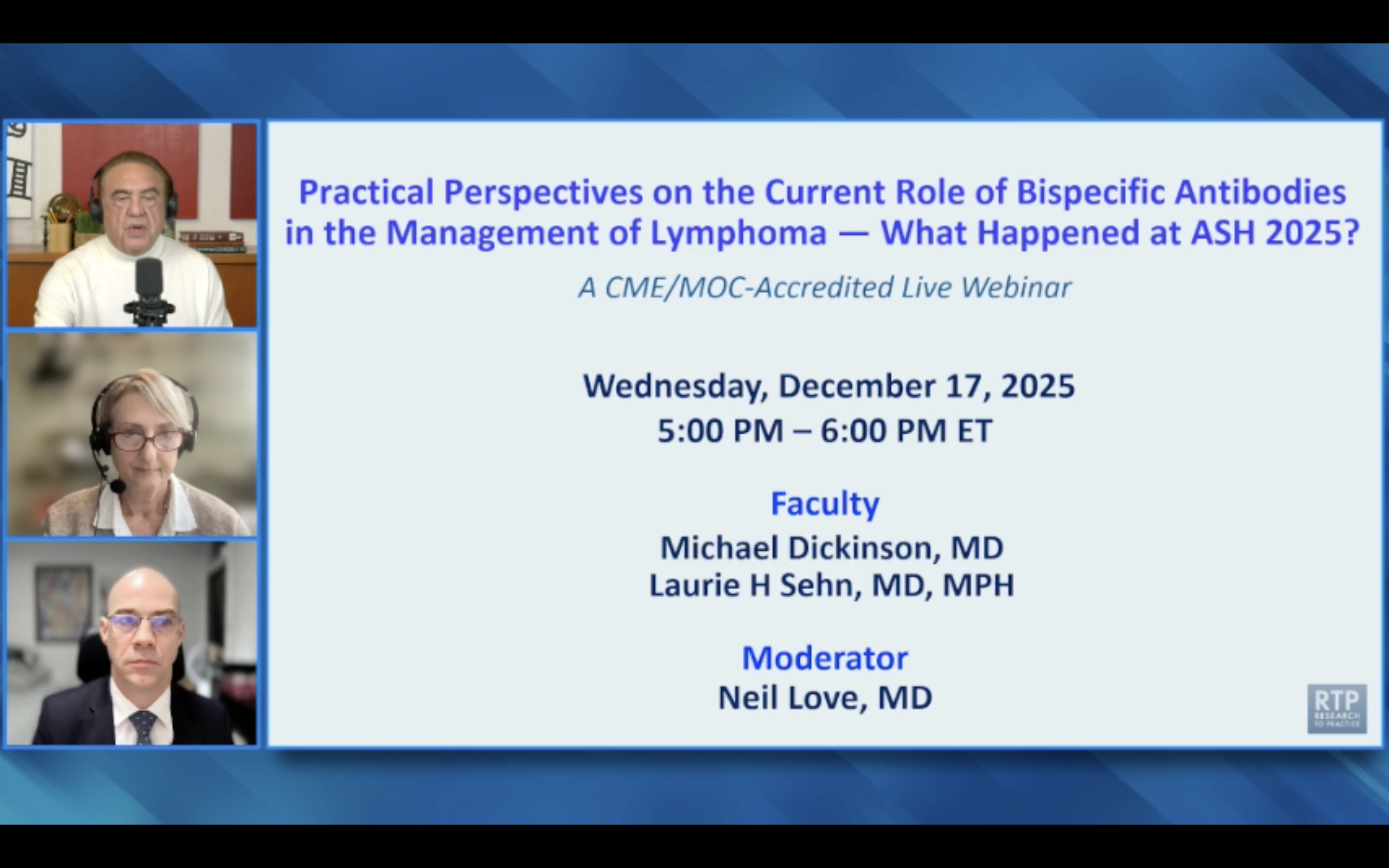
Provocative data from a German study showed an 81% complete response rate in untreated, elderly DLBCL patients using a chemotherapy-free regimen of polatuzumab (an ADC), glofitamab (a bispecific), and rituximab. This challenges the decades-long R-CHOP chemotherapy backbone and points to a future of targeted frontline therapies.

Experts view R-mini-CHOP, the standard for older/unfit DLBCL patients, as a poor benchmark that urgently needs to be replaced. Promising chemo-free or chemo-light regimens, like the R-Polo-Glofitamab combination, are seen as the future, aiming to improve outcomes in this vulnerable population without harsh toxicities.

The regimen's profound success in relapsed/refractory patients is not an endpoint, but a launchpad. It provides the rationale for the ongoing Epcor FL2 trial, which directly challenges standard chemoimmunotherapy and could establish a chemotherapy-free, bispecific-based combination as the new first-line standard of care.
An expert treating DLBCL states they no longer use bispecific antibodies as monotherapy. Combining them with partners like chemotherapy (GemOx) or ADCs (Polatuzumab) raises the complete response rate by 15-20%, offering a better chance of benefit for patients.

In relapsed/refractory mantle cell lymphoma, the bispecific antibody glofitimab is achieving complete remission rates above 75%. This is unprecedented and notably better than existing CAR-T therapy data, suggesting an accessible, off-the-shelf immunotherapy can outperform more complex cellular therapies in this setting.

Emerging data reveals significant synergy when combining antibody-drug conjugates (ADCs) like polatuzumab vedotin with bispecific antibodies like glofitumab. These combinations show impressive results in relapsed/refractory non-Hodgkin lymphoma, signaling a major future direction for developing more potent therapies.
In clinical practice for relapsed large cell lymphoma, glofitumab is a preferred bispecific antibody. Clinicians favor it over epcoritamab because it is time-limited (vs. indefinite treatment) and has a more patient-friendly every-three-week schedule, while also being more active than mosunetuzumab.
Long-term follow-up from the pivotal epcoritamab trial reveals that 46% of DLBCL patients who achieve a complete remission maintain it at four years. This durability provides strong evidence that bispecific monotherapy, not just CAR-T, can be a curative treatment for a subset of patients.