Get your free personalized podcast brief
We scan new podcasts and send you the top 5 insights daily.
Microsoft is allowing Anthropic's competing AI agent, Claude, to integrate directly into Microsoft Teams. The strategy is to own user behavior by making Teams the central platform where all AI agents are accessed, thus entrenching the product even if it means promoting a rival to its own Copilot.

Related Insights
Microsoft is not solely reliant on its OpenAI partnership. It actively integrates competitor models, such as Anthropic's, into its Copilot products to handle specific workloads where they perform better, like complex Excel tasks. This pragmatic "best tool for the job" approach diversifies its AI capabilities.

By allowing superior competing models like Anthropic's Claude on its platform, Microsoft signals it won't be training the most cutting-edge models itself. This may deter top AI researchers who want to work on frontier models, making it harder for Microsoft to compete for talent against labs like Anthropic.
Microsoft is making Anthropic's Claude and Co-Work available through its Co-pilot service. This suggests an acknowledgment that their own models aren't always superior and that the future of enterprise AI lies in providing a suite of best-in-class models, not a single-provider ecosystem.

To compete with agent tools like OpenClaw, Microsoft CEO Satya Nadella reorganized by combining consumer and enterprise Copilot teams. This unified effort, with executives reporting directly to Nadella, signals a top-level priority to develop more autonomous, 'always-on' AI agents and centralize the company's response.
Salesforce is actively promoting Anthropic's "Claude Tag" AI agent within Slack, despite potential cannibalization of its own "Slack bot." This reveals a platform-first strategy: making Slack the indispensable "App Store" for any AI agent is more valuable than ensuring the dominance of its own proprietary tool.
The race in enterprise AI isn't just about agent capabilities, but about owning the central dashboard where employees direct agents across all applications (Salesforce, Jira, etc.). Companies like OpenAI and Microsoft are vying to become this primary interface, controlling the customer relationship and relegating other apps to the background.
Faced with growing competition in AI coding assistants, Microsoft's GitHub is positioning itself as the central hub. By becoming the 'Agent HQ' where developers can manage and deploy multiple competing agents, GitHub ensures its platform's growth regardless of which agent wins.
Anthropic's goal for Claude is to be a "virtual coworker," not just a personalized chatbot. This means deep integration into team workflows like Slack and meetings, allowing it to act as a true team member. This framing explains why superficial personalization features have failed to create user lock-in; the real value lies in contextual, collaborative integration.

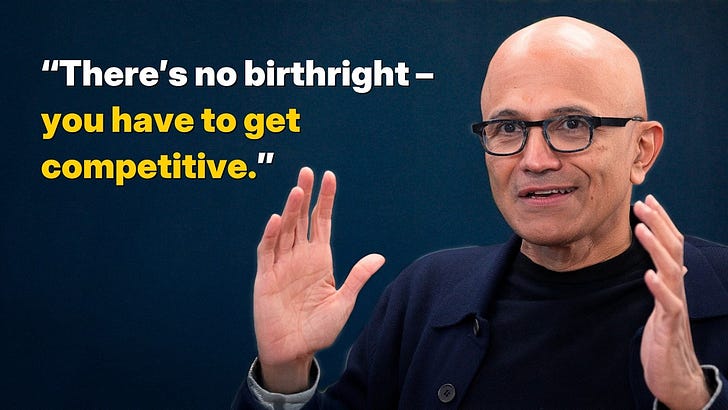
Microsoft CEO Satya Nadella is personally experimenting with Anthropic's AI tools, including the open-source project "Maltbot." He is actively sharing his findings with deputies, using the rival's cross-application agent capabilities as a direct challenge and source of inspiration for improving Microsoft's own 365 Copilot product.
Microsoft, despite its deep ties to OpenAI, was alarmed by the capabilities of Anthropic's new productivity platform. This reaction signifies a competitive shift where Anthropic is now seen as a primary threat, forcing Microsoft to rapidly prototype similar features to maintain its edge in AI productivity tools.