Get your free personalized podcast brief
We scan new podcasts and send you the top 5 insights daily.
Anthropic's goal for Claude is to be a "virtual coworker," not just a personalized chatbot. This means deep integration into team workflows like Slack and meetings, allowing it to act as a true team member. This framing explains why superficial personalization features have failed to create user lock-in; the real value lies in contextual, collaborative integration.

Related Insights
Instead of merely 'sprinkling' AI into existing systems for marginal gains, the transformative approach is to build an AI co-pilot that anticipates and automates a user's entire workflow. This turns the individual, not the software, into the platform, fundamentally changing their operational capacity.
The paradigm is shifting from using AI as a general chatbot to building a team of 'digital employees.' Claude Skills allow users to encapsulate a specific, repeatable workflow—like drafting a newsletter from tweets—into a tool that can be executed on demand, creating a specialized agent for that job.

The vision for Codex extends beyond a simple coding assistant. It's conceptualized as a "software engineering teammate" that participates in the entire lifecycle—from ideation and planning to validation and maintenance. This framing elevates the product from a utility to a collaborative partner.

Remote and global teams suffer from a loss of context. An "AI Buddy" can solve this by delivering personalized, timely information about what relevant colleagues are doing. This automated, customized "newsletter" keeps everyone in the loop without them having to read everything, increasing social awareness.
AI is best understood not as a single tool, but as a flexible underlying interface. It can manifest as a chat box for some, but its real potential is in creating tailored workflows that feel native to different roles, like designers or developers, without forcing everyone into a single interaction model.

The most effective application of AI isn't a visible chatbot feature. It's an invisible layer that intelligently removes friction from existing user workflows. Instead of creating new work for users (like prompt engineering), AI should simplify experiences, like automatically surfacing a 'pay bill' link without the user ever consciously 'using AI.'

The transition from AI as a productivity tool (co-pilot) to an autonomous agent integrated into team workflows represents a quantum leap in value creation. This shift from efficiency enhancement to completing material tasks independently is where massive revenue opportunities lie.

Instead of generating static text, Claude 4.5 can build interactive, shareable web apps like customer persona guides or campaign dashboards. This transforms the AI's role from a personal assistant into a central tool for team alignment and decision-making, as these "artifacts" can be easily distributed to stakeholders.

The paradigm shift with AI agents is from "tools to click buttons in" (like CRMs) to autonomous systems that work for you in the background. This is a new form of productivity, akin to delegating tasks to a team member rather than just using a better tool yourself.
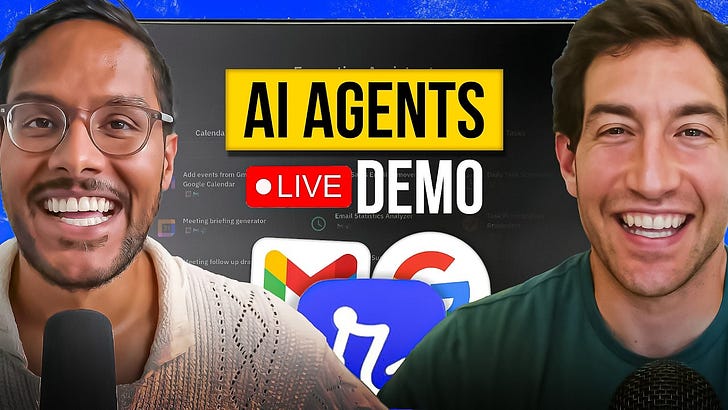
Anthropic's upcoming 'Agent Mode' for Claude moves beyond simple text prompts to a structured interface for delegating and monitoring tasks like research, analysis, and coding. This productizes common workflows, representing a major evolution from conversational AI to autonomous, goal-oriented agents, simplifying complex user needs.