Get your free personalized podcast brief
We scan new podcasts and send you the top 5 insights daily.
Faced with growing competition in AI coding assistants, Microsoft's GitHub is positioning itself as the central hub. By becoming the 'Agent HQ' where developers can manage and deploy multiple competing agents, GitHub ensures its platform's growth regardless of which agent wins.
Related Insights
OpenAI embraces the 'platform paradox' by selling API access to startups that compete directly with its own apps like ChatGPT. The strategy is to foster a broad ecosystem, believing that enabling competitors is necessary to avoid losing the platform race entirely.

Advanced agentic AI coding tools have strong product-market fit with prosumers, but this is a high-churn, price-sensitive market. In the enterprise, the most established PMF is still with simpler autocomplete features like GitHub Copilot, not the more sophisticated—and less proven—agentic solutions.

Instead of building a walled-garden AI, the Zed IDE created the Agent Client Protocol (ACP), allowing any coding agent to integrate. This 'Switzerland' strategy, modeled after the Language Server Protocol, lets Zed benefit from all AI innovation rather than competing against it, even attracting competitors like JetBrains to adopt the standard.

Instead of using siloed note-taking apps, structure all your knowledge—code, writing, proposals, notes—into a single GitHub monorepo. This creates a unified, context-rich environment that any AI coding assistant can access. This approach avoids vendor lock-in and provides the AI with a comprehensive "second brain" to work from.

To serve both solo developers and large enterprises, GitHub focuses on creating horizontal "primitives" and APIs first. This foundational layer allows different user types to build their own specific workflows on top, avoiding the trap of creating a one-size-fits-none user experience.

The evolution from AI autocomplete to chat is reaching its next phase: parallel agents. Replit's CEO Amjad Masad argues the next major productivity gain will come not from a single, better agent, but from environments where a developer manages tens of agents working simultaneously on different features.
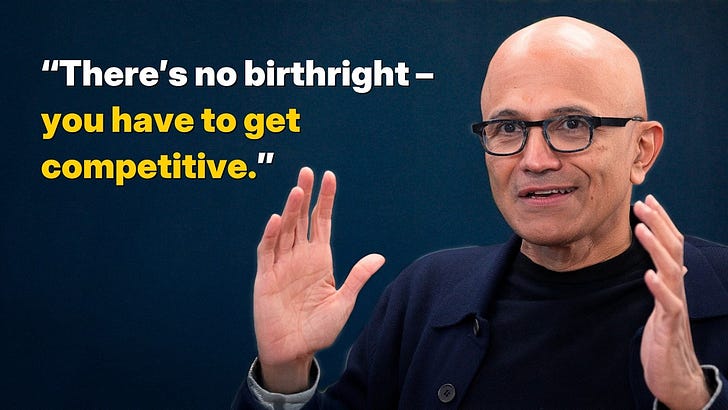
Satya Nadella states that Microsoft's core philosophy for platforms like Azure and GitHub is that they are only successful if the ecosystem partners building on top of them capture more economic value than Microsoft does. This partner-first approach is central to their strategy.

Instead of relying on a single, all-purpose coding agent, the most effective workflow involves using different agents for their specific strengths. For example, using the 'Friday' agent for UI tasks, 'Charlie' for code reviews, and 'Claude Code' for research and backend logic.

According to GitHub's COO, the initial concept for Copilot was a tool to help developers with the tedious task of writing documentation. The team pivoted when they realized the same underlying transformer model was far more powerful for generating the code itself.
Historically, developer tools adapted to a company's codebase. The productivity gains from AI agents are so significant that the dynamic has flipped: for the first time, companies are proactively changing their code, logging, and tooling to be more 'agent-friendly,' rather than the other way around.
