Get your free personalized podcast brief
We scan new podcasts and send you the top 5 insights daily.
The next wave of AI agents is moving beyond individual use ('single-player mode') to exist within shared team spaces like Slack channels. Tools like Claude Tag embed agents with full team context, transforming them from personal tools into collaborative resources that better mirror how organizational work actually happens.

Related Insights
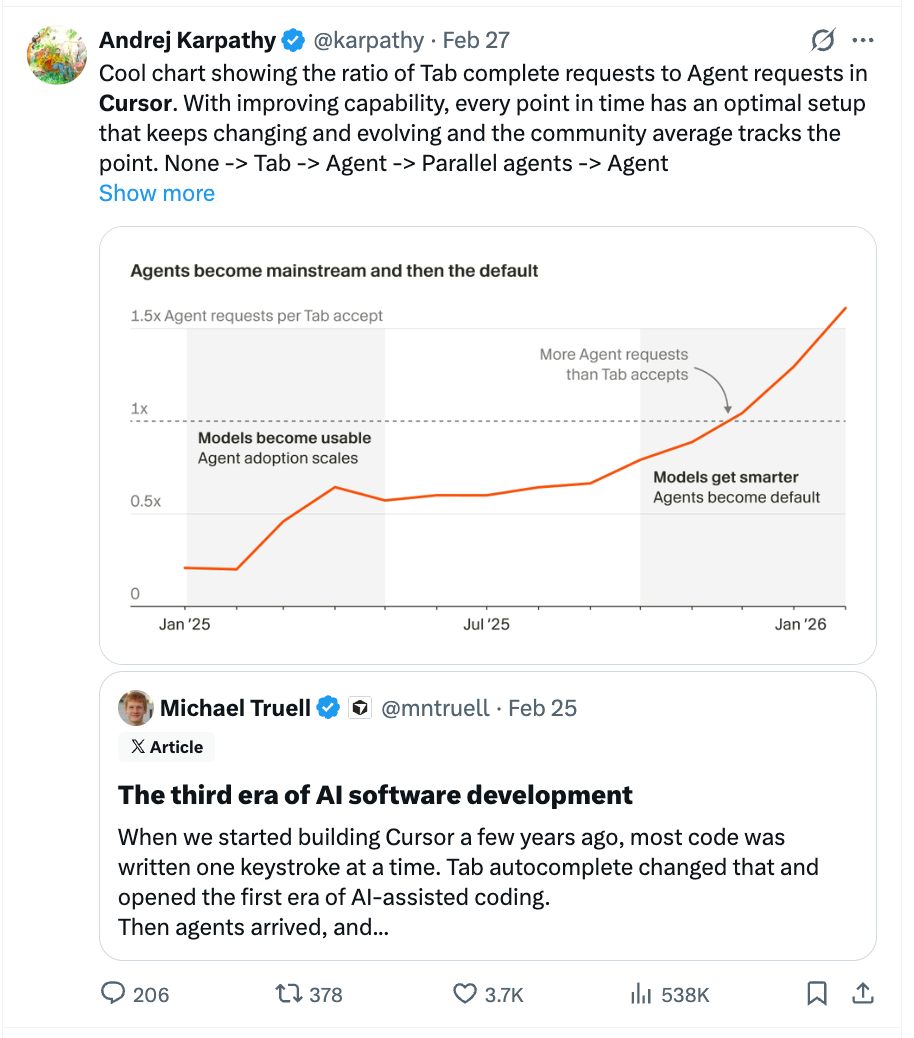
Anthropic's Claude Tag represents what Andre Karpathy calls the "third major redesign of LLM UI." It moves AI from a solo tool (website/app) to a persistent, asynchronous entity within collaborative spaces like Slack, where it acts as a full team member absorbing shared context.
Features like Anthropic's Claude Tag embed powerful AI capabilities directly into collaborative platforms like Slack. This moves AI from an individual tool to a group experience, giving non-technical team members access to advanced functions and providing the AI with persistent team context.
At Cursor, development is increasingly happening in Slack channels. Team members collectively kick off and redirect a cloud agent in a thread, turning development into a collaborative discussion. The IDE becomes a secondary tool, while communication platforms become the primary surface.
Most AI tools are single-player experiences. Linear is designing its agent sessions to be shared, collaborative spaces. Multiple people, like a PM and a designer, can jump into the same chat with an agent, see its work, and give it feedback together, collapsing the collaboration loop.

Using AI agents in shared Slack channels transforms coding from a solo activity into a collaborative one. Multiple team members can observe the agent's work, provide corrective feedback in the same thread, and collectively guide the task to completion, fostering shared knowledge.
Isolated AI workflows create team disconnects. Pablo Stanley argues for integrating agents into shared, Slack-like environments where they become first-class participants. This allows for transparent, collaborative work between humans and AI, rather than having individuals work with agents in private.
The next evolution for autonomous agents is the ability to form "agentic teams." This involves creating specialized agents for different tasks (e.g., research, content creation) that can hand off work to one another, moving beyond a single user-to-agent relationship towards a system of collaborating AIs.

The next frontier for AI isn't just personal assistants but "teammates" that understand an entire team's dynamics, projects, and shared data. This shifts the focus from single-user interactions to collaborative intelligence by building a knowledge graph connecting people and their work.

Treating AI as a personal assistant solves individual tasks but not team coordination. The solution is to deploy "AI Teammates"—integrated agents with specific roles, permissions, and the ability to work with multiple stakeholders within a shared workflow, autonomously moving projects forward.
Today's AI agents like Codex primarily operate as single-player tools on your desktop. The next wave involves multiplayer agents that live in collaborative spaces like Slack. These team-based agents can be accessed by anyone, share knowledge, and automate group workflows, creating new challenges in permissions and shared memory.
