Get your free personalized podcast brief
We scan new podcasts and send you the top 5 insights daily.
In the AI era, Microsoft could shift from being a high-margin software 'creator' to a lower-margin 'distributor' of AI models. Like Spotify, which has thin margins because music labels capture most revenue, Microsoft's platform may facilitate AI usage while model providers capture the majority of the economic value.

Related Insights
Nadella posits a future where the winner isn't the company with the best model. Instead, value accrues to the platform that provides the data, context, and tools (the 'scaffolding') that make any model useful, especially as capable open-source alternatives proliferate.
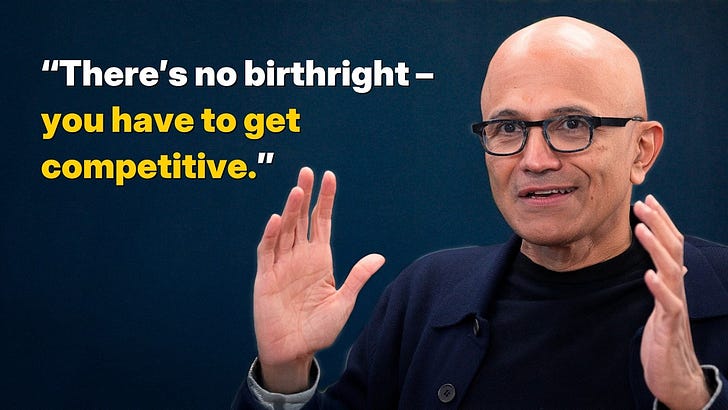
The market narrative has flipped. Instead of seeing Microsoft as a brilliant AI player via its OpenAI investment, investors now see a company lacking its own compelling, proprietary AI products. Its reliance on OpenAI is perceived as a low-margin vulnerability, not a strategic advantage.

While AI expands software's capabilities, vendors may not capture the value. Companies could use AI to build solutions in-house more cheaply. Furthermore, traditional "per-seat" pricing models are undermined when AI reduces the number of employees required, potentially shrinking revenue even as the software delivers more value.

The compute-heavy nature of AI makes traditional 80%+ SaaS gross margins impossible. Companies should embrace lower margins as proof of user adoption and value delivery. This strategy mirrors the successful on-premise to cloud transition, which ultimately drove massive growth for companies like Microsoft.

Unlike competing products like Google Docs, AI doesn't just offer an alternative tool. It fundamentally reduces the human labor needed for tasks like writing or analysis, undermining the value of Microsoft's per-seat subscription model, which assumes one license per human cognitive worker.
The partnership has shifted from Microsoft holding the power to OpenAI acting with autonomy. Similar to how Apple and Google eventually dominated the carriers who initially funded them, OpenAI now has the scale and valuation to make deals with Microsoft's competitors (like AWS), weakening Microsoft's exclusive advantage.
Microsoft's decision to promote Anthropic models on Azure as aggressively as OpenAI's reflects a core belief from CEO Satya Nadella. He anticipates AI models will become commoditized, making the underlying intelligence interchangeable and the cloud platform the primary point of differentiation and value capture.

AI is making core software functionality nearly free, creating an existential crisis for traditional SaaS companies. The old model of 90%+ gross margins is disappearing. The future will be dominated by a few large AI players with lower margins, alongside a strategic shift towards monetizing high-value services.

Microsoft faces a strategic dilemma with OpenAI. Losing model exclusivity hurts the Azure sales team's competitive edge against rivals like AWS. However, OpenAI's broader availability boosts Microsoft's equity stake, creating conflict between operational sales incentives and long-term investment returns.

If AI makes intelligence cheap and universally available, its economic value may collapse. This theory suggests that selling raw AI models could become a low-margin, utility-like business. Profitability will depend on building moats through specialized applications or regulatory capture, not on selling base intelligence.
