Get your free personalized podcast brief
We scan new podcasts and send you the top 5 insights daily.
AI companies moving to token-based pricing will face the same client scrutiny as law firms with billable hours. Customers, shocked by huge, unpredictable bills, will demand granular usage reports, creating a new market for cost optimization and transparency tools.

Related Insights
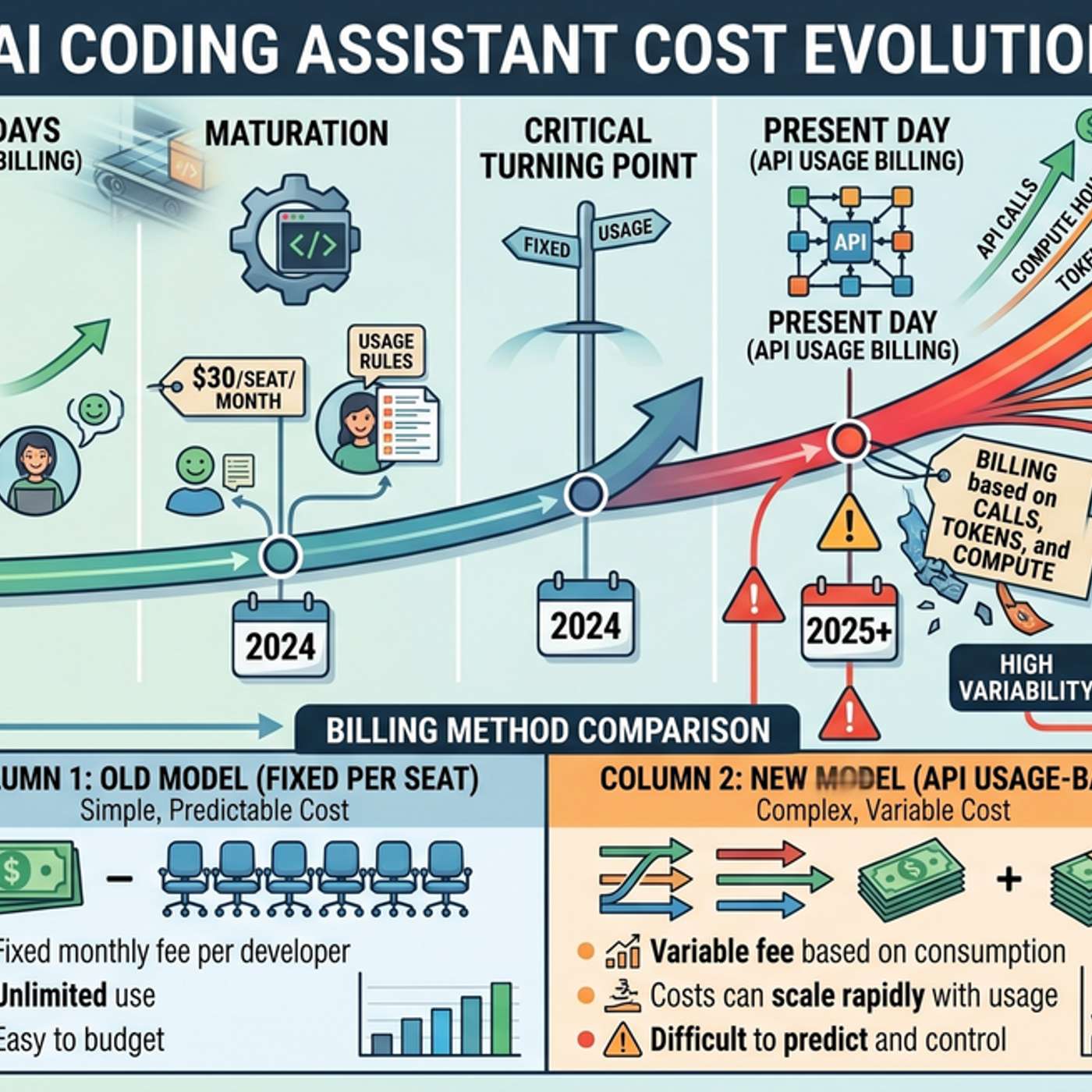
For years, flat-rate AI subscriptions heavily subsidized power users, masking the true cost of token consumption. As providers shift to usage-based billing, this subsidy is ending. Enterprises now face "sticker shock" and must justify AI spend with clear ROI, moving from rampant experimentation to cost-conscious implementation.
![The AI Token Shortage Begins [AI Monthly Recap] thumbnail](https://d3t3ozftmdmh3i.cloudfront.net/staging/podcast_uploaded_nologo/41472609/41472609-1752234663609-8665756a468e5.jpg)
Intense demand for AI tokens is outstripping compute supply, making flat-rate SaaS pricing unsustainable. Companies like GitHub are now shifting to usage-based billing to cover escalating inference costs, marking a fundamental change in how AI products are sold and signaling a broader industry trend.
As more companies integrate AI, their costs are tied to variable usage (e.g., tokens, inference). This is causing a profound, economy-wide transformation away from predictable seat-based subscriptions towards more dynamic usage-based models to align costs with revenue.

AI tools drastically reduce the time needed to complete complex tasks, breaking the traditional billable-hour model for consultants and agencies. The focus must shift to value-based pricing, where compensation is tied to the problem solved or the output created, not the hours worked.

As companies spend billions on tokens, they will demand justification, similar to how law firms use the billable hour. Vertical AI startups can win by demonstrating the specific ROI of every token used for a business task, answering the question: 'Where's my ROI?'

The move away from seat-based licenses to consumption models for AI tools creates a new operational burden. Companies must now build governance models and teams to track usage at an individual employee level—like 'Bob in accounting'—to control unpredictable costs.

Beyond upfront pricing, sophisticated enterprise customers now demand cost certainty for consumption-based AI. They require vendors to provide transparent cost structures and protections for when usage inevitably scales, asking, 'What does the world look like when the flywheel actually spins?'
To combat the unpredictable costs of token-based AI usage, Pega is adopting a value-based pricing model. Instead of charging per token, they charge based on work completed (e.g., per loan funded or service request processed), aligning costs directly with business outcomes and enabling forecasting.

Just as uncontrolled cloud spending in the 2010s spawned the FinOps field, the shift to consumption-based AI pricing will necessitate a similar discipline. This involves attributing costs to specific workloads, setting granular budgets, and providing real-time visibility to prevent budget overruns and measure ROI accurately.
AI tools drastically reduce time for tasks traditionally billed by the hour. Clients, aware of these efficiencies, now demand law firms use AI and question hourly billing. This is forcing a non-optional industry shift towards alternative models like flat fees, driven by client pressure rather than firm strategy.
