Get your free personalized podcast brief
We scan new podcasts and send you the top 5 insights daily.
As AI solves one problem, like writing code, it exposes the next constraint in the system, such as code review or strategic decision-making. Leaders must recognize that AI implementation is a continuous process of identifying and resolving these newly created human bottlenecks, not a one-time efficiency gain.

Related Insights
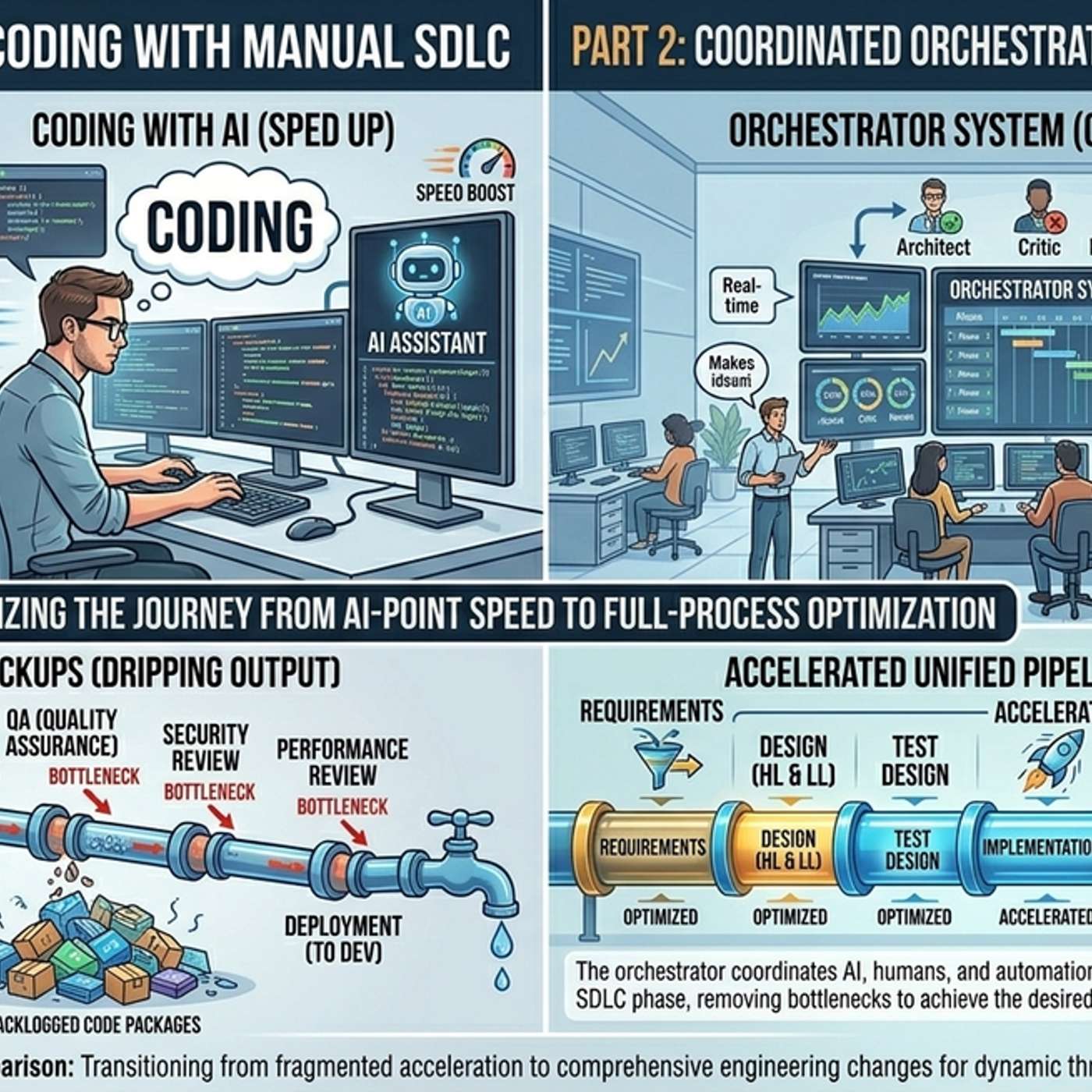
Speeding up just the coding phase with AI doesn't increase overall project delivery speed. It merely shifts the bottleneck to other parts of the Software Development Life Cycle (SDLC) like design, review, or deployment. To achieve real throughput gains, the entire end-to-end workflow must be optimized.
Beyond model capabilities and process integration, a key challenge in deploying AI is the "verification bottleneck." This new layer of work requires humans to review edge cases and ensure final accuracy, creating a need for entirely new quality assurance processes that didn't exist before.

Effective AI implementation isn't about automating entire human jobs. It's about re-architecting workflows to assign AI the research and analysis tasks it excels at, while preserving relationship-building, empathy, and high-judgment tasks for humans. This division of labor maximizes the strengths of both.

While AI tools make building technology faster, adoption is ultimately constrained by human and organizational factors. Systems for payroll, regulations, and workflows are built around people, who change much slower than tech. This human layer acts as a natural brake on technological disruption.

With AI, the "human-in-the-loop" is not a fixed role. Leaders must continuously optimize where team members intervene—whether for review, enhancement, or strategic input. A task requiring human oversight today may be fully automated tomorrow, demanding a dynamic approach to workflow design.

Even when AI automates complex workflows, a human is still required to provide the initial prompt and direction. The nature of work shifts from manual execution to high-leverage direction, but the human role remains critical.

Simply deploying AI to write code faster doesn't increase end-to-end velocity. It creates a new bottleneck where human engineers are overwhelmed with reviewing a flood of AI-generated code. To truly benefit, companies must also automate verification and validation processes.

AI is not a panacea for organizational dysfunction. When integrated into an institution with flawed processes, AI-driven scaling will simply overload the remaining human and procedural bottlenecks, worsening inefficiencies. Only functionally sound institutions will successfully leverage AI.

Braintrust's CEO argues that developer productivity is already 'tapped out.' Even if AI models become 5% better at writing code, it won't dramatically increase output because the true bottleneck is the human capacity to manage, test, deploy, and respond to user feedback—not the speed of code generation itself.

When one team member uses AI to achieve 10x capacity, it creates a "train wreck" if their work is handed off to someone operating at 1x capacity. Leaders must analyze and redesign the entire workflow, not just empower individuals, to realize true organizational gains.
