Get your free personalized podcast brief
We scan new podcasts and send you the top 5 insights daily.
Microsoft CEO Satya Nadella argues that the ultimate measure of a platform's success isn't its own revenue, but the economic value created by its ecosystem. A platform thrives when partners and developers generate multiples of the platform's own revenue, creating a durable competitive advantage and fostering global trust.
Related Insights
Roblox's leadership intentionally directs a larger portion of revenue back to its creator community rather than maximizing corporate profits. This strategy fosters a more engaged and innovative developer base, which in turn drives the platform's overall success and long-term defensibility.

While some competitors prioritize winning over ROI, Nadella cautions that "at some point that party ends." In major platform shifts like AI, a long-term orientation is crucial. He cites Microsoft's massive OpenAI investment, committed *before* ChatGPT's success, as proof of a long-term strategy paying off.
OpenAI embraces the 'platform paradox' by selling API access to startups that compete directly with its own apps like ChatGPT. The strategy is to foster a broad ecosystem, believing that enabling competitors is necessary to avoid losing the platform race entirely.

Nadella posits a future where the winner isn't the company with the best model. Instead, value accrues to the platform that provides the data, context, and tools (the 'scaffolding') that make any model useful, especially as capable open-source alternatives proliferate.
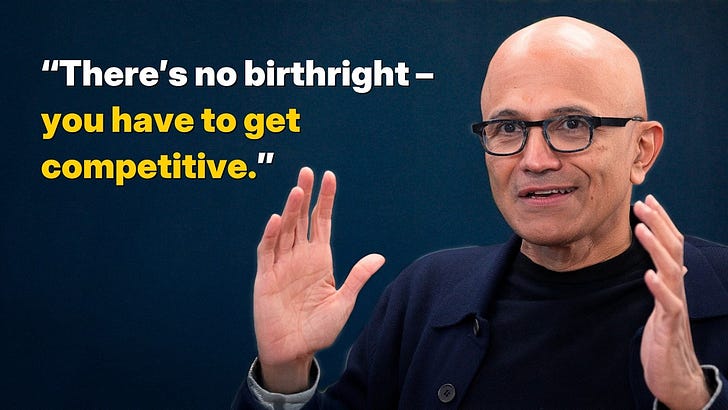
A true platform company prioritizes developer choice over favoring its own products. Nadella emphasizes that failing to support all tools, including competitors, will cause developers to leave the platform. This mindset is key to long-term platform dominance and preventing churn.
Vercel's CTO Malte Ubl outlines a third way for open source monetization beyond support (Red Hat) or open-core models. Vercel creates truly open libraries to grow the entire ecosystem. They find that as the overall "pie" grows, their relative slice remains constant, leading to absolute revenue growth.

Managed Service Providers become indispensable to vendors like Microsoft and Google by adding $7-11 of high-value services for every dollar of product revenue they generate. This value creation gives them significant leverage and makes them a more respected and crucial part of the vendor's ecosystem.

Satya Nadella states that Microsoft's core philosophy for platforms like Azure and GitHub is that they are only successful if the ecosystem partners building on top of them capture more economic value than Microsoft does. This partner-first approach is central to their strategy.

Instead of chasing a larger Total Addressable Market (TAM), Sensei's exclusive focus on the Microsoft ecosystem signals long-term commitment. This assures channel partners like MSPs that Sensei won't pivot, simplifying the partnership and building trust because the strategy is predictable and stable.
Contrary to early narratives, a proprietary dataset is not the primary moat for AI applications. True, lasting defensibility is built by deeply integrating into an industry's ecosystem—connecting different stakeholders, leveraging strategic partnerships, and using funding velocity to build the broadest product suite.