Get your free personalized podcast brief
We scan new podcasts and send you the top 5 insights daily.
Google DeepMind made high-capacity Mixture of Experts (MOE) models viable for low-latency products by changing the serving pattern. Instead of sharding experts across chips (high communication), they pipelined model layers, reducing communication overhead and making MOEs fast enough for production.

Related Insights
Separating inference into "prefill" (memory-bound) and "decode" (bandwidth-bound) tasks is a game-changer for hardware longevity. It allows older GPUs to be used for prefill tasks indefinitely, extending their useful economic life from 3-4 years to 10-15 years, a boon for data centers and their financiers.
![Gavin Baker - Watts and Wafers - [Invest Like the Best, EP.473] thumbnail](https://megaphone.imgix.net/podcasts/3bc7d580-53ec-11f1-99c0-3bd245449e4f/image/31563a7dd10ea92493c934f0c1e723fe.jpg?ixlib=rails-4.3.1&max-w=3000&max-h=3000&fit=crop&auto=format,compress)
A core challenge in physical AI is the tension between large, powerful models (offboard, in a data center) and the need for low-latency models (onboard, on the machine). The key is using techniques like distillation to create smaller derivatives that run in milliseconds for safety-critical decisions.

The most in-demand skill at labs like Google DeepMind is low-level engineering for accelerating LLM runtime. This involves creating efficient, custom software artifacts (kernels) for new neural net architectures and serving techniques at scale.
Spreading a model's layers across multiple GPU racks (pipeline parallelism) is a strategy to overcome memory capacity limits on a single rack. However, for inference, it offers no latency improvement; the total time remains the same. Its sole benefit is in memory capacity management for enormous models.

Top inference frameworks separate the prefill stage (ingesting the prompt, often compute-bound) from the decode stage (generating tokens, often memory-bound). This disaggregation allows for specialized hardware pools and scheduling for each phase, boosting overall efficiency and throughput.
The model uses a Mixture-of-Experts (MoE) architecture with over 200 billion parameters, but only activates a "sparse" 10 billion for any given task. This design provides the knowledge base of a massive model while keeping inference speed and cost comparable to much smaller models.
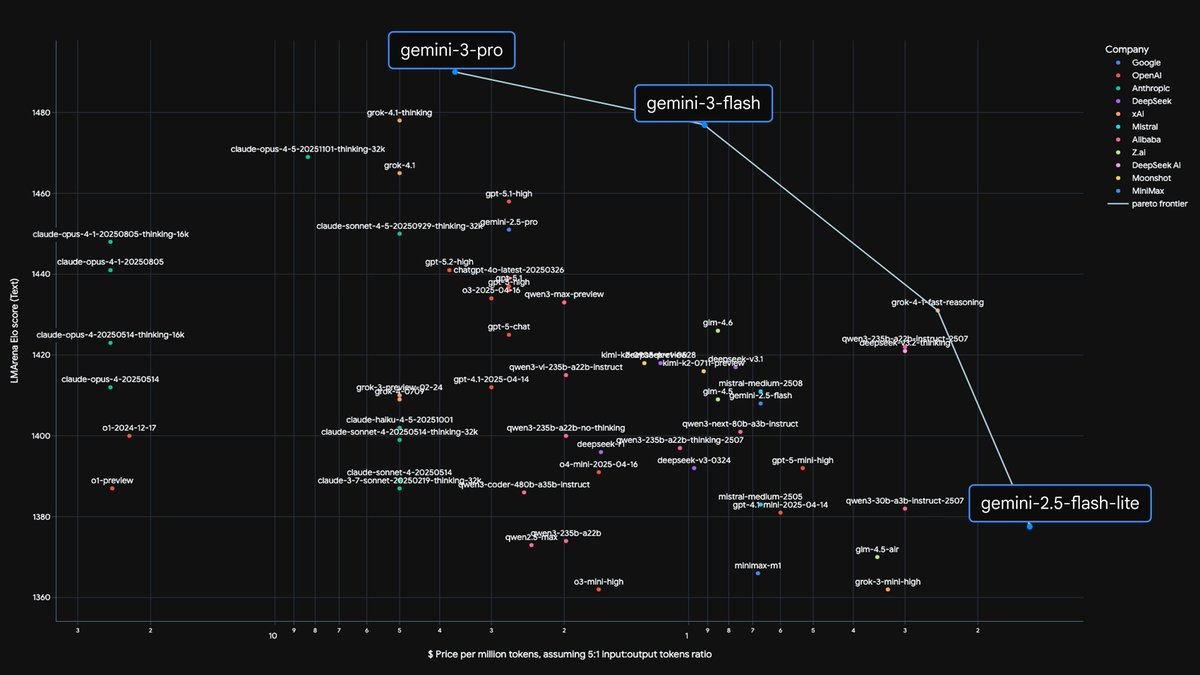
Google's focus on fast, cost-effective models like Gemini 3.5 Flash is driven by the needs of its massive-scale products (e.g., Search). For billions of users, low latency and cost are more critical than absolute peak performance, as users are often unwilling to wait for a slightly smarter but slower response.

The public-facing models from major labs are likely efficient Mixture-of-Experts (MOE) versions distilled from much larger, private, and computationally expensive dense models. This means the model users interact with is a smaller, optimized copy, not the original frontier model.
![[LIVE] Anthropic Distillation & How Models Cheat (SWE-Bench Dead) | Nathan Lambert & Sebastian Raschka thumbnail](https://substackcdn.com/feed/podcast/1084089/post/189277598/ca7468da5614a246d2906ee8926f6de7.jpg)
Mixture-of-Experts (MoE) models require an "all-to-all" communication pattern. This is efficient within a single GPU rack's high-speed interconnect but becomes a major bottleneck between racks, where communication is ~8x slower. This effectively limits an MoE layer's maximum size to what a single rack can support.
Google's strategy involves creating both cutting-edge models (Pro/Ultra) and efficient ones (Flash). The key is using distillation to transfer capabilities from large models to smaller, faster versions, allowing them to serve a wide range of use cases from complex reasoning to everyday applications.