Get your free personalized podcast brief
We scan new podcasts and send you the top 5 insights daily.
Google's focus on fast, cost-effective models like Gemini 3.5 Flash is driven by the needs of its massive-scale products (e.g., Search). For billions of users, low latency and cost are more critical than absolute peak performance, as users are often unwilling to wait for a slightly smarter but slower response.

Related Insights
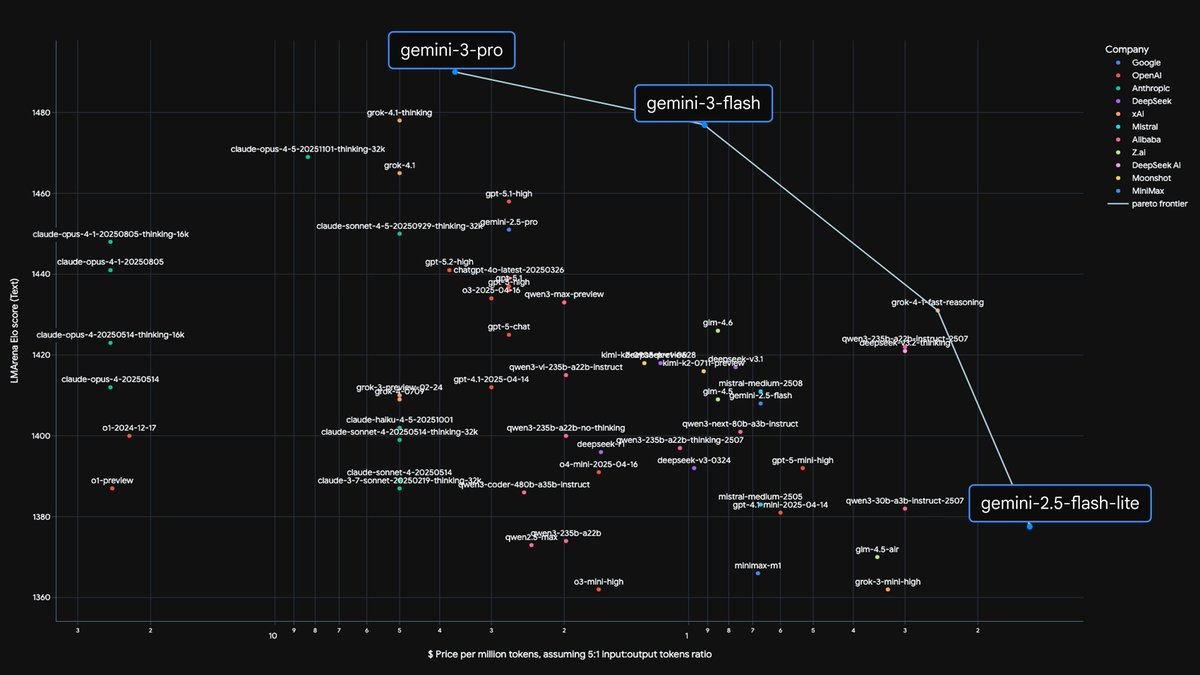
The primary threat from competitors like Google may not be a superior model, but a more cost-efficient one. Google's Gemini 3 Flash offers "frontier-level intelligence" at a fraction of the cost. This shifts the competitive battleground from pure performance to price-performance, potentially undermining business models built on expensive, large-scale compute.

Google's rumored "Gemini 3.2 Flash" model suggests a strategy focused on cost-efficiency rather than chasing state-of-the-art benchmarks. By offering near-frontier performance at a 15-20x lower inference cost, Google can capture a huge segment of the enterprise market focused on practical, scalable implementation.

Models like Gemini 3 Flash show a key trend: making frontier intelligence faster, cheaper, and more efficient. The trajectory is for today's state-of-the-art models to become 10x cheaper within a year, enabling widespread, low-latency, and on-device deployment.

Companies like OpenAI and Anthropic are intentionally shrinking their flagship models (e.g., GPT-4.0 is smaller than GPT-4). The biggest constraint isn't creating more powerful models, but serving them at a speed users will tolerate. Slow models kill adoption, regardless of their intelligence.
![Dylan Patel - Inside the Trillion-Dollar AI Buildout - [Invest Like the Best, EP.442] thumbnail](https://megaphone.imgix.net/podcasts/799253cc-9de9-11f0-8661-ab7b8e3cb4c1/image/d41d3a6f422989dc957ef10da7ad4551.jpg?ixlib=rails-4.3.1&max-w=3000&max-h=3000&fit=crop&auto=format,compress)
Google's strategy involves creating both cutting-edge models (Pro/Ultra) and efficient ones (Flash). The key is using distillation to transfer capabilities from large models to smaller, faster versions, allowing them to serve a wide range of use cases from complex reasoning to everyday applications.
Parser's AI costs are lower than its server costs. They achieve this by intentionally avoiding the most powerful, expensive LLMs which are often slow and rate-limited. Instead, they find a balance, prioritizing speed and cost-effectiveness to process high volumes affordably.

When multiple models can solve a task reliably ('benchmark saturation'), the strategic goal is no longer to find the most intelligent model. Instead, it becomes an optimization problem: select the smallest, cheapest, and fastest model that still meets the performance bar, creating a major competitive advantage in inference.

Gemini is converting daily ChatGPT users not just with model capabilities, but with superior UX like better response sizing and perceived speed. Crucially, the trust in the Google brand for search is transferring to its AI, making users more confident in its reliability, even with less complex reasoning.

As AI models become commodities, the underlying hardware's speed and efficiency for inference is the true differentiator. The company that powers the fastest AI experiences will win, similar to how Google won with fast search, because there is no market for slow AI.

The release of Gemini 3.1 Pro highlights a market shift where raw capability is becoming table stakes. Google achieved a massive intelligence jump with zero incremental cost, demonstrating that the new competitive frontier for AI models is commoditizing intelligence and winning on distribution and price efficiency, rather than just holding the top spot on a benchmark for a few weeks.