Get your free personalized podcast brief
We scan new podcasts and send you the top 5 insights daily.
Claude Code operates by interpreting text files, which isn't secure or reliable enough for production systems. For business-critical automation, use tools like N8N to define hard-coded logic and guardrails, reserving Claude for personal productivity and prototyping.

Related Insights
Contrary to the vision of free-wheeling autonomous agents, most business automation relies on strict Standard Operating Procedures (SOPs). Products like OpenAI's Agent Builder succeed by providing deterministic, node-based workflows that enforce business logic, which is more valuable than pure autonomy.

Building complex, multi-step AI processes directly with code generators creates a black box that is difficult to debug. Instead, prototype and validate the workflow step-by-step using a visual tool like N8N first. This isolates failure points and makes the entire system more manageable.

Don't give LLMs full control. Use deterministic code for core logic, validation, and enforcing rules. Delegate only tasks requiring flexibility or understanding of unstructured input to the LLM, treating it as a specialized component, not the entire system.
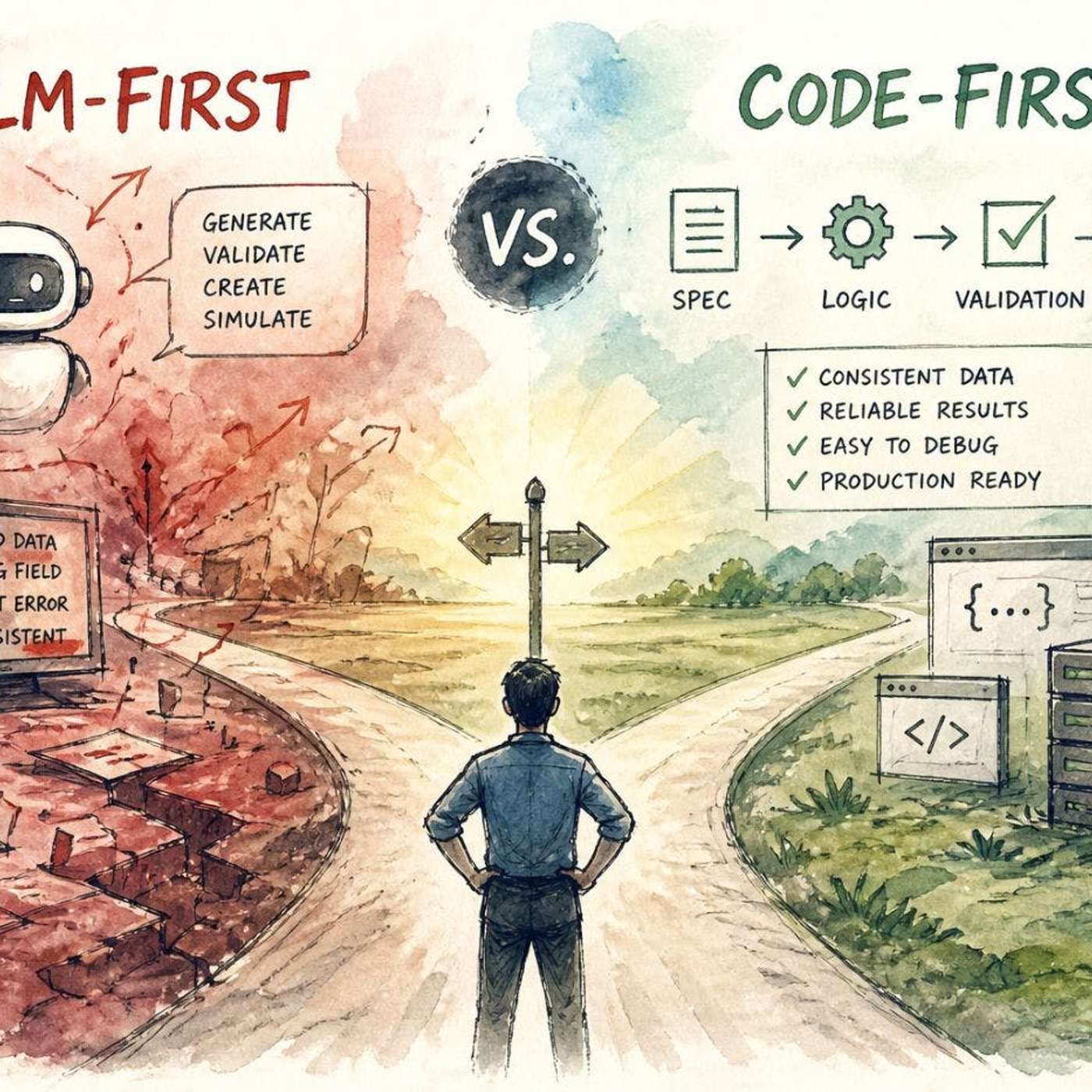
An 'LLM-first' approach, where the model handles core logic, creates impressive demos but lacks production reliability. A 'code-first' approach, using code for structure and LLMs for specific tasks, is less flashy but proves robust and debuggable in real-world applications.
The term "agent" is overloaded. Claude Code agents excel at complex, immediate, human-supervised tasks (e.g., researching and writing a one-off PRD). In contrast, platforms like N8N or Lindy are better suited for building automated, recurring workflows that run on a schedule (e.g., daily competitor monitoring).

Separate AI's role. Use an AI assistant to write reliable, deterministic code for structuring data (e.g., pulling Slack messages via API). Then, apply a live AI model only for the subjective task, like categorizing message urgency. This hybrid approach creates a more robust and controllable system.

Tools like N8N succeed by translating complex backend code and JSON into a visual, drag-and-drop interface. Seeing nodes turn green as the agent 'thinks' demystifies the process, lowering the barrier to entry for non-technical users from marketing or business backgrounds to build powerful automations.

The learning curve for traditional workflow automation tools like N8N is steep for non-coders. A more accessible starting point is "vibe coding"—using natural language prompts to build applications in environments like Anthropic's Claude. This lowers the barrier for marketers to create valuable, custom tools without deep technical expertise.
A structured learning path is crucial for aspiring builders. Start with a visual workflow tool like n8n to grasp core agent components, then advance to Claude Code for complex automation, and finally explore OpenClaw for delegated, sandboxed work environments.
OpenClaw offers an 'always-on,' autonomous feel with features like Heartbeat and better mobile integration. Claude Code provides superior reliability, security, and model performance, making it a more stable tool for augmenting daily work rather than acting as a standalone agent.
