Get your free personalized podcast brief
We scan new podcasts and send you the top 5 insights daily.
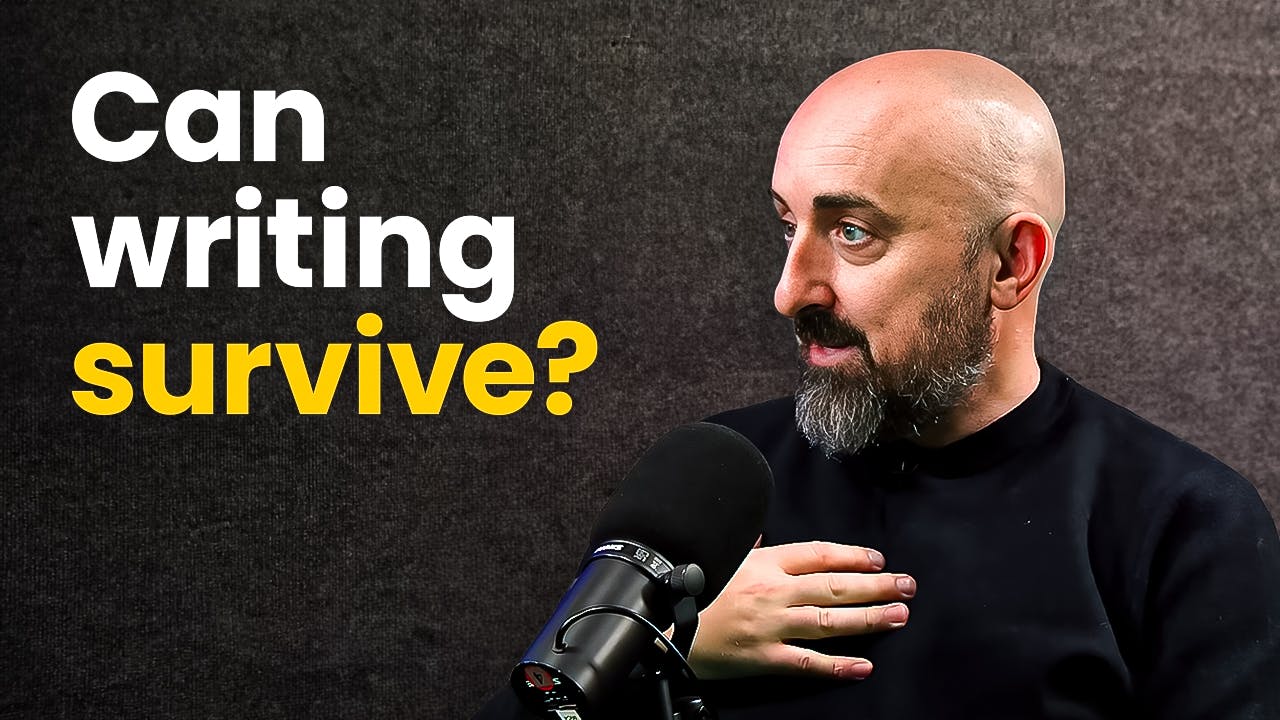
While podcasts and videos are ephemeral and unlikely to be revisited in a decade, the written word endures. Writing well is the foundation of great communication and creates a permanent record of one's thoughts, establishing a legacy that can be consumed by future generations in a way other media formats cannot.

Related Insights
To create authentic work, creators should ignore social media's immediate feedback loops, which reward outrage. Instead, write as if the only audience is your children 20 years from now. This forces fearlessness and a focus on timeless truths over transient, algorithm-pleasing trends.

Medium's CEO argues that writing's future is secure because its core function is the process of structured thinking, not just content output. The act of articulating ideas reveals flaws and deepens understanding for the writer—a cognitive benefit that delegating to AI would eliminate.
While social media fosters an 'oral' culture of ephemeral, conversational content, podcasts function more like the 'literate' tradition. They demand dedicated, distraction-free time for deep listening, mirroring the focused act of reading rather than the constant, fluid back-and-forth of online discourse.

The most valuable and enduring professional skill is storytelling—the ability to take data, craft a compelling narrative, and persuade people to act. This competency underpins sales, fundraising, and leadership. The foundational skill for great storytelling is strong writing, making it a critical area of study regardless of major.

Human communication is returning to its oral and visual roots. Text, a low-dimensional medium, was a temporary necessity for scalable knowledge storage—a 'parenthesis' in history. As AI makes creating rich media as easy as writing, society will default back to more natural, higher-bandwidth formats like audio and video.

Framing content creation through a "legacy lens"—asking if a piece of work would matter if it were your last—fundamentally shifts the focus. It moves beyond tactical strategy ('what works') to core beliefs ('what's worth saying'), resulting in more meaningful and impactful communication.

The act of writing tests an idea's coherence. Unlike a podcast where one can speak freely, writing requires a logical flow and supporting evidence, making it a more rigorous process for clarifying thought and filtering out flawed theories.

A physical, handwritten note cuts through digital noise and is perceived as more meaningful because the brain registers the effort involved. These notes often become keepsakes that serve as long-term reminders of appreciation, far outlasting a fleeting text or email.

Writing is not just the documentation of pre-formed thoughts; it is the process of forming them. By wrestling with arguments on the page, you clarify your own thinking. Outsourcing this "hard part" to AI means you skip the essential step of developing a unique, well-reasoned perspective.

To create lasting impact, shift focus from content with a short lifespan to mediums that endure. Books, for example, hold their value for decades, representing a deeper investment of wisdom and attention compared to a podcast or a 60-second clip.
