Get your free personalized podcast brief
We scan new podcasts and send you the top 5 insights daily.
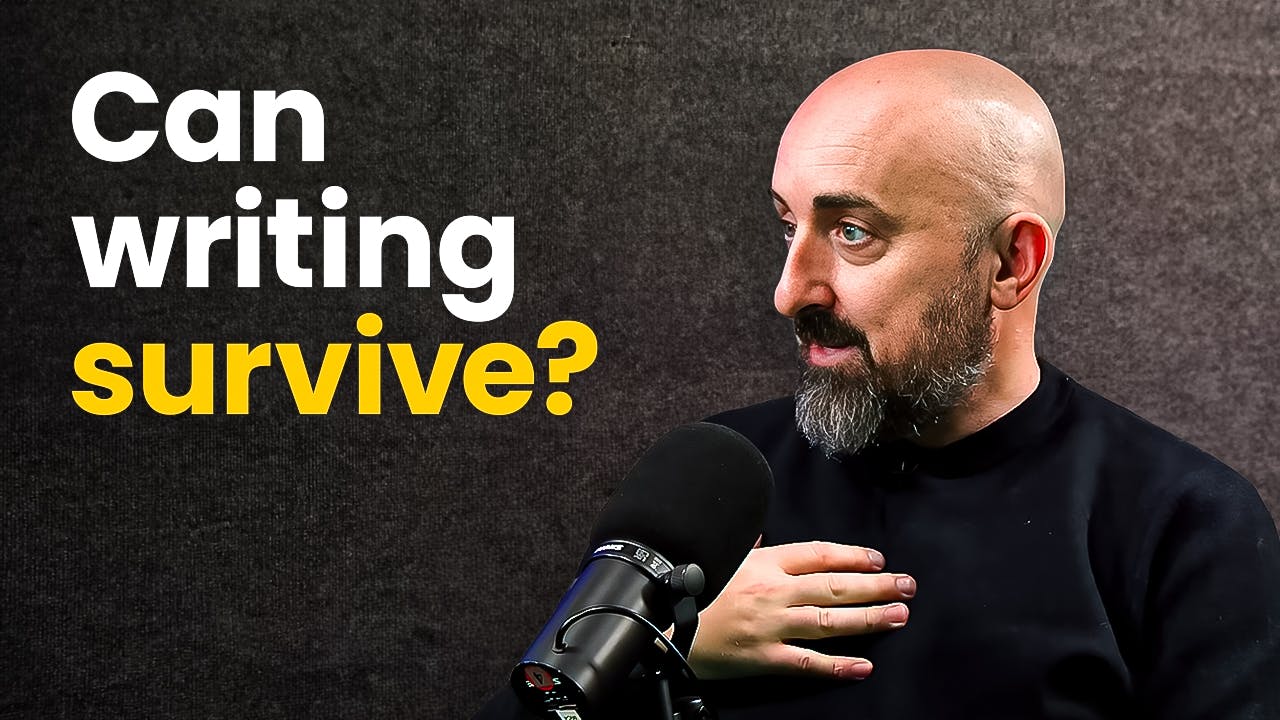
Medium's CEO argues that writing's future is secure because its core function is the process of structured thinking, not just content output. The act of articulating ideas reveals flaws and deepens understanding for the writer—a cognitive benefit that delegating to AI would eliminate.
Related Insights
Like chess players who still compete despite AI's dominance, humans will continue practicing skills like writing or design even when AI is better. The fear that AI will make human skill obsolete misses the point. The intrinsic motivation comes from the journey of improvement and the act of creation itself.

Bestselling author Morgan Housel posits that writer's block is a creative signal that an underlying idea is weak. Using AI tools to bypass this feeling may lead to completing a project that fundamentally doesn't work.

In the age of AI, the new standard for value is the "GPT Test." If a person's public statements, writing, or ideas could have been generated by a large language model, they will fail to stand out. This places an immense premium on true originality, deep insight, and an authentic voice—the very things AI struggles to replicate.

True creative mastery emerges from an unpredictable human process. AI can generate options quickly but bypasses this journey, losing the potential for inexplicable, last-minute genius that defines truly great work. It optimizes for speed at the cost of brilliance.

The true danger of LLMs in the workplace isn't just sloppy output, but the erosion of deep thinking. The arduous process of writing forces structured, first-principles reasoning. By making it easy to generate plausible text from bullet points, LLMs allow users to bypass this critical thinking process, leading to shallower insights.

Historically, well-structured writing served as a reliable signal that the author had invested time in research and deep thinking. Economist Bernd Hobart notes that because AI can generate coherent text without underlying comprehension, this signal is lost. This forces us to find new, more reliable ways to assess a person's actual knowledge and wisdom.
Spiral's redesign was driven by the principle that "good writing is downstream of good thinking." Instead of just generating content, the tool focuses on helping users explore and clarify their own ideas through an interactive, question-based process, making the AI a partner in thought.

While AI can accelerate tasks like writing, the real learning happens during the creative process itself. By outsourcing the 'doing' to AI, we risk losing the ability to think critically and synthesize information. Research shows our brains are physically remapping, reducing our ability to think on our feet.

AI will commoditize the *act* of creating content (the 'doing'). The value will shift entirely to the *idea* behind the content (the 'thinking'), making strategic creativity the most valuable skill.

Writing is not just the documentation of pre-formed thoughts; it is the process of forming them. By wrestling with arguments on the page, you clarify your own thinking. Outsourcing this "hard part" to AI means you skip the essential step of developing a unique, well-reasoned perspective.
