Get your free personalized podcast brief
We scan new podcasts and send you the top 5 insights daily.
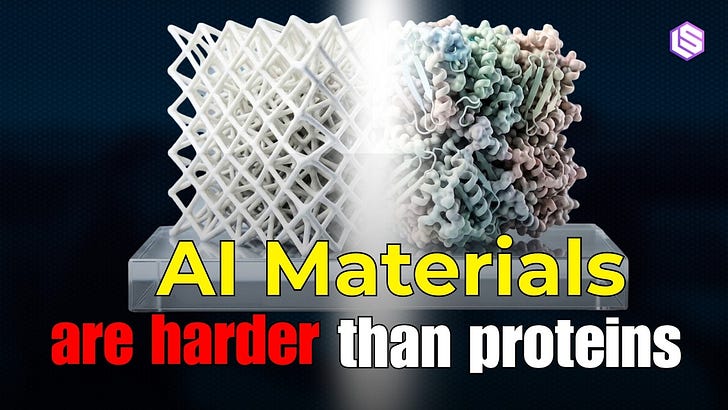
Dirac's historical assertion that solving single-atom quantum mechanics reduced the rest of physics to chemistry proved incorrect in condensed matter physics. Simple physical governing equations give rise to complex, emergent collective phenomena that cannot be predicted by composing isolated atomic rules. As Phil Anderson noted with 'more is different,' materials like high-temperature superconductors exhibit emergent properties requiring empirical experimentation beyond basic theoretical simulations.

Related Insights
Major superconductor breakthroughs often emerge from brute-force empirical iteration across known materials rather than theoretical predictions. Ekin Dogus Cubuk notes that high-temperature ambient superconductors like magnesium diboride sat on laboratory shelves for decades prior to discovery. Theorizing candidate chemical regimes is relatively simple, but physical synthesis is the true obstacle; high-throughput automated synthesis enables compressing a career's worth of trials into a single month.
Despite their prevalence, simulations like MD and DFT often fail in practice. They excel at modeling idealized, perfect systems but cannot handle the complexity of real-world, 'interesting' materials with defects and dopants. This discrepancy makes their practical utility much lower than is often believed.

A particle's quantum state collapses not due to a conscious observer, but when any physical interaction captures information about its path. This suggests the universe is a system responding to information processing, where computation is more fundamental than matter.

A radical implication of string theory is the concept of "emergent spacetime." Our familiar four dimensions may not be the fundamental building blocks of reality. Instead, they could be an emergent property derived from a deeper quantum phenomenon, specifically entanglement.

The field of fundamental physics is in a period of slow progress because, unlike in the past, theoretical work is not being fueled by new empirical data. Major experiments, while successful, have not revealed the clues needed to unify existing theories.

Unlike many AI fields obsessed with compute, the primary bottleneck in materials discovery is the speed and cost of running physical experiments. Progress depends on experimental throughput, not just bigger models or more GPUs.

Despite significant hype, new "foundation models" for materials science may not be ready to replace traditional physics-based methods. In practice, one prominent model was only five times faster than existing GPU-accelerated calculations and proved unreliable, with molecules nonsensically falling apart, highlighting the need for more rigorous evaluation.
The entire field of quantum computing was sparked by physicist Anthony Leggett's provocative question: "Do macroscopic objects behave quantum mechanically?" This question directly inspired John Martinis's Nobel-winning experiment, which proved it was possible and laid the groundwork for the field.

Experiments are not just for validation; they are a form of computation. By treating nature as a 'Physics Processing Unit' (PPU) working alongside digital GPUs, we can integrate physical experimentation directly into the computational loop, creating a powerful hybrid system for materials discovery.
Experiments testing quantum theory have conclusively proven that "local realism" is false. This means physical objects, like electrons, do not possess definite properties such as a specific position or spin until the moment they are actually measured or observed, challenging our classical intuition about reality.
