Get your free personalized podcast brief
We scan new podcasts and send you the top 5 insights daily.
Unlike many AI fields obsessed with compute, the primary bottleneck in materials discovery is the speed and cost of running physical experiments. Progress depends on experimental throughput, not just bigger models or more GPUs.
Related Insights
Even the most advanced AI model can't accelerate science without practical, real-world data. The current bottleneck is often logistical—knowing reagent lead times, lab inventory, and costs. Superior model intelligence is less critical than having access to this operational context.

Unlike language models trained on the internet, AI for materials science overcomes data scarcity and unreliability (e.g., conflicting literature) with a closed loop. The system actively directs experiments, analyzes grounded results for patterns, and uses that new data to drive the next cycle.

The traditional scientific method in materials science—hypothesize, experiment, learn—is being replaced. AI enables a new paradigm: treating the vast space of all possible molecules as a searchable database. Scientists can now query for materials with desired properties, radically accelerating discovery.

A "software-only singularity," where AI recursively improves itself, is unlikely. Progress is fundamentally tied to large-scale, costly physical experiments (i.e., compute). The massive spending on experimental compute over pure researcher salaries indicates that physical experimentation, not just algorithms, remains the primary driver of breakthroughs.

The focus in AI has evolved from rapid software capability gains to the physical constraints of its adoption. The demand for compute power is expected to significantly outstrip supply, making infrastructure—not algorithms—the defining bottleneck for future growth.

Unlike protein folding, which benefited from the CASP competition's experimental ground truth data, materials science lacks large-scale, high-quality experimental datasets. Existing data often comes from low-fidelity simulations, meaning even the best AI models are trained on imperfect information, hindering a major breakthrough.
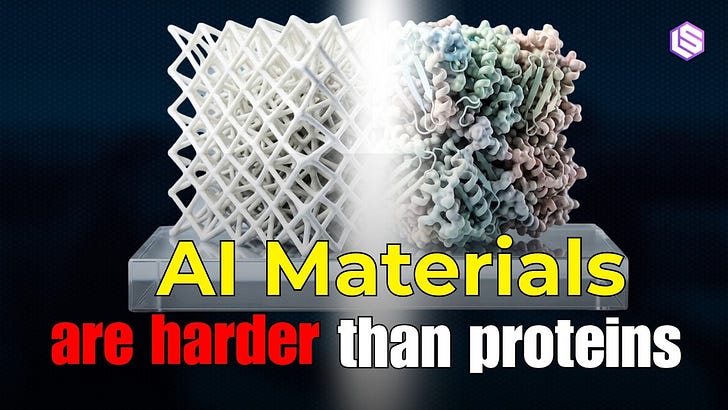
Despite significant hype, new "foundation models" for materials science may not be ready to replace traditional physics-based methods. In practice, one prominent model was only five times faster than existing GPU-accelerated calculations and proved unreliable, with molecules nonsensically falling apart, highlighting the need for more rigorous evaluation.
Experiments are not just for validation; they are a form of computation. By treating nature as a 'Physics Processing Unit' (PPU) working alongside digital GPUs, we can integrate physical experimentation directly into the computational loop, creating a powerful hybrid system for materials discovery.
Contrary to the idea that AI will make physical experiments obsolete, its real power is predictive. AI can virtually iterate through many potential experiments to identify which ones are most likely to succeed, thus optimizing resource allocation and drastically reducing failure rates in the lab.

The founder of AI and robotics firm Medra argues that scientific progress is not limited by a lack of ideas or AI-generated hypotheses. Instead, the critical constraint is the physical capacity to test these ideas and generate high-quality data to train better AI models.