Get your free personalized podcast brief
We scan new podcasts and send you the top 5 insights daily.
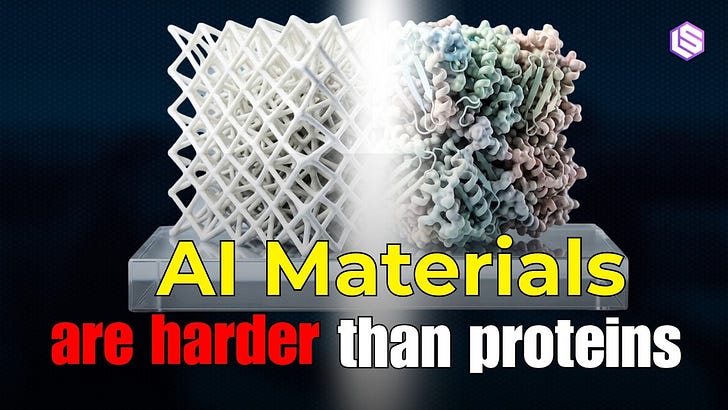
Despite significant hype, new "foundation models" for materials science may not be ready to replace traditional physics-based methods. In practice, one prominent model was only five times faster than existing GPU-accelerated calculations and proved unreliable, with molecules nonsensically falling apart, highlighting the need for more rigorous evaluation.
Related Insights
Unlike traditional engineering, breakthroughs in foundational AI research often feel binary. A model can be completely broken until a handful of key insights are discovered, at which point it suddenly works. This "all or nothing" dynamic makes it impossible to predict timelines, as you don't know if a solution is a week or two years away.

Despite their prevalence, simulations like MD and DFT often fail in practice. They excel at modeling idealized, perfect systems but cannot handle the complexity of real-world, 'interesting' materials with defects and dopants. This discrepancy makes their practical utility much lower than is often believed.

The traditional scientific method in materials science—hypothesize, experiment, learn—is being replaced. AI enables a new paradigm: treating the vast space of all possible molecules as a searchable database. Scientists can now query for materials with desired properties, radically accelerating discovery.

DE Shaw Research (DESRES) invested heavily in custom silicon for molecular dynamics (MD) to solve protein folding. In contrast, DeepMind's AlphaFold, using ML on experimental data, solved it on commodity hardware. This demonstrates data-driven approaches can be vastly more effective than brute-force simulation for complex scientific problems.
Foundation models can't be trained for physics using existing literature because the data is too noisy and lacks published negative results. A physical lab is needed to generate clean data and capture the learning signal from failed experiments, which is a core thesis for Periodic Labs.

Unlike protein folding, which benefited from the CASP competition's experimental ground truth data, materials science lacks large-scale, high-quality experimental datasets. Existing data often comes from low-fidelity simulations, meaning even the best AI models are trained on imperfect information, hindering a major breakthrough.
The gap between benchmark scores and real-world performance suggests labs achieve high scores by distilling superior models or training for specific evals. This makes benchmarks a poor proxy for genuine capability, a skepticism that should be applied to all new model releases.

AI models will produce a few stunning, one-off results in fields like materials science. These isolated successes will trigger an overstated hype cycle proclaiming 'science is solved,' masking the longer, more understated trend of AI's true, profound, and incremental impact on scientific discovery.

Rather than just replacing physics-based models, AI can be used to select the *correct* physics model. Heather Kulik's team uses the quantum wave function itself as an input to a neural network to predict which quantum mechanical approximation will be most accurate for a specific material, a complex task that defies simple heuristics.
AI models can screen vast material spaces to identify novel solutions that defy conventional chemical intuition. Heather Kulik's group used AI to discover a quantum mechanical phenomenon that made a polymer four times tougher, a design experimentalists admitted they would never have conceived on their own.