/
© 2026 RiffOn. All rights reserved.

Get your free personalized podcast brief

We scan new podcasts and send you the top 5 insights daily.

  1. Latent Space: The AI Engineer Podcast
  2. 🔬Why There Is No "AlphaFold for Materials" — AI for Materials Discovery with Heather Kulik
🔬Why There Is No "AlphaFold for Materials" — AI for Materials Discovery with Heather Kulik

🔬Why There Is No "AlphaFold for Materials" — AI for Materials Discovery with Heather Kulik

Latent Space: The AI Engineer Podcast · Mar 24, 2026

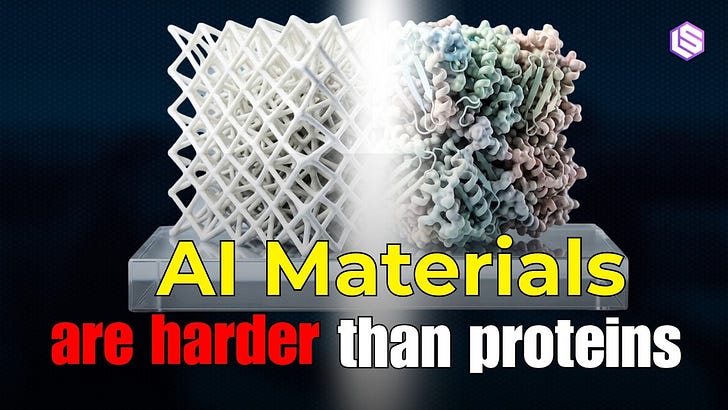
MIT's Heather Kulik explains why there's no "AlphaFold for Materials," citing data scarcity, chemical complexity, and the limits of current AI.

Current LLMs Fail at Constrained Molecular Design, Despite PhD-Level Knowledge

While LLMs possess vast 'Wikipedia-level' chemical knowledge, they struggle with specific, constrained tasks that expert chemists find trivial, such as designing a molecule with an exact number of atoms. This highlights a critical gap between general knowledge and applied, creative design in AI.

🔬Why There Is No "AlphaFold for Materials" — AI for Materials Discovery with Heather Kulik thumbnail

🔬Why There Is No "AlphaFold for Materials" — AI for Materials Discovery with Heather Kulik

Latent Space: The AI Engineer Podcast·6 hours ago

Active Learning Is Key for Multi-Objective Problems in Materials Discovery

Designing new materials involves balancing multiple competing objectives, like cost, stability, and performance. Active learning is particularly powerful for navigating these trade-offs, offering a 100-1000x speedup for each objective you add, making it ideal for finding the 'needle in a haystack' material.

🔬Why There Is No "AlphaFold for Materials" — AI for Materials Discovery with Heather Kulik thumbnail

🔬Why There Is No "AlphaFold for Materials" — AI for Materials Discovery with Heather Kulik

Latent Space: The AI Engineer Podcast·6 hours ago

Human Interpretation Bias Makes Text-Mined Scientific Literature Unreliable Training Data

AI models trained on scientific literature face a hidden challenge: author interpretation bias. When extracting data, researchers found that numerical data in graphs often contradicts the authors' own textual interpretation of those same graphs, introducing a significant source of error and noise into datasets.

🔬Why There Is No "AlphaFold for Materials" — AI for Materials Discovery with Heather Kulik thumbnail

🔬Why There Is No "AlphaFold for Materials" — AI for Materials Discovery with Heather Kulik

Latent Space: The AI Engineer Podcast·6 hours ago

AI in Materials Science Uncovers Non-Intuitive Quantum Phenomena Human Experts Miss

AI models can screen vast material spaces to identify novel solutions that defy conventional chemical intuition. Heather Kulik's group used AI to discover a quantum mechanical phenomenon that made a polymer four times tougher, a design experimentalists admitted they would never have conceived on their own.

🔬Why There Is No "AlphaFold for Materials" — AI for Materials Discovery with Heather Kulik thumbnail

🔬Why There Is No "AlphaFold for Materials" — AI for Materials Discovery with Heather Kulik

Latent Space: The AI Engineer Podcast·6 hours ago

An "AlphaFold for Materials" is Blocked by a Lack of High-Fidelity Experimental Data

Unlike protein folding, which benefited from the CASP competition's experimental ground truth data, materials science lacks large-scale, high-quality experimental datasets. Existing data often comes from low-fidelity simulations, meaning even the best AI models are trained on imperfect information, hindering a major breakthrough.

🔬Why There Is No "AlphaFold for Materials" — AI for Materials Discovery with Heather Kulik thumbnail

🔬Why There Is No "AlphaFold for Materials" — AI for Materials Discovery with Heather Kulik

Latent Space: The AI Engineer Podcast·6 hours ago

Hyped Materials "Foundation Models" Often Fail and Offer Only Marginal Speedups

Despite significant hype, new "foundation models" for materials science may not be ready to replace traditional physics-based methods. In practice, one prominent model was only five times faster than existing GPU-accelerated calculations and proved unreliable, with molecules nonsensically falling apart, highlighting the need for more rigorous evaluation.

🔬Why There Is No "AlphaFold for Materials" — AI for Materials Discovery with Heather Kulik thumbnail

🔬Why There Is No "AlphaFold for Materials" — AI for Materials Discovery with Heather Kulik

Latent Space: The AI Engineer Podcast·6 hours ago

AI's Next Frontier in Physics: Predicting the Best Quantum Approximation Method to Use

Rather than just replacing physics-based models, AI can be used to select the *correct* physics model. Heather Kulik's team uses the quantum wave function itself as an input to a neural network to predict which quantum mechanical approximation will be most accurate for a specific material, a complex task that defies simple heuristics.

🔬Why There Is No "AlphaFold for Materials" — AI for Materials Discovery with Heather Kulik thumbnail

🔬Why There Is No "AlphaFold for Materials" — AI for Materials Discovery with Heather Kulik

Latent Space: The AI Engineer Podcast·6 hours ago