Get your free personalized podcast brief
We scan new podcasts and send you the top 5 insights daily.
Instead of having LLMs parse messy files directly, a more effective method is to instruct the model to write a temporary Python script to convert the unstructured data into a standardized format. The script is then discarded. This leverages the model's strength in code generation over its weakness in direct file parsing.

Related Insights
A practical hack to improve AI agent reliability is to avoid built-in tool-calling functions. LLMs have more training data on writing code than on specific tool-use APIs. Prompting the agent to write and execute the code that calls a tool leverages its core strength and produces better outcomes.

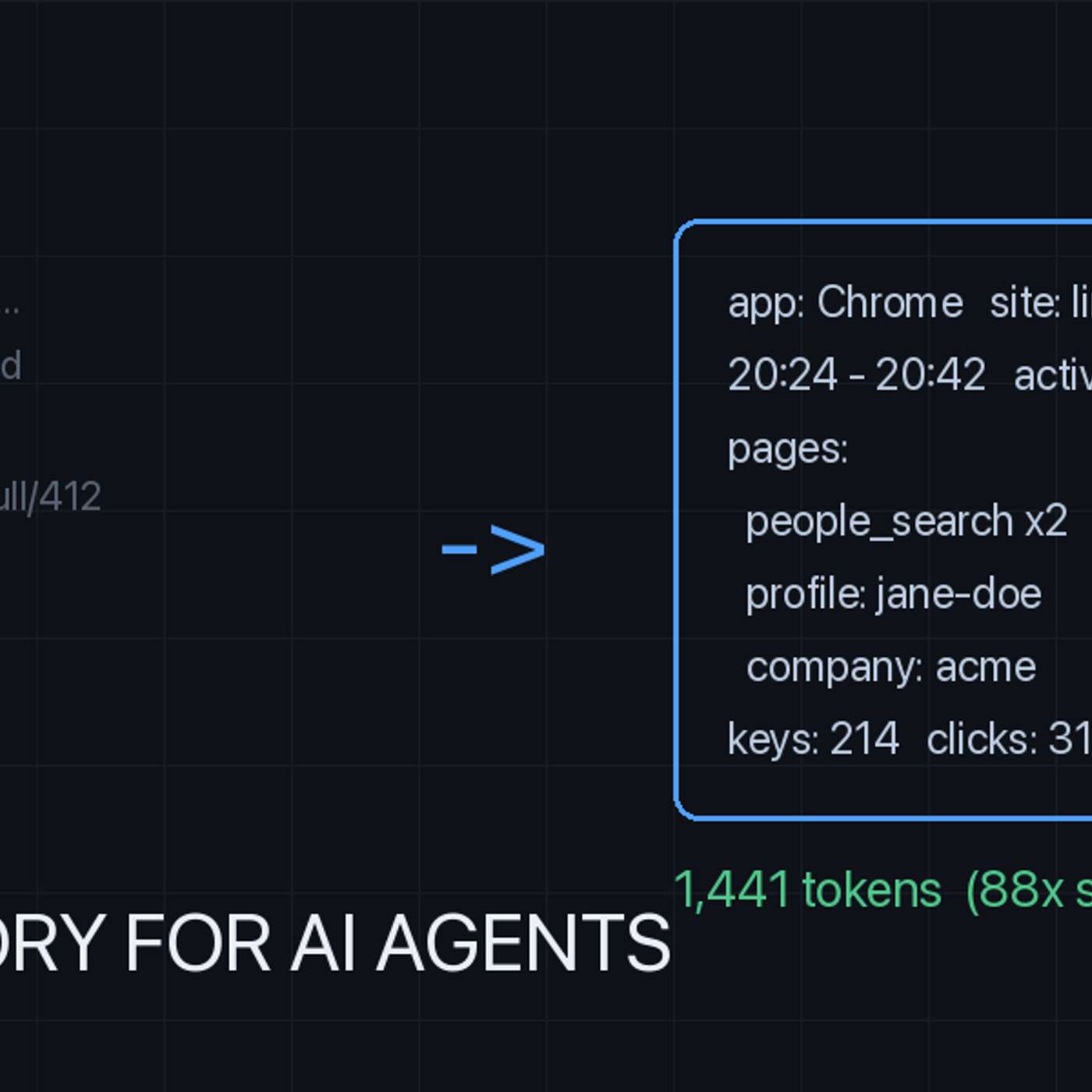
While using an LLM to summarize raw user activity seems intuitive, it is expensive, non-deterministic, and prone to hallucination. A superior approach is a "boring" deterministic compiler using plain code to transform raw data into structured, trustworthy, and recomputable memory episodes, reserving the LLM for higher-level interpretation.
Providing too much raw information can confuse an AI and degrade its output. Before prompting with a large volume of text, use the AI itself to perform 'context compression.' Have it summarize the data into key facts and insights, creating a smaller, more potent context for your actual task.

If a tool, like the meeting-note app Granola, lacks an official MCP for integration, you can write a simple script for your AI agent to execute. The script can fetch data and save it as local files, effectively making any external data source part of the agent's accessible context.

A major hurdle for enterprise AI is messy, siloed data. A synergistic solution is emerging where AI software agents are used for the data engineering tasks of cleansing, normalization, and linking. This creates a powerful feedback loop where AI helps prepare the very data it needs to function effectively.

Simply feeding a dataset to an AI and asking questions is ineffective. For accurate analysis, you must provide context—essentially an 'in-the-moment data dictionary.' Define your fields, explain your data model, and clarify terms (e.g., what a 'pipeline created' date means) to guide the AI’s script generation and ensure valid outputs.

To make AI agents reliable with messy data, strip the layout-parsing responsibility from the LLM. Build a defensive, code-based wrapper that pre-checks document quality, pre-structures the data using coordinates, and uses separate validation steps. This treats the LLM as a reasoner, not a parser.
Instead of embedding data directly into your prompt, instruct the AI to save it as a separate file (e.g., data.json). This decouples design from content, allowing you to instantly generate new prototype variations simply by swapping the data file.

Separate AI's role. Use an AI assistant to write reliable, deterministic code for structuring data (e.g., pulling Slack messages via API). Then, apply a live AI model only for the subjective task, like categorizing message urgency. This hybrid approach creates a more robust and controllable system.

For complex, one-time tasks like a code migration, don't just ask AI to write a script. Instead, have it build a disposable tool—a "jig" or "command center”—that visualizes the process and guides you through each step. This provides more control and understanding than a black-box script.