Get your free personalized podcast brief
We scan new podcasts and send you the top 5 insights daily.
The Klan's popularity waned partly because it succeeded. The passage of the restrictive Johnson-Reed Immigration Act of 1924 and the spread of state-level eugenics laws meant two of its central political objectives had been codified into law, making the organization itself seem less necessary to its members.

Related Insights
Klan terrorism was a calculated political strategy. By creating persistent violence and chaos, white Southern Democrats aimed to exhaust the North's will to enforce Reconstruction. They correctly gambled that Northerners would eventually tire of the costly project and withdraw federal power.
Although the first iteration of the Ku Klux Klan was ultimately suppressed by 1872, it had already achieved its primary long-term goals. It successfully destroyed the Republican Party's infrastructure in the South and, crucially, exhausted the North's political will to continue Reconstruction, paving the way for generations of white supremacist rule.
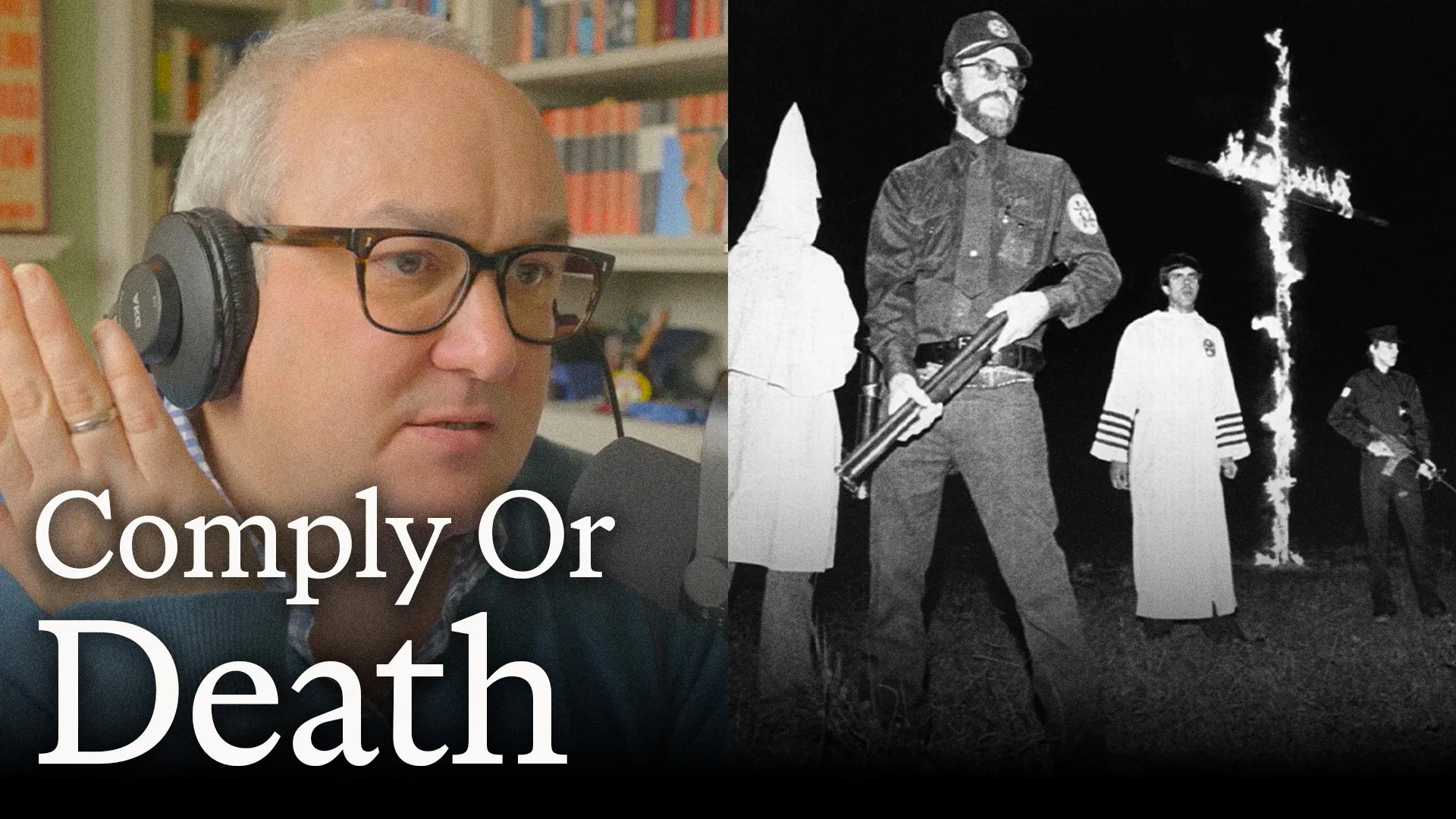
Counterintuitively, the first KKK chapter in Tennessee was ordered to disband by its leader not because it was defeated, but because it had become unnecessary. A new, more moderate state government began implementing their goals, such as restoring Confederate voting rights and introducing poll taxes, making the Klan's violent tactics redundant.
The Klan's rapid downfall was triggered not by external opposition but by a scandal. Indiana's Grand Dragon, David C. Stephenson, kidnapped, raped, and murdered Madge Oberholzer. His conviction exposed the movement's hypocrisy, and its membership collapsed from hundreds of thousands to just 4,000 in two years.
The KKK's success was not just about violence but about creating a social movement. It hosted picnics, parades, and even circuses, embedding its hateful ideology into ordinary, taken-for-granted community life for millions of white Protestants, making it seem normal and even wholesome.
The Indiana Klan operated a highly effective political organization. It compiled detailed data on all political candidates, published approved slates in church newsletters, and organized massive get-out-the-vote efforts, successfully installing a governor and dominating the state legislature.
Contrary to popular association, public lynchings peaked in 1919 and then declined as the second Klan grew. The two forms of violence were distinct: KKK violence was typically nocturnal vigilantism by masked perpetrators, while lynchings were often public, broad-daylight rituals where openness was part of the point.
The KKK positioned itself as the moral authority violently enforcing Prohibition, a task federal and local authorities struggled with. This resonated with temperance-supporting Protestants and provided a pretext for vigilantism against immigrant communities, particularly Catholics.
While not a perfect match for European fascism—it lacked a single charismatic leader and expansionist war goals—the 1920s KKK shared key traits: a cult of victimhood, paramilitary violence, mass rituals, and a demographic base of anxious, middle-class Protestants and small businessmen.
Contrary to its common image, the second Klan's strongholds were not in the former Confederacy but in future Rust Belt states like Indiana, Ohio, and Oregon. This reflects its primary focus on anti-immigrant and anti-Catholic sentiment rather than post-Civil War racial dynamics.