Get your free personalized podcast brief
We scan new podcasts and send you the top 5 insights daily.
In the Musk-OpenAI trial, Satya Nadella neutralized allegations that Microsoft "controls" OpenAI by re-contextualizing his "above, below, around them" comment. He explained it referred to Microsoft's technical role as an infrastructure provider (below), application developer (above), and tool provider (around), not a statement of corporate dominance.

Related Insights
Internal emails revealed in the Musk trial show Microsoft executives worried that if they didn't fund OpenAI, the startup would "storm off to Amazon... and shit talk us." This fear of negative PR, alongside strategic interest, was a key driver of their early $1 billion investment.

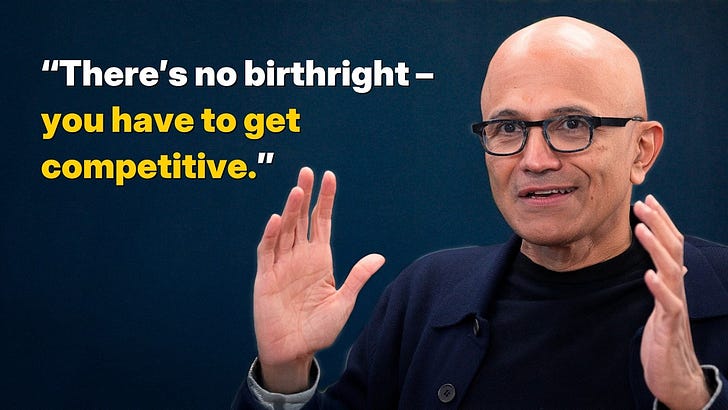
While some competitors prioritize winning over ROI, Nadella cautions that "at some point that party ends." In major platform shifts like AI, a long-term orientation is crucial. He cites Microsoft's massive OpenAI investment, committed *before* ChatGPT's success, as proof of a long-term strategy paying off.

Nadella posits a future where the winner isn't the company with the best model. Instead, value accrues to the platform that provides the data, context, and tools (the 'scaffolding') that make any model useful, especially as capable open-source alternatives proliferate.
Nadella adopts a grounded perspective on AI's current state. He likens it to past technological revolutions, viewing it as a powerful tool that enhances human intellect and productivity, rather than subscribing to the more mystical 'final revolution' narrative about AGI.
Microsoft's CEO Satya Nadella is promoting a new computing paradigm, borrowed from Notion's CEO. Instead of a tool ("bicycle for the mind"), the computer is now an orchestration layer for vast AI capabilities.

Nadella has delegated management responsibilities to embed himself directly in AI product development. He now spends his time in internal Teams channels, emailing engineers with specific flaws, and holding weekly product grillings to accelerate Copilot's improvement, acting as a hands-on product leader.
Satya Nadella reveals that Microsoft prioritizes building a flexible, "fungible" cloud infrastructure over catering to every demand of its largest AI customer, OpenAI. This involves strategically denying requests for massive, dedicated data centers to ensure capacity remains balanced for other customers and Microsoft's own high-margin products.

Satya Nadella reveals that the initial billion-dollar investment in OpenAI was not an easy sell. He had to convince a skeptical board, including a hesitant Bill Gates, about the unconventional structure and uncertain outcome. This highlights that even visionary bets require navigating significant internal debate and political capital.
Satya Nadella’s deposition reveals the OpenAI deal was driven by his perpetual 'dissatisfaction with the rate of progress' at Microsoft, both in absolute terms and versus competitors. This frames strategic investment not as an admission of internal failure, but as a critical CEO tool to accelerate innovation and bypass inertia.

Beyond the equity stake and Azure revenue, Satya Nadella highlights a core strategic benefit: royalty-free access to OpenAI's IP. For Microsoft, this is equivalent to having a "frontier model for free" to deeply integrate across its entire product suite, providing a massive competitive advantage without incremental licensing costs.