Get your free personalized podcast brief
We scan new podcasts and send you the top 5 insights daily.
Because PMs deeply understand the customer's job, needs, and alternatives, they are the only ones qualified to write the evaluation criteria for what a successful AI output looks like. This critical task goes beyond technical metrics and is core to the PM's role in the AI era.
Related Insights
To successfully automate complex workflows with AI, product teams must go beyond traditional discovery. A "forward-deployed PM" works on-site with customers, directly observing workflows and tweaking AI parameters like context windows and embeddings in real-time to achieve flawless automation.

As AI tools become operable via plain English, the key skill shifts from technical implementation to effective management. People managers excel at providing context, defining roles, giving feedback, and reporting on performance—all crucial for orchestrating a "team" of AI agents. Their skills will become more valuable than pure AI expertise.
AI automates tactical tasks, shifting the PM's role from process management to de-risking delivery by developing deep customer insights. This allows PMs to spend more time confirming their instincts about customer needs, which engineering teams now demand.

Instead of generic PRD generators, a high-leverage AI agent for PMs is a personalized reviewer. By training an agent on your manager's past document reviews, you can pre-empt their specific feedback, align your work with their priorities, and increase your credibility and efficiency.

AI evaluation shouldn't be confined to engineering silos. Subject matter experts (SMEs) and business users hold the critical domain knowledge to assess what's "good." Providing them with GUI-based tools, like an "eval studio," is crucial for continuous improvement and building trustworthy enterprise AI.
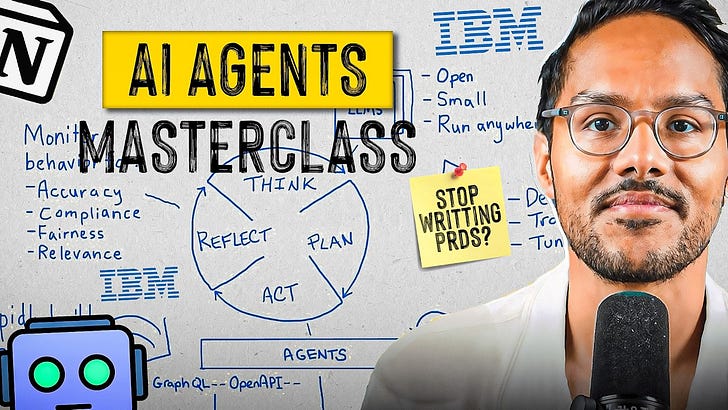
The key technical skill for an AI PM is not deep knowledge of model architecture but a higher-level understanding of how to orchestrate AI components. Knowing what AI can do and how systems connect is more valuable than knowing the specifics of fine-tuning or RAG implementation.
Technical implementation is becoming easier with AI. The critical, and now more valuable, skill is the ability to deeply understand customer needs, communicate effectively, and guide a product to market fit. The focus is shifting from "how to build it" to "what to build and why."

As AI automates synthesis and creation, the product manager's core value shifts from managing the development process to deeply contextualizing all available information (market, customer, strategy) to define the *right* product direction.

Great PMs excel by understanding and influencing human behavior. This "people sense" applies to both discerning customer needs to build the right product and to aligning internal teams to bring that vision to life. Every aspect, from product-market fit to go-to-market strategy, ultimately hinges on understanding people.
