Get your free personalized podcast brief
We scan new podcasts and send you the top 5 insights daily.
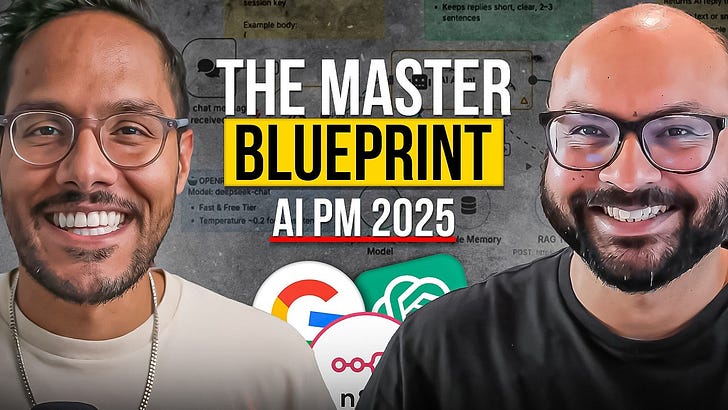
The key technical skill for an AI PM is not deep knowledge of model architecture but a higher-level understanding of how to orchestrate AI components. Knowing what AI can do and how systems connect is more valuable than knowing the specifics of fine-tuning or RAG implementation.
Related Insights
To successfully automate complex workflows with AI, product teams must go beyond traditional discovery. A "forward-deployed PM" works on-site with customers, directly observing workflows and tweaking AI parameters like context windows and embeddings in real-time to achieve flawless automation.

The 30-40% pay premium for AI PMs isn't just because "AI is hot." It's rooted in the scarcity of their specialized skillset, similar to how analytics PMs with statistics backgrounds are paid more. Companies are paying for demonstrated experience with AI tooling and technical fluency, which is rare.
As AI becomes foundational, the PM role will specialize. A new "AI Platform PM" will emerge to own core infrastructure like embeddings and RAG. They will expose these as services to domain-expert PMs who focus on user-facing features, allowing for deeper expertise in both areas.
With AI agents automating raw code generation, an engineer's role is evolving beyond pure implementation. To stay valuable, engineers must now cultivate a deep understanding of business context and product taste to know *what* to build and *why*, not just *how*.

Instead of asking an AI to directly build something, the more effective approach is to instruct it on *how* to solve the problem: gather references, identify best-in-class libraries, and create a framework before implementation. This means working one level of abstraction higher than the code itself.

Top-performing engineering teams are evolving from hands-on coding to a managerial role. Their primary job is to define tasks, kick off multiple AI agents in parallel, review plans, and approve the final output, rather than implementing the details themselves.
GSB professors warn that professionals who merely use AI as a black box—passing queries and returning outputs—risk minimizing their own role. To remain valuable, leaders must understand the underlying models and assumptions to properly evaluate AI-generated solutions and maintain control of the decision-making process.
AI's rise means traditional product roles are merging. Instead of identifying as a PM or designer, focus on your core skills (e.g., visual aesthetics, systems thinking) and use AI to fill gaps. This 'builder' mindset, focused on creating end-to-end, is key for future relevance.

Technical implementation is becoming easier with AI. The critical, and now more valuable, skill is the ability to deeply understand customer needs, communicate effectively, and guide a product to market fit. The focus is shifting from "how to build it" to "what to build and why."

In the rapidly evolving AI landscape where ideas are quickly commoditized, the most valuable trait for a product manager is not having one great idea, but possessing the creative skill to generate many good ideas consistently. This creative muscle is more important than being attached to a single concept.