Get your free personalized podcast brief
We scan new podcasts and send you the top 5 insights daily.
Larry Ellison argues that AI won't kill SaaS incumbents because Oracle is aggressively adopting AI coding tools internally. This allows smaller engineering teams to build new products and embed AI agents into existing suites more quickly, effectively neutralizing the speed advantage of new AI-native startups.

Related Insights
Even if AI dramatically lowers coding costs, it won't destroy established SaaS businesses. Technical expenses only account for 10-20% of revenue for major SaaS players. The other 80% is spent on marketing, events, and client service, creating an opportunity for significant margin expansion.

Unlike the slow denial of SaaS by client-server companies, today's SaaS leaders (e.g., HubSpot, Notion) are rapidly integrating AI. They have an advantage due to vast proprietary data and existing distribution channels, making it harder for new AI-native startups to displace them. The old playbook of a slow incumbent may no longer apply.

According to Amplitude's CEO, the traditional moat of having established software is gone because AI enables rapid replication. The only remaining defensible advantage for SaaS companies is the speed at which they can integrate bleeding-edge AI capabilities, making continuous, rapid innovation paramount.
For decades, buying generalized SaaS was more efficient than building custom software. AI coding agents reverse this. Now, companies can build hyper-specific, more effective tools internally for less cost than a bloated SaaS subscription, because they only need to solve their unique problem.

Turing's CEO claims SaaS is dead for two reasons. First, powerful foundation models drastically lower the cost of building custom software internally. Second, existing SaaS products are built for human interaction via GUIs, not for AI agents that will increasingly use APIs and tool-calling functions directly.

AI coding agents will make migrating between complex enterprise systems like SAP and Oracle dramatically easier and cheaper. This erodes the moat of high switching costs, forcing incumbents to compete on product value rather than customer lock-in, where they once held customers as "hostages."

The idea that AI will eliminate SaaS is overblown because it incorrectly projects small startup behavior onto large enterprises. Fortune 100s face immense change management, security, and maintenance challenges, making replacing established vendors with internal AI-coded tools impractical.
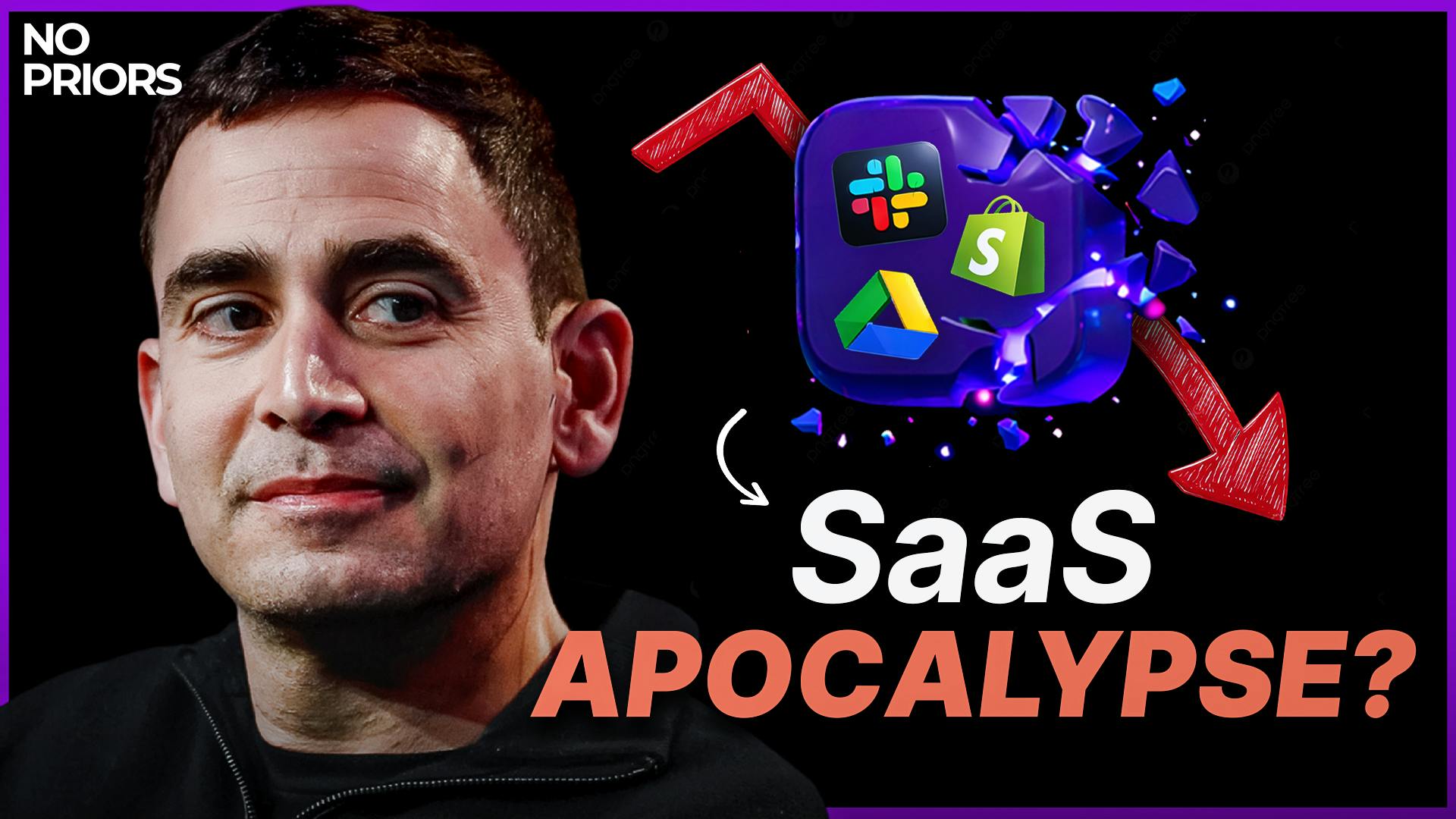
As AI tools like Claude Code make it easy for customers to build their own software, SaaS companies are the most threatened. To survive, they must become the most aggressive adopters of AI, creating a reflexive loop where they accelerate the very trend that undermines their business model.

Contrary to the 'SaaSpocalypse' narrative, Jensen Huang believes AI agents will use existing SaaS tools rather than replace them. This will increase demand for best-in-class software like databases, as it's more efficient for an agent to leverage an existing tool than to build one from scratch.
AI's biggest impact on incumbent SaaS won't be replacement, but the erosion of moats built on high switching costs. AI coding agents will make complex migrations (e.g., from SAP to Oracle) faster and less risky, forcing vendors to compete on product value rather than relying on customer lock-in.